First Seen
2023-05-10T21:03:34+00:00
simple-description (llama3.2-vision_11b)
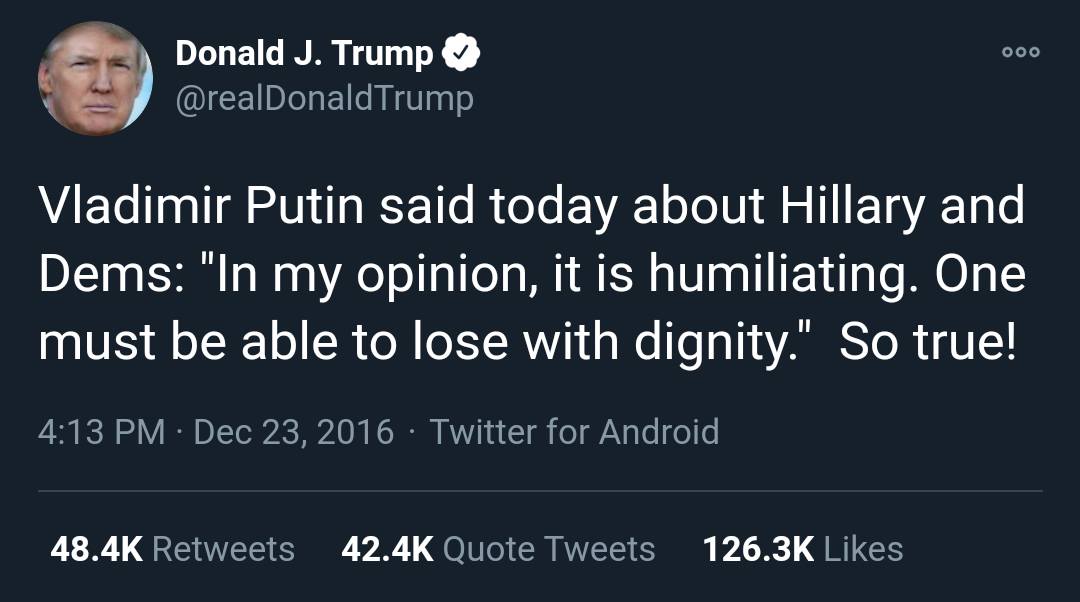
The meme is a screenshot of a tweet by Donald Trump, where he quotes Vladimir Putin saying that Trump's opinion on Hillary Clinton and Donald Trump is "humiliating" and "one must be able to lose with dignity." The tweet is a response to a tweet by Donald Trump, where he says "I am not a politician, I am a businessman" and "I am a politician, I am a businessman."
detailed-analysis (gemma3-27b-vision)
Okay, let's break down this Donald Trump tweet (dated December 23, 2016) through the lenses of the specified theoretical frameworks. I'll provide sections where the frameworks are relevant to the tweet, and will note when a framework isn't strongly applicable.
1. Visual Description
- Image: The tweet features a close-up, slightly cropped, headshot of Donald Trump. The lighting is dramatic, casting shadows and emphasizing lines on his face, suggesting a focus on his authority or image projection. His expression is neutral-to-serious. The color palette is dominated by warmer tones.
- Text: The tweet features a quote attributed to Vladimir Putin criticizing Hillary Clinton and the Democratic Party's reaction to the 2016 election results. Trump adds an endorsement, "So true!" The language is simple and direct, characteristic of Trump’s Twitter style.
- Platform Features: The tweet is posted from Twitter for Android, displaying retweets, quote tweets, and likes which further underscore the viral nature of the post. The use of bold text and a clear timestamp is in line with Twitter's format.
2. Foucauldian Genealogical Discourse Analysis
This framework is highly applicable. The tweet is rich with opportunities for this analysis.
- Discourse of "Losing with Dignity": Foucault would be interested in how the concept of "losing with dignity" is constructed as a norm. What power dynamics underpin this expectation? The statement implies a certain 'correct' way to react to defeat, subtly policing acceptable responses. This seemingly innocuous phrase serves to reinforce a specific understanding of political behavior.
- Power/Knowledge: The fact that Trump quotes Putin on this matter is central. It’s not just the statement itself, but the source that matters. Trump is using the authority of a foreign leader (Putin) to legitimize his own views and delegitimize his political opponents. This creates a power dynamic where Putin's voice carries weight in American political discourse. This exemplifies Foucault's idea that power and knowledge are inextricably linked – the power to define what is acceptable knowledge (in this case, how to react to defeat) is a form of power itself.
- Genealogy of "Acceptable" Political Conduct: Examining the historical development of expectations around political behavior reveals how these norms are not natural or inevitable, but socially constructed. Trump’s tweet can be seen as an attempt to define what "good" political behavior looks like, drawing on implicit standards of honor and respect that are, in reality, contingent on specific social and historical contexts.
- The Role of Twitter: Twitter itself functions as a site for the production and dissemination of discourses. The retweet/like statistics represent quantifiable markers of how a specific discourse is gaining traction and establishing itself.
3. Critical Theory
Critical Theory is very relevant here, especially considering the broader context of the 2016 election and Trump's presidency.
- Hegemony & Counter-Hegemony: The tweet subtly participates in a battle over cultural hegemony. The expectation to "lose with dignity" can be seen as part of the dominant culture's norms. Trump’s embrace of Putin’s statement can be interpreted as a disruption of these norms, implicitly legitimizing a more confrontational and less conventional style of political behavior.
- Ideology: The tweet reinforces a specific ideology that casts those who disagree with Trump as lacking dignity or grace. It's a veiled accusation that Clinton and the Democrats were “sore losers.” This contributes to a broader narrative designed to delegitimize opposing viewpoints.
- The Role of Media and Information: The fact that this statement is spread via social media, and championed by the then-President-Elect, is crucial. It demonstrates how information, even coming from a foreign leader, can be weaponized to shape public opinion and advance a political agenda.
4. Marxist Conflict Theory
While not the primary lens, some aspects can be considered:
- Power Relations and Class Struggle: The statement can be viewed as a manifestation of a broader struggle for power between different political factions and the groups they represent. Implicitly, the "dignity" demanded is tied to a specific class or social group's expectations of appropriate behavior. The dismissive tone towards Democrats could be interpreted as reinforcing class divisions.
- Ideology as a Tool of Control: From a Marxist perspective, the idea of "losing with dignity" is potentially a tool for maintaining the status quo. It encourages acceptance of outcomes, even if those outcomes are unjust or detrimental to certain groups.
5. Postmodernism
Postmodern thought can provide some interesting interpretations, though it isn't the strongest fit:
- Deconstruction of "Dignity": A postmodern approach would question the very concept of "dignity." What does it mean to lose with dignity? The statement assumes a shared understanding of this concept, but a postmodernist would argue that meaning is fluid and context-dependent. The tweet could be seen as using a seemingly neutral concept to mask underlying power dynamics.
- The Simulacrum: Trump’s reliance on a quote from Putin, rather than articulating a position himself, could be seen as a kind of simulation. The authenticity of the statement is less important than its symbolic value.
- Blurring of Boundaries: The fact that a foreign leader is offering commentary on American politics blurs the boundaries between national interests and creates a sense of instability in the political landscape.
6. Queer Feminist Intersectional Analysis
This framework is least applicable to this specific tweet. However, one could arguably see:
- The Policing of Emotion: The demand for “dignity” can be seen as a way of policing emotional responses, particularly those deemed “unacceptable” for political actors. This can disproportionately affect marginalized groups who are often expected to maintain composure in the face of discrimination. The expectation to behave “appropriately” can be used to silence and control those who deviate from dominant norms.
- Intersectional Power Dynamics: The statement is made in a context of broader power dynamics relating to gender, race, and class. The expectation of dignity could be perceived differently by those who are historically marginalized and whose voices are often silenced in political discourse.
I hope this comprehensive breakdown, organized by these theoretical lenses, is helpful! Let me know if you'd like me to elaborate on any particular aspect.
simple-description (llama3.2-vision)
This meme is a screenshot of a tweet from former US President Donald Trump. It appears to be a response to a statement made by Russian President Vladimir Putin about the 2016 US presidential election. The tweet quotes Putin as saying "In my opinion, it is humiliating. One must be able to lose with dignity. But for you, it’s better to lose to you than to lose to them."
tesseract-ocr
Donald J. Trump @ 200 @realDonaldTrump Vladimir Putin said today about Hillary and Dems: "In my opinion, it is humiliating. One must be able to lose with dignity." So true! 4:13 PM - Dec 23, 2016 - Twitter for Android 48.4K Retweets 42.4K Quote Tweets 126.3K Likes