First Seen
2025-06-17T05:33:39.701217+00:00
simple-description (qwen3.5_2b-q8_0)
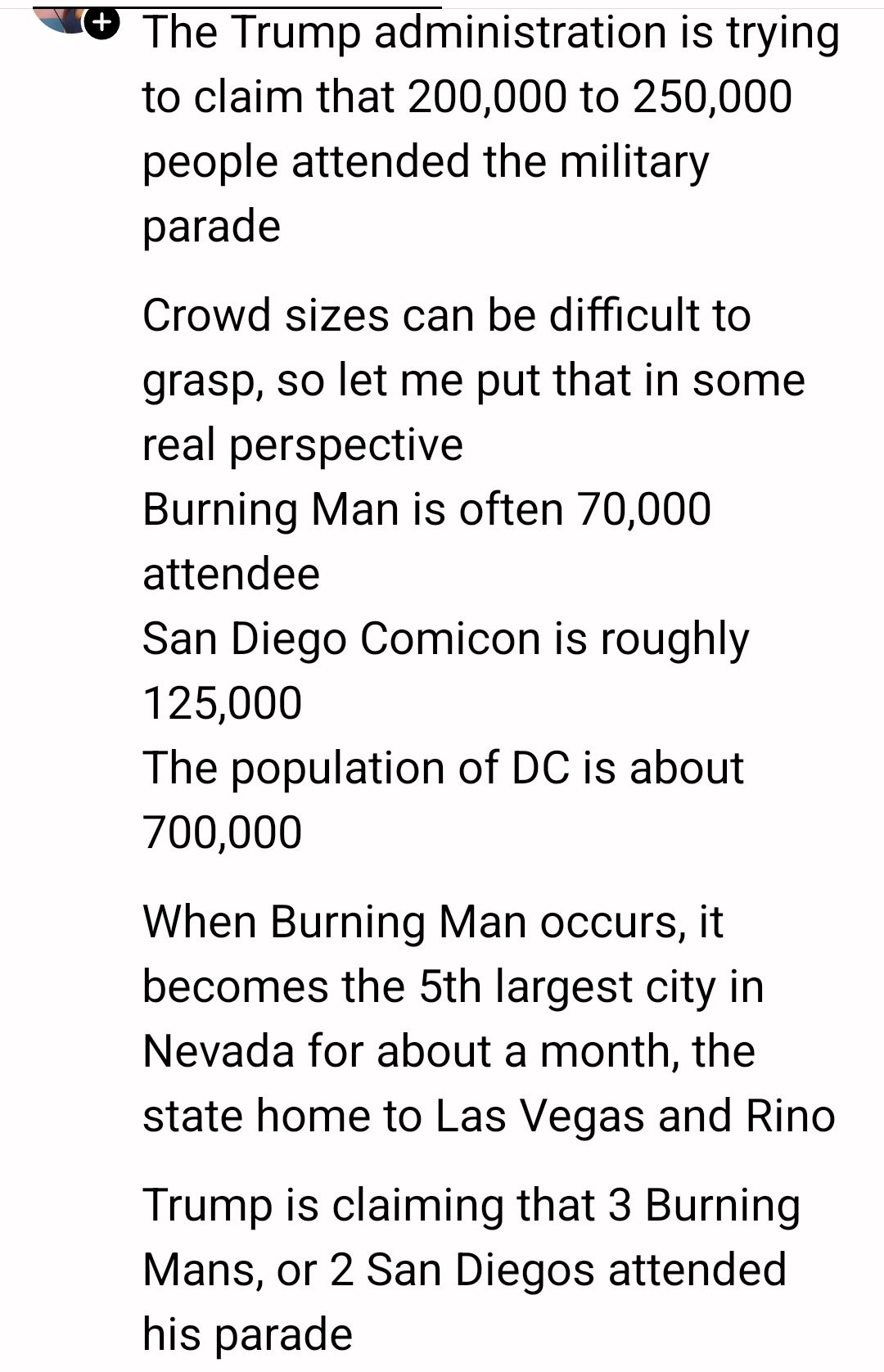
This anti-Trump meme is designed to expose what the administration is lying about, comparing massive parade crowds to everyday events like Burning Man and San Diego Comic-Con. The joke lists specific statistics—such as Burning Man having 70,000 attendees or San Diego Comic-Con reaching over 125,000—to highlight that the crowd was much bigger than the Trump administration suggests they attended. The punchline reveals the government's claim is a deception where they are allegedly only counting three times the size of a Burning Man or two entire San Diegos as "crowds" instead of actual thousands.
detailed-analysis (gemma3_27b-it-q8_0)
Here’s an analysis of the meme from the perspective of an “Anti-Trump” category, broken down into relevant theoretical frameworks. Given the meme's focus on numbers and perceptions of reality, it lends itself to multiple interpretations.
Visual Description
The meme isn't visually complex. It's text-based, relying on a list of comparative crowd sizes to undermine a claim made by the Trump administration regarding attendance at a military parade. The text format itself emphasizes the logical dismantling of the administration’s claim. The final line – “Trump is claiming 3 Burning Mans, or 2 San Diegos attended his parade” – functions as the punchline, highlighting the absurdity of the claimed number.
Foucauldian Genealogical Discourse Analysis
From a Foucauldian perspective, this meme deconstructs the discourse of truth constructed by the Trump administration. The administration attempts to wield power through control of narrative—specifically, the narrative of large turnout signifying public support. This is a performance of power, aiming to create an aura of legitimacy and strength.
The meme genealogically traces the origins of this power dynamic. Historically, rulers have used displays of size and grandeur to demonstrate authority. By comparing the claimed attendance to recognizable events (Burning Man, Comic-Con), the meme reveals how the administration attempts to manipulate the episteme (the underlying structures of thought) to bolster its claims. The comparison demonstrates that the scale claimed by the administration is simply implausible, and therefore untruthful.
The meme operates as a counter-discourse, challenging the administration’s attempt to define reality. By presenting alternative metrics of size and scale, it seeks to expose the fabrication and erode the administration’s authority.
Critical Theory
The meme embodies a core tenet of Critical Theory: exposing power structures and challenging dominant narratives. Trump’s claims about crowd size aren't about simply accurately reporting numbers; they are about constructing a reality that supports his political agenda. The meme serves as a form of critical consciousness-raising, prompting viewers to question the information presented by those in power.
The focus on the quantifiable (crowd size) is significant. The administration attempts to legitimate itself through appeals to “facts” (albeit fabricated ones). However, Critical Theory points out that even "facts" are often constructed through power dynamics and serve particular ideologies. The meme reveals the underlying manipulative intent behind the administration’s use of numbers.
Marxist Conflict Theory
While not immediately apparent, a Marxist reading can be applied. The administration’s manipulation of attendance numbers represents an attempt to maintain ideological hegemony – the dominance of a particular worldview that serves the interests of the ruling class (in this case, the administration itself).
By creating the impression of widespread support, the administration seeks to quell dissent and reinforce its position of power. The meme can be interpreted as a form of resistance—a challenge to that hegemony. The act of debunking the administration’s claim is a way to expose the contradictions within the system and undermine its legitimacy. The “people” are being misled to serve the administration’s needs.
Postmodernism
This meme very much aligns with a postmodern sensibility. The claim about the parade’s attendance represents a rejection of objective truth, embracing instead a constructed “reality” based on desire and projection. Trump’s insistence on a specific, exaggerated number points to a rejection of verifiable data in favor of a narrative that supports his ego and political goals.
The meme itself is inherently playful and deconstructive, utilizing irony and hyperbole to expose the absurdity of the administration's claim. The juxtaposition of the parade with events like Burning Man and Comic-Con highlights the arbitrary nature of meaning and the subjective experience of reality. The meme doesn't attempt to offer a true number, but rather to reveal the inherent instability of truth itself in the context of political power.
In Summary
From an anti-Trump perspective, this meme is a potent example of resistance to the administration's tactics of misinformation and manipulation. It employs critical thinking, exposes power dynamics, and challenges the notion of objective truth, all while utilizing humor to effectively convey a political message.
simple-description (llama3.2-vision_11b)
This meme is a satirical commentary on the Trump administration's claims about the size of the crowd at the 2017 Inauguration. The meme uses a quote from Trump's inauguration speech to compare the size of the crowd to a fictional event, such as the Burning Man festival or a comic-con event. The meme is humorous and ironic, poking fun at Trump's exaggeration of the crowd size.
detailed-analysis (gemma3-27b-vision)
Okay, here's an analysis of the provided text, broken down into sections based on the requested theoretical frameworks. It's important to note that some frameworks will be more applicable than others. I'll explain why as I go.
1. Visual Description
This isn't a visual medium in the sense of a photo or painting. It's a text extract. However, we can note:
- Format: A sequence of statements. It reads like a social media post or the notes from a speech.
- Style: The style is comparative, using quantifiable information (crowd numbers) to create context and, implicitly, to cast doubt on a claim.
- Framing: The text immediately establishes a power dynamic: The "Trump administration" is claiming something, and the author is seeking to contextualize or refute it. The use of comparison implies a challenge to the administration's narrative.
2. Foucauldian Genealogical Discourse Analysis
This framework is highly applicable. Foucault focuses on the relationship between power, knowledge, and discourse. This text lends itself to this analysis beautifully.
- Power/Knowledge: The core of the text is a challenge to the Trump administration's construction of knowledge about the size of the parade. The administration is attempting to exercise power by presenting a specific narrative. The author is attempting to counter that power by providing alternative data and framing.
- Discourse: The text reveals a discourse surrounding the presentation of reality, particularly in relation to political events. It’s a discourse of numbers, comparison, and verification. The administration attempts to establish a truth (the parade was large), and the author actively disrupts that truth through alternative knowledge.
- Genealogy: A genealogical approach would trace the historical development of this kind of contestation over numbers and "truth" in political discourse. We've seen this repeated pattern: politicians making grand claims about attendance, then challenges/counter-claims based on verifiable data. Tracing the history of these claims would show the evolving strategies used to manipulate perception.
- Normalization: The text is inherently engaging in the process of normalization. By providing baseline numbers for other, established events, it sets up the parade's attendance as being outside the norm if the administration's claims are accurate.
3. Critical Theory
This framework is also strongly applicable. Critical Theory examines power structures and seeks to critique them.
- Ideology: The Trump administration's claim about the crowd size can be seen as an attempt to create a particular ideology of strength and popularity. Large crowds are symbolic of support, and presenting a massive turnout reinforces a narrative of political success.
- Hegemony: The attempt to convince the public of a large turnout is a bid for hegemony - establishing dominance through a consensus that favors the administration's view of reality.
- Critique of Enlightenment Reason: While subtle, there's a nod to a critique of "Enlightenment reason" here. The author isn't simply presenting facts; they're using quantifiable data to challenge a claim presented as objective truth.
- Mass Manipulation: The core of the text points to a potential instance of mass manipulation through the distortion of information. The attempt to falsely inflate a number is a strategic effort to shape public opinion.
4. Marxist Conflict Theory
This framework is moderately applicable.
- Power Struggles: The text illustrates a conflict between the Trump administration (representing a specific power structure) and the author (who challenges that structure).
- Control of Narrative: Control over the narrative of the parade's size is a form of control over the perception of power. The administration wants to be seen as popular and successful, while the author attempts to destabilize that image.
- Ideological Struggle: There is an ideological struggle happening, as discussed in Critical Theory. The size of the crowd is a symbol, and contesting that symbol challenges the dominant ideology.
- Class/Bourgeoisie/Proletariat: This is a bit of a stretch, but the administration could be seen as representing the interests of the "bourgeoisie" (ruling class) and attempting to maintain control, while the author can be seen as a voice questioning authority.
5. Postmodernism
This framework is applicable, but in a limited way.
- Deconstruction of Truth: The text implicitly deconstructs the idea of a singular, objective "truth" regarding the crowd size. The author presents alternative data, suggesting that there isn't one definitive answer.
- Meta-Narratives: The claim about the parade size could be seen as a "meta-narrative" - a grand, overarching story that attempts to legitimize power. The author challenges that narrative by exposing its potential inaccuracies.
- Simulacra & Simulation: This is a bit more abstract, but you could argue that the representation of the crowd (the claim of 200,000-250,000) has become more important than the actual crowd itself. It's a "simulacrum" – a copy without an original.
6. Queer Feminist Intersectional Analysis
This framework is the least applicable in this particular text. There is nothing inherently feminist or queer about the content. However, a very broad stretch could be made:
- Challenging Authority: In general, queer and feminist theories challenge existing power structures and dominant narratives. The author's critique of the administration's claims could align with this broader goal.
- Epistemological Authority: The author’s challenge to the administration’s numbers demonstrates a shift in epistemological authority – questioning the perceived authority of the administration to accurately portray reality.
- Intersectional Considerations: (This is really pushing it). One could argue that challenging disinformation and the abuse of power is vital to marginalized communities, who are often disproportionately affected by false narratives.
In Summary:
The text is most readily analyzed through the lenses of Foucauldian Discourse Analysis, Critical Theory, and Marxist Conflict Theory. These frameworks highlight the power dynamics, ideological struggles, and attempts at manipulation embedded in the challenge to the administration's claim. Postmodernism has some relevance, but it is not central. Queer feminist intersectional analysis is the least relevant framework in this case, as the text does not directly address issues of gender, sexuality, or intersectionality.
simple-description (llama3.2-vision)
This meme is a screenshot of a text post that mocks the Trump administration's claims about the size of the crowd at the 2017 inauguration. The text post claims that the administration is trying to downplay the size of the crowd, saying it was only 200,000-250,000 people, when it was actually over 800,000. The post also points out that the crowd was much larger than the Trump administration claimed, and that the president's claims about the crowd size are "a lie."