First Seen
2023-05-10T21:03:34+00:00
simple-description (llama3.2-vision_11b)
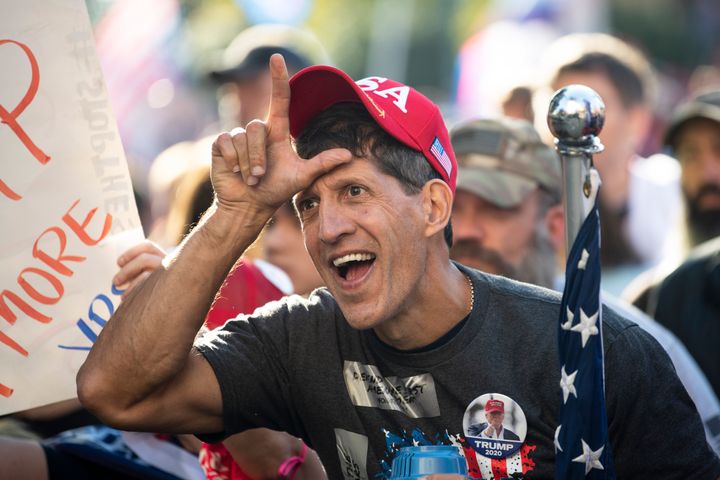
This meme is a photo of a man holding a sign that reads "We the People" in a protest against former US President Donald Trump. The image is captioned "We the People" and features a man in a "Make America Great Again" hat, symbolizing the anti-Trump movement. The meme is likely used to express dissent or criticism of Trump's policies or actions.
detailed-analysis (gemma3-27b-vision)
Okay, let's break down this image using the frameworks requested. Keep in mind these are interpretive exercises and other readings are possible.
Visual Description
The image depicts a man seemingly in the midst of a political rally or demonstration. He is white, middle-aged, and wearing a red “Make America Great Again” (MAGA) hat and a t-shirt emblazoned with a Trump 2020 campaign image. He’s visibly excited or agitated, with his mouth open in what appears to be a shout or yell and his arm raised with a finger pointing upwards, possibly giving a call to action or expressing enthusiasm.
The background is a crowd of people, mostly men, many wearing hats and appearing to be involved in the same event. A partial protest sign, with the letters “MORE” visible, is on the left side of the frame. The lighting is bright and sunny, with some lens flare, giving the scene a heightened, almost theatrical quality. The overall impression is one of fervent political support and potentially, a degree of performative energy.
---
Foucauldian Genealogical Discourse Analysis
From a Foucauldian perspective, the image provides a snapshot of the discursive formations surrounding political identity in the United States. The "MAGA" hat and the Trump imagery aren't simply symbols of political preference; they represent a power/knowledge nexus.
- Genealogy of "America": The concept of "Making America Great Again" itself has a history – a genealogy. It evokes a specific, often mythologized, past—a past defined by notions of national exceptionalism, racialized hierarchies, and economic prosperity that existed for a select group. The phrase constructs a narrative about a lost idyllic past and positions Trump as the restorer of it.
- Disciplinary Power: The visual performance of support (the raised arm, the shout) can be seen as an enactment of disciplinary power. The man isn't being directly coerced, but he's internalizing and expressing norms associated with the "true American" (as defined within the discursive field supporting Trump). He’s performing the role of the committed patriot.
- Normalization: The repeated use of such symbols and performance has the effect of normalizing a particular brand of national identity—one that prioritizes certain values and excludes others. This isn’t necessarily a top-down imposition, but a complex interplay of power and knowledge shaping subjects' ways of seeing and being.
---
Critical Theory
Applying a Critical Theory lens (drawing on thinkers like Adorno and Horkheimer) reveals aspects of mass culture and the spectacle.
- Reification: The image can be read as an example of reification—the process by which social relations are presented as things. Support for Trump isn't about complex political ideology; it's distilled into a symbol (the hat) and a performance (the shout). This simplifies and obscures the underlying social and economic forces at play.
- Culture Industry: The visual elements of the rally—the flags, the banners, the performative energy—can be understood as part of the "culture industry." This industry creates standardized, commodified experiences that discourage critical thought and encourage conformity.
- Authoritarian Personality: The man's fervor and enthusiastic embrace of a strong leader might be interpreted through the lens of the "authoritarian personality," as explored by Adorno et al. This perspective suggests a susceptibility to demagoguery and a preference for hierarchical structures.
---
Marxist Conflict Theory
From a Marxist perspective, the image reveals underlying class conflict and the ways in which ideology functions to maintain the status quo.
- False Consciousness: The man’s fervent support for Trump, particularly if he belongs to a working-class demographic, could be seen as a manifestation of "false consciousness." He’s supporting a political figure who, despite rhetoric, primarily benefits the wealthy elite. The appeal to nationalist sentiment and promises of economic restoration mask the ways in which his economic interests are actually being undermined.
- Ideology and Hegemony: The MAGA hat and rally serve as tools of ideological control. They create a sense of unity and shared identity that obscures the fundamental contradictions of capitalism.
- Class Interests: The rally attendees likely represent a segment of the population that feels economically disenfranchised. However, the political solutions offered (nationalism, protectionism) don't address the root causes of their economic struggles, but rather redirect their anger toward scapegoats.
---
Postmodernism
A postmodern analysis would focus on the image's representation of reality and the blurring of boundaries between authenticity and simulation.
- Hyperreality: The rally itself can be seen as a hyperreal spectacle—a simulation of reality that has become more real than real. The emphasis on image, performance, and spectacle overshadows substantive political issues.
- Fragmentation of Meaning: The image doesn’t offer a stable, coherent meaning. The MAGA hat is a signifier that has been stripped of its original context and reappropriated to serve a particular political agenda.
- Deconstruction of Grand Narratives: The image challenges any universal claims about American identity or values. It reveals the constructed and contingent nature of such narratives.
---
Queer Feminist Intersectional Analysis
While the image does not directly depict gender or sexuality, a queer feminist intersectional analysis can provide insights.
- Masculinity & Nationalism: The image strongly evokes a specific type of (often white, heterosexual) masculinity that is deeply intertwined with nationalist ideology. This masculinity is often premised on dominance, control, and a rejection of anything perceived as “feminine” or “weak.”
- Exclusion & Erasure: The fervent expression of nationalism can often be associated with exclusion and erasure of marginalized groups—including LGBTQ+ people, people of color, and immigrants. The image, by representing this nationalist fervor, implicitly contributes to this exclusionary dynamic.
- Intersection of Oppression: The image highlights how various forms of oppression (sexism, racism, heteronormativity) can intersect and reinforce one another within a broader political context. The appeal to a nostalgic vision of America often ignores or actively suppresses the experiences of those who have historically been marginalized within that nation.
Disclaimer: These are interpretations, and the image is open to multiple readings. Each framework highlights different aspects and nuances. It’s also important to remember that the individual in the image is a complex person and cannot be reduced to a simple representation of these theoretical concepts.
simple-description (llama3.2-vision)
The meme features a photo of a person wearing a "Make America Great Again" (MAGA) hat, with their hand raised in a "V" shape for victory. The image is captioned "I just got a new job" and is likely meant to be humorous, implying that the person is celebrating their new job with a victory gesture. The tone is likely sarcastic, suggesting that the person is not actually celebrating a new job, but rather making a joke about their job search.
tesseract-ocr
> te ; - Fi ane) Ne K