First Seen
2023-05-10T21:03:34+00:00
simple-description (llama3.2-vision_11b)
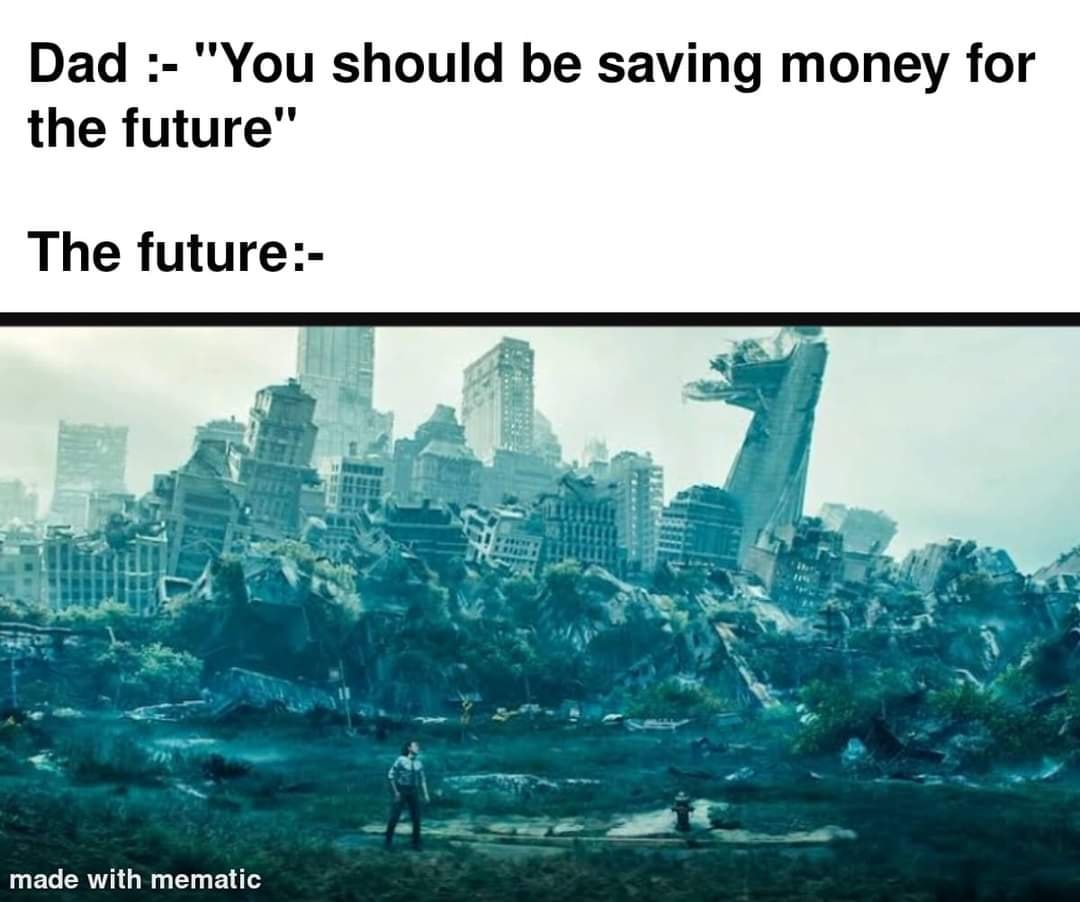
The meme depicts a desolate, post-apocalyptic landscape with a lone figure standing in the center. The text above the image reads, "Dad: 'You should save for the future.' The future: [image of a devastated cityscape with a single person standing in the center, looking out at the ruins]." The meme humorously illustrates the irony of a father's advice to save for the future, only to have the future turn out to be a catastrophic, post-apocalyptic wasteland.
detailed-analysis (gemma3-27b-vision)
Okay, let's break down this meme through several theoretical lenses. It’s a rich image for analysis because it juxtaposes a conventional parental imperative (saving for the future) with a very bleak visual of what that future might actually hold.
Visual Description
The image is a digitally manipulated or rendered scene depicting a ruined urban landscape. It appears to be a city skyline—recognizable building shapes suggest a modern metropolis—but overgrown with vegetation and displaying significant structural damage. Buildings are crumbling, broken, or partially submerged. The color palette is muted and desaturated, dominated by greens, grays, and browns, evoking a sense of decay and abandonment. In the foreground, two silhouetted figures are walking, dwarfed by the scale of the devastation. The lighting suggests a hazy, overcast atmosphere. The overall effect is post-apocalyptic and unsettling, hinting at environmental collapse, war, or some other catastrophic event. The text overlay reads "Dad :- 'You should be saving for the future'," followed by "The future :-" and then this image.
Foucauldian Genealogical Discourse Analysis
This meme utilizes a stark visual contrast to disrupt a taken-for-granted discourse around financial planning and the future.
- Discourse of Future Security: The father's statement ("You should be saving for the future") embodies a dominant discourse emphasizing deferred gratification, financial responsibility, and the belief in a stable, predictable future where savings will yield benefits. It's a discourse steeped in capitalism, encouraging participation in systems of economic accumulation.
- Genealogical Disruption: The image, however, genealogically disrupts this discourse by presenting an alternative "future" where the traditional structures that savings are supposed to support—society, economy, infrastructure—have collapsed. This isn’t simply predicting a different future; it’s revealing the contingent history that has led to the present construction of ‘the future’ as something reliable and attainable through individual effort.
- Power/Knowledge: Foucault's concept of power/knowledge is at play here. The father’s statement exerts a power dynamic through the assertion of wisdom and the normalization of financial prudence. The meme, by juxtaposing this with a devastated future, questions the basis of that knowledge. What if the "future" that saving is intended for never arrives, or is unrecognizable? It challenges the assumption that the systems in place are stable enough to guarantee a return on investment (whether financial or emotional).
- Archaeology of Knowledge: The meme acts as a kind of archaeological dig. It's revealing the unstable foundations upon which the idea of a 'safe' future is built.
Critical Theory
The meme can be examined through the lens of Critical Theory, particularly concerning the concept of ideology and its relation to social control.
- Ideology & False Consciousness: The father's statement represents a dominant ideology promoting capitalist values of thrift and future planning. This ideology can be seen as contributing to "false consciousness," where individuals are led to believe that their personal financial responsibility can secure a future that is, in fact, increasingly precarious due to systemic issues.
- Alienation: The meme implies a kind of alienation. Individuals are encouraged to invest in a future that may not exist, effectively detaching their efforts from a meaningful outcome. It highlights the disconnect between individual actions and the larger, uncontrollable forces shaping the world.
- Critique of Reason: The image critiques the “instrumental reason” central to modern capitalist society. The emphasis on efficiency, productivity, and long-term planning seems absurd when confronted with the possibility of complete systemic collapse.
- Systemic Critique: The ruined city is not the result of individual failure, but of systemic failures—environmental degradation, economic inequality, political instability. The meme subtly points toward the absurdity of pursuing individual wealth accumulation in a context where the very foundations of society are crumbling.
Marxist Conflict Theory
The meme is heavily suggestive of class conflict and the inherent contradictions within capitalism.
- Capitalist Contradictions: The image illustrates the potential consequences of unchecked capitalist growth and exploitation. Environmental devastation, resource depletion, and social inequality are all implicit in the ruined cityscape. The meme implies that the pursuit of profit has created a future where even the wealthy are vulnerable.
- False Promises: The father's advice can be seen as a way to perpetuate the capitalist system by encouraging individuals to invest in a future that disproportionately benefits the ruling class. The promise of a secure future through saving is a false promise for many, as systemic inequalities prevent equal access to resources and opportunities.
- Alienation from Production: The ruined city represents the ultimate alienation from the fruits of labor. The work and investment that created the city have been rendered meaningless by its destruction.
- Class Struggle: The meme can be interpreted as a subtle commentary on class struggle. The devastation depicted could be the result of a catastrophic event that disproportionately impacts the working class, while the wealthy may have the resources to escape or survive.
Postmodernism
From a postmodern perspective, the meme deconstructs the grand narratives of progress and stability.
- Rejection of Metanarratives: The image challenges the metanarrative of continuous economic growth and improvement. It suggests that the future is not predetermined or predictable, but contingent and chaotic.
- Simulation & Hyperreality: The ruined city can be seen as a simulation of a failed future. It raises questions about the relationship between reality and representation, and whether the "future" we imagine is merely a construct of our own making.
- Deconstruction of Meaning: The meme deconstructs the meaning of "saving for the future." It suggests that the traditional association between saving and security is no longer valid in a world facing existential threats.
- Irony & Parody: The meme employs irony by juxtaposing a conventional parental message with a dystopian image. It parodies the idea that individual effort can guarantee a positive outcome in a chaotic world.
Queer Feminist Intersectional Analysis
While not immediately the primary focus, a Queer Feminist Intersectional lens can reveal additional layers of meaning.
- Vulnerability & Precarity: The ruined cityscape highlights the precarity of existence, especially for marginalized communities. Queer and feminist theories often emphasize the heightened vulnerability of individuals and groups facing systemic discrimination. Environmental disasters and societal collapse disproportionately impact these communities.
- Disrupting Normative Futures: The image disrupts the normative assumptions about the future, particularly those centered on traditional family structures and economic stability. It challenges the idea that everyone can or should aspire to the same "future."
- Care & Mutual Aid: The image implicitly calls for a shift away from individualistic pursuits towards collective care and mutual aid. In a post-apocalyptic scenario, survival depends on collaboration and community, rather than individual wealth accumulation. Queer and feminist activism often prioritize these principles.
- Challenging Capitalist Structures: This meme aligns with feminist critiques of capitalism, highlighting its exploitative and unsustainable practices that contribute to environmental destruction and social inequality. It asks what a future built on care, justice, and sustainability might look like, rather than simply perpetuating the same harmful systems.
I hope this detailed breakdown provides a comprehensive analysis of the meme through various theoretical lenses! Let me know if you'd like me to elaborate on any particular point.
simple-description (llama3.2-vision)
This meme is a humorous take on the idea that people often don't save enough for their future. The image shows a person standing in a desolate, post-apocalyptic landscape, with a city in the background that has been destroyed by a massive tree. The text at the top reads "Dad: 'You should be saving money for the future'" and the text at the bottom reads "The future:". The implication is that the person's dad's advice to save money is not going to help them in the face of a catastrophic event, and the image is a darkly comedic commentary on the idea that even the best advice can't prepare you for the worst.
tesseract-ocr
Dad :- "You should be saving money for the future" The future:- rt : ye { A I ee a — eo GR a ol eee i aie a ig Mica | ee Raa tee om aon Ee = s Rig oe vr AS Fe a et eae ene aida pe . ———— made with mematic