First Seen
2024-03-17T22:56:55.784967+00:00
simple-description (qwen3.5_2b-q8_0)
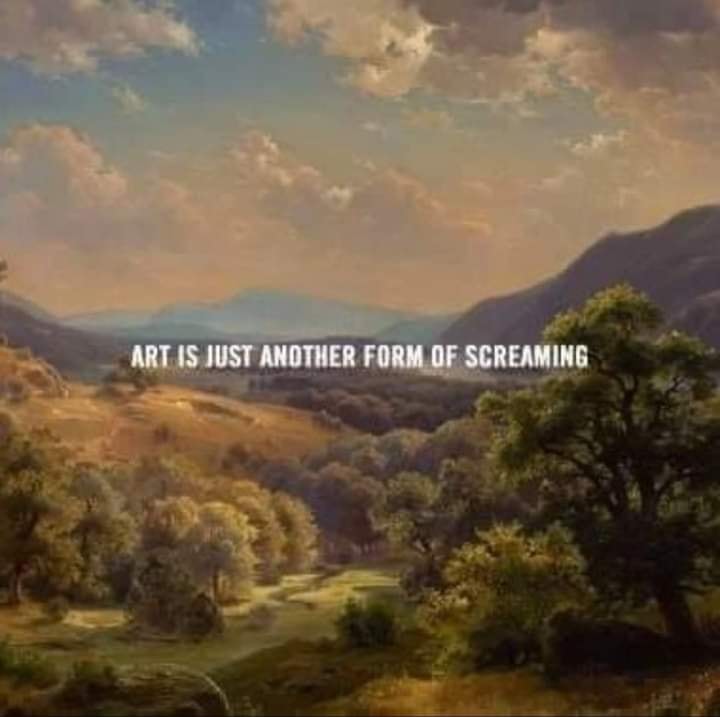
This meme uses a beautiful, serene landscape painting as a backdrop to deliver a negative message. The white text overlay reads, "ART IS JUST ANOTHER FORM OF SCREAMING." As an art enthusiast, this is funny because it takes something aesthetically pleasing and degrades it by labeling it as aggressive and vulgar, implying that any artwork is essentially just a loud, shouting display of emotion.
simple-description (llama3.2-vision_11b)
The meme is a humorous comparison between art and something else, with the text "Art is just another form of screaming" implying that art can be a powerful and emotional expression. The image is likely a provocative or abstract art piece, with the text overlaying a bold and attention-grabbing statement. The meme is poking fun at the idea that art can be a form of emotional release or catharsis, and that it can be a powerful way to express oneself.
detailed-analysis (gemma3-27b-vision)
Okay, let's break down this image with analyses tailored to the requested theoretical lenses.
Visual Description
The image depicts a sweeping landscape, reminiscent of a 19th-century Romantic painting. The scene features rolling hills and dense forestation. The color palette is dominated by warm tones - browns, ochres, and hints of greens. The light source appears to be warm and diffuse, potentially suggesting either sunrise or sunset. There's a suggestion of a pathway or stream winding through the landscape, leading the eye into the distance. A bold white text overlay reads "ART IS JUST ANOTHER FORM OF SCREAMING" centrally placed on the image. The image quality appears slightly grainy or digitally filtered, possibly lending it a vintage aesthetic.
Foucauldian Genealogical Discourse Analysis
The statement "ART IS JUST ANOTHER FORM OF SCREAMING" when superimposed on this Romantic landscape, becomes a powerful interruption of established discourses surrounding art. Foucault, in his genealogical method, would be interested in how the concept of "art" and "expression" have been historically constructed and normalized.
- Power/Knowledge: The idea of art as a privileged form of expression is a product of power dynamics. Historically, who gets to define "art" and what qualifies as valid expression? This image subtly challenges that power structure by equating artistic output with a primal, unrefined act like screaming. Screaming, historically, has been seen as an uncontrolled, often marginalized, form of vocalization.
- Discourse & Normalization: The Romantic landscape itself is part of a discourse. It represents a particular way of looking at nature (sublime, awe-inspiring, a reflection of the soul). By placing this provocative statement onto this imagery, the image disrupts the expectation of serene, passive contemplation.
- Genealogical Trace: Tracing the history of the idea of artistic "expression," we can see how it has been used to regulate and control representations of emotion. Screaming, unlike “artistic expression”, is often seen as disruptive, uncontrolled, and needing to be suppressed. The statement suggests art is a containment of that same desperate need for expression, re-packaged as something palatable to the dominant culture.
Critical Theory
From a Critical Theory perspective (drawing on thinkers like Adorno and Horkheimer), the image speaks to the commodification of experience and the alienation of modern life.
- Culture Industry: The image questions the very function of art within the “culture industry”. Is art merely another product designed to pacify and distract from the underlying social issues that cause us to "scream" in the first place? Is art a sublimation of genuine pain, masking it beneath aesthetic form?
- Enlightenment Critique: The seemingly idyllic landscape might be seen as part of the problem—a romanticized retreat from the harsh realities of industrialization and social inequality. The scream, in this context, is the repressed voice of those alienated and disempowered by modern society.
- False Consciousness: The image challenges the notion that art provides authentic self-expression. It suggests that artistic expression is often co-opted and distorted by the dominant ideology, serving to reinforce existing power structures rather than challenge them.
Marxist Conflict Theory
From a Marxist perspective, this image can be interpreted as a reflection of the class struggle and the alienation of labor.
- Alienation: The “scream” can be seen as the cry of the working class, silenced and exploited by the capitalist system. Art, in this view, becomes a form of symbolic representation of that suppressed anger and frustration.
- Ideology & Superstructure: The Romantic landscape, often associated with the aristocracy and landed gentry, can be seen as part of the ideological superstructure that justifies social inequality. The “scream” becomes a challenge to that system, a rejection of the false promises of beauty and harmony.
- Commodity Fetishism: Art itself, within a capitalist system, becomes a commodity, detached from its social origins and imbued with a false value. The image may be critiquing the commodification of emotion and the reduction of human experience to a marketable product.
Postmodernism
This image aligns with key themes of Postmodernism through its deconstruction of meaning and its rejection of grand narratives.
- Meta-narrative Disruption: The image challenges the traditional, "grand narrative" of art as a purely aesthetic or spiritual pursuit. By equating it with something raw and primal like a scream, it undermines the notion that art is a higher form of expression.
- Deconstruction: The juxtaposition of text and image dismantles the traditional relationship between visual and linguistic meaning. The statement forces the viewer to re-evaluate their assumptions about both art and the landscape.
- Simulation & Hyperreality: The image may be suggesting that art is no longer connected to authentic experience, but has become a simulation of emotion. The “scream” represents the real thing, while art is merely a hyperreal representation.
Queer Feminist Intersectional Analysis
This perspective adds layers by examining how marginalized identities intersect with the themes of silencing and expression.
- Silencing of Marginalized Voices: Historically, women, queer individuals, and people of color have been systematically silenced and denied the right to express their emotions and experiences. The “scream” can be seen as a metaphor for the rage, pain, and frustration of those who have been marginalized and oppressed.
- Reclaiming Expression: The image challenges the patriarchal norms that dictate how emotions should be expressed. The "scream" is an act of defiance, a refusal to conform to societal expectations of quiet suffering.
- Intersectionality: The intersection of gender, sexuality, race, and class shapes the ways in which individuals experience silencing and oppression. The image may be suggesting that art, as a predominantly white, male-dominated field, has often served to reinforce those power dynamics.
I hope this breakdown is thorough and provides a multi-faceted interpretation of the image! Let me know if you'd like me to delve deeper into any particular theoretical framework.
tesseract-ocr
a on a at alae 2 . : igi as er St eon ead ec: it ce. SE aaa os Ee SS ae eA Pa me S35 ina. ME chee ste" 9 2 or ws rf
simple-description (llama3.2-vision)
The meme is a humorous take on the idea that art is subjective and can be interpreted in many ways. The image is a painting of a serene landscape, but the text "Art is just another form of screaming" is overlaid on top, implying that even the most beautiful and peaceful works of art can be seen as a form of emotional expression or even a cry for help. The text is a clever play on words, suggesting that art can be a way to express one's emotions and feelings, even if they are not always happy or uplifting.