First Seen
2023-05-10T21:03:32+00:00
simple-description (llama3.2-vision_11b)
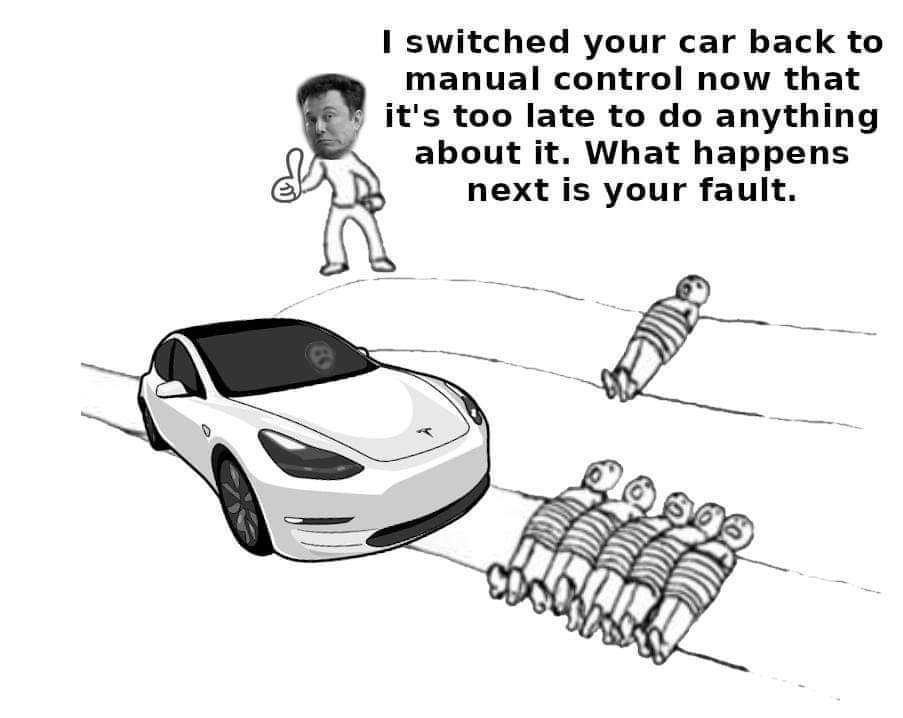
The meme is a humorous illustration of a person who has been stuck in a loop of being punished for their mistakes, with a car that is also being punished for its own mistakes. The text above the image reads, "I switched your car back to manual control now that it's too late to do anything about it. What happens next is your fault." This meme is relevant to the category of Artificial Intelligence - Ethics because it pokes fun at the idea of blaming the victim or the car for its own mistakes, which is a common theme in AI ethics discussions about accountability and blame. The meme is a satirical take on the idea of being punished for one's mistakes, and the use of a car as a metaphor for the consequences of one's actions.
detailed-analysis (gemma3-27b-vision)
Okay, here's an analysis of the image, broken down into sections as requested, focusing on applicable theoretical frameworks. Given the image's content and themes, several of these frameworks are quite relevant.
Visual Description
The image is a cartoon-style illustration depicting a Tesla vehicle with a stick figure standing above it and a line of stick figures being dragged behind. The Tesla appears to be moving forward. The stick figure above the car has a smug expression and a speech bubble that says, "I switched your car to manual control now that it's too late to do anything about it. What happens next is your fault.” The line of trailing figures appears to be tethered to the car, implying that their fates are connected to its movement, while their faces appear to convey shock and terror.
Foucauldian Genealogical Discourse Analysis
The image speaks to power dynamics and the construction of knowledge/truth. A Foucauldian reading would center on how the figure above the car establishes a discourse of control and accountability.
- Power/Knowledge: The figure's statement isn't simply a description of events; it creates a truth. By declaring that "what happens next is your fault," they assign blame before any outcome manifests. This illustrates how power isn't simply repressive, but productive – it creates categories of responsibility and guilt.
- Discipline & Biopower: The tethered figures represent a subjected population, literally "disciplined" by the car's movement and the controller's power. Their fates are dictated by the “driver”, and they have limited agency. This can be tied to biopower, the way power operates on the level of life and bodies, regulating and controlling populations.
- Genealogy: We could imagine a historical "genealogy" of automated systems and the increasing delegation of control to technology. The image hints at the potential for this control to be withdrawn or manipulated, leaving individuals vulnerable and responsible for consequences they couldn't prevent.
Critical Theory
The image is highly amenable to a critical theoretical reading, which examines how social structures and ideologies perpetuate power imbalances.
- Domination & Exploitation: The image directly depicts a clear power imbalance. The figure controlling the car wields power over the group being dragged, representing a situation of domination. The trailing figures' lack of control over their own trajectory speaks to exploitation – they are subjected to forces beyond their agency.
- Ideology & False Consciousness: The controller's statement functions ideologically. It presents a situation of imposed responsibility, obscuring the true source of control. This could be seen as a metaphor for how dominant narratives mask systemic inequalities. The trailing figures appear as though they accept this framing, implying that ideology works to naturalize domination.
- Rationalization & Bureaucracy: The scenario reflects a contemporary phenomenon where increasing technological complexity can be used to shift blame and avoid accountability. The "switching" to manual control creates a bureaucratic layer that shields the controller from responsibility for the outcome.
Marxist Conflict Theory
The image can be read through the lens of class struggle and the exploitation of labor.
- Class Relations: The figure above the car represents those in control of the "means of production" (the car, the control mechanisms), while the trailing figures represent the exploited labor. The car's movement drives their fate, symbolizing how those in power dictate the lives of others.
- Alienation: The trailing figures are alienated from their own agency and control over their destiny. They are reduced to objects, dragged along by forces outside of their influence.
- Surplus Value: The "switching" to manual control can be seen as a metaphor for how the owning class extracts surplus value from the working class. The controller maintains control, while the others bear the consequences.
Postmodernism
A postmodern reading would focus on the image's deconstruction of grand narratives and its rejection of fixed meanings.
- Simulacra & Simulation: The image itself could be seen as a simulacrum – a copy without an original. The situation is artificially constructed, and the sense of reality is distorted.
- Deconstruction of Authority: The image subverts traditional notions of authority and control. The controller’s smugness and disavowal of responsibility are presented as part of a cynical game.
- Fragmentation & Instability: The image captures a sense of fragmentation and instability. The trailing figures are disconnected from each other and from the source of their movement.
Conclusion
The image is rich with symbolic potential, allowing for a variety of theoretical interpretations. It speaks to themes of power, control, accountability, and the potential for exploitation in a technologically advanced world. The application of these frameworks highlights the image's complex message and its relevance to contemporary social and political issues.
Let me know if you'd like me to expand on any of these analyses, or focus on a particular theoretical perspective in more detail.
simple-description (llama3.2-vision)
The meme is a humorous illustration of a person trying to control a car's navigation system, but the system keeps asking for clarification on their destination. The image shows a person standing on the road, with a car in the background, and a group of people in the distance, all looking confused. The text above the car reads: "I switched your car back to manual control. Now that it's late, it's too late to do anything about it. What happens next is your fault."
tesseract-ocr
| switched your car back to manual control now that it's too late to do anything about it. What happens next is your fault. — — | &- ESO “~_ AISLES CiiA PS - is is, WW