First Seen
2023-05-10T21:03:32+00:00
simple-description (llama3.2-vision_11b)
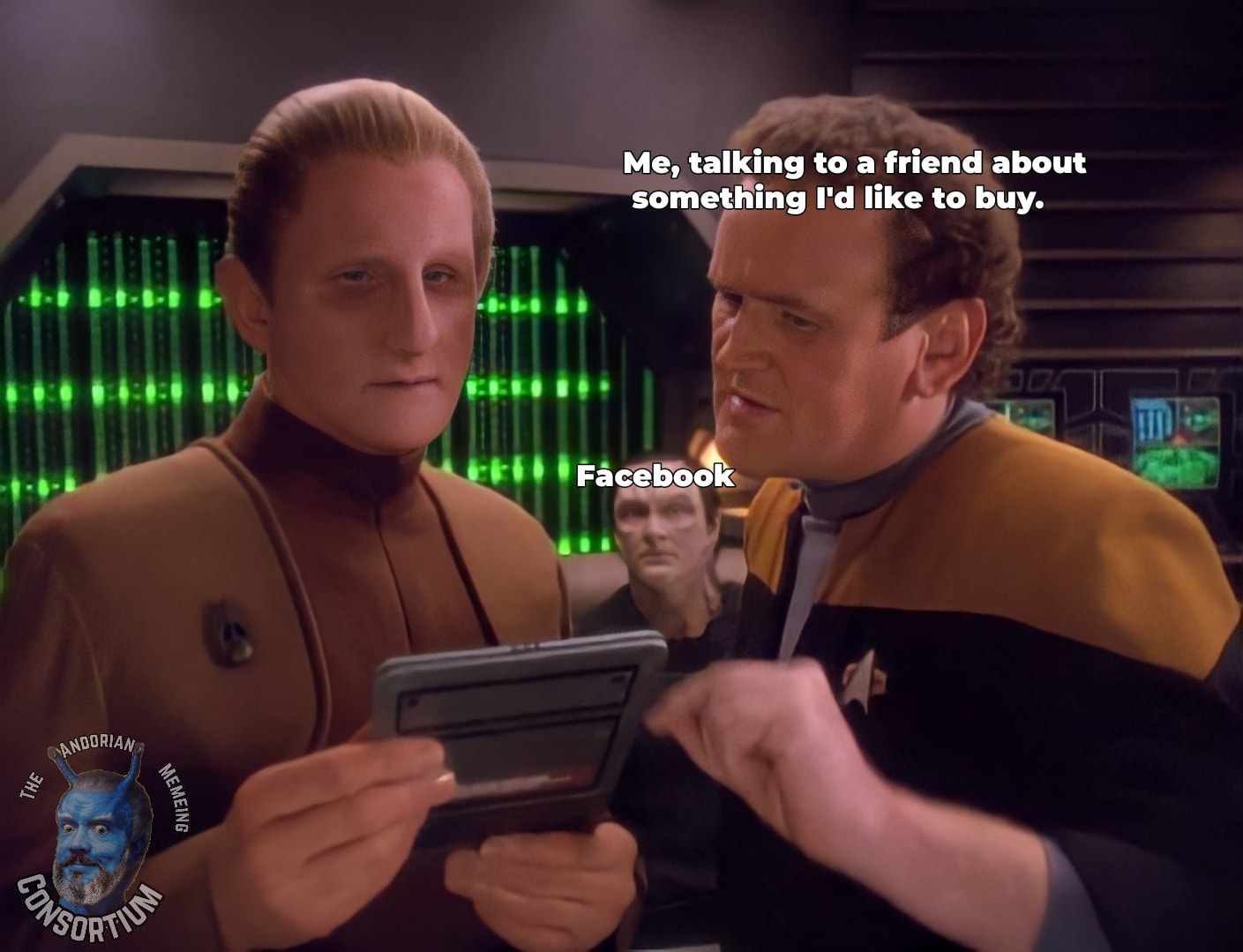
The meme is a humorous take on the ethics of artificial intelligence, specifically the potential for AI to be used for social manipulation. The image features a character from Star Trek: The Next Generation, Captain Jean-Luc Picard, and a Star Trek: The Next Generation character, Data, in a scene from the show. The text "Me, talking to a friend about something I'd like to buy" is a commentary on how AI-powered chatbots can be used to manipulate people into making purchases.
detailed-analysis (gemma3-27b-vision)
Okay, let's break down this image/meme through the lenses you've requested. It's important to note that applying these theories often involves interpretation and looking for underlying themes, so this is not a definitive "right answer." I'll indicate if a section doesn't really apply.
Visual Description
The image is a still from Star Trek: The Next Generation. It features Commander Riker and Captain Picard engaged in a close, serious conversation. Riker is holding a PADD (Personal Access Display Device – a Star Trek tablet) and appears to be showing something to Picard. A background character (Geordi LaForge) is partially visible, looking on. The framing is tight, focusing on the two captains. Text overlays the image: "Me, talking to a friend about something I'd like to buy" is positioned above the captains, and "Facebook" is placed over Geordi LaForge's head. The visual contrast is high, with the dark uniforms and brightly lit PADD drawing the eye.
Foucauldian Genealogical Discourse Analysis
This image can be analyzed through a Foucauldian lens by examining the power dynamics at play, and how ‘sharing’ online has evolved. The PADD, in the Star Trek universe, represents a controlled access to information. It's a device controlled by the Federation. We can view the desire to 'show' someone something on Facebook as a contemporary parallel.
The 'Facebook' label on Geordi is key. Geordi, traditionally a 'viewer' of data (due to his VISOR) and a more subordinate officer, becomes symbolic of the passive audience consuming the 'data' presented – a 'feed' if you will. The conversation between Picard and Riker (representing the ‘sender’) and Geordi/Facebook (the ‘receiver’) highlights how online ‘sharing’ has become a normalized practice of self-presentation, often for purposes of validation or to establish social standing. We can see this as a shift in discourse: from direct, meaningful communication (Picard/Riker) to mediated communication broadcast to a 'public' (Facebook/Geordi).
The genealogy of this shift shows how communication has evolved from private, face-to-face encounters to public digital displays. This evolution reflects changes in the construction of self and the desire for external validation.
Critical Theory
The meme touches on themes of consumerism and commodification, central to Critical Theory. Picard and Riker discussing a potential purchase on Facebook highlights how desire and consumption are increasingly linked to social performance.
The meme subtly critiques the role of social media in shaping desires. Facebook isn't simply a platform for sharing information; it’s a space where wants are created, amplified, and constantly displayed. The meme implies that even figures of authority and intellect (Picard and Riker) are susceptible to the influence of consumer culture and the need to broadcast their desires.
The framing also suggests that we are constantly being observed (Geordi/Facebook), contributing to a culture of surveillance and self-monitoring.
Marxist Conflict Theory
While not a dominant theme, a Marxist reading could focus on the alienating effects of social media. The meme can be seen as an example of how capitalism has infiltrated even personal relationships. The 'need' to share a desired purchase on Facebook reflects the commodification of experience and identity.
The implied social pressure to display consumption (to get 'likes' or validation) can be seen as a form of false consciousness. Individuals are led to believe that their happiness and worth are tied to material possessions and external validation, obscuring the underlying structures of inequality and exploitation.
Postmodernism
The meme is inherently a postmodern construct. It takes a well-known image from a science fiction television show and recontextualizes it with contemporary social media terminology. This act of appropriation and remixing is a hallmark of postmodernism.
The humor of the meme lies in the juxtaposition of the "high culture" of Star Trek with the "low culture" of Facebook. This blurring of boundaries and deconstruction of established categories is another key feature of postmodern thought.
The meme also implies a lack of authenticity. The characters' serious conversation about a purchase is undercut by the triviality of sharing it on Facebook, suggesting that all communication is mediated and performative.
Queer Feminist Intersectional Analysis
This theory doesn't fit well with the meme. The image does not contain anything that clearly references gender, sexuality or intersectionality. While you could stretch an argument about social performance and presentation of self aligning with queer theory (and presentation of self), that’s a considerable leap.
Let me know if you’d like me to expand on any of these analyses!
simple-description (llama3.2-vision)
This meme is a humorous take on a common social media scenario. It features a screenshot from the Star Trek: The Next Generation episode "The Game" with a character (Bert) looking at a PADD (a personal access display) with a concerned expression. The text overlayed on the image reads: "Me, talking to a friend about something I'd like to buy. Facebook: 'I'll be watching you'". The meme is a lighthearted commentary on the way Facebook and other social media platforms often collect and use our personal data.
tesseract-ocr
" = ™ : F y ail a aa y ) Me, talking to a friendjabout ay . , something I'd like to buy. | ) 7 7 me... Poeeooe S eats te | aE eo Sooo Q 1. erm a ae 4 Z | : aoe » Seen TS os al \ Wet . ates ' | diane! ' al 3 _ it E 1 < ‘ | a ‘ , os > Aenea ‘ =