First Seen
2023-05-10T21:03:32+00:00
simple-description (llama3.2-vision_11b)
This meme is a play on the concept of facial recognition technology, which is a type of artificial intelligence that can identify and analyze faces. The image likely shows a person or a group of people, with a caption or text overlay that pokes fun at the idea of facial recognition being used to identify "dozens of politicians as criminals". The text overlay is likely a humorous or ironic commentary on the idea of using facial recognition to identify people who are not actually criminals, but rather politicians who are being accused of wrongdoing.
detailed-analysis (gemma3-27b-vision)
Okay, let's break down this meme through several theoretical lenses.
Visual Description
The meme is a two-panel image.
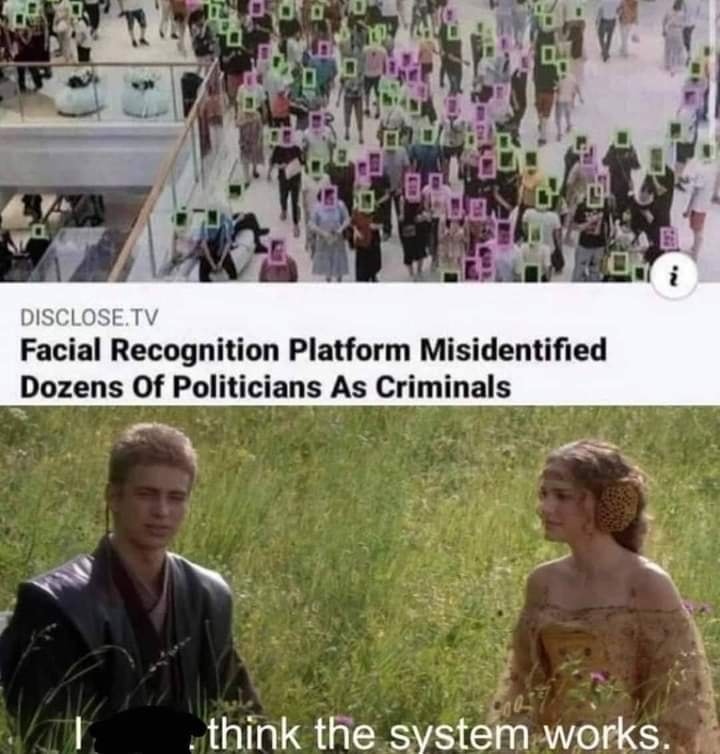
- Top Panel: Shows a screenshot of a news headline from DISCLOSE.TV, reporting that a facial recognition platform misidentified dozens of politicians as criminals. The image shows a crowd of people with boxes around their faces, indicating detection by a facial recognition system.
- Bottom Panel: Is a still image from Star Wars: Revenge of the Sith featuring Anakin Skywalker (Darth Vader) and Padmé Amidala looking at each other with a mixture of concern and dawning realization. Text at the bottom reads: "I think the system works." The implication is ironic, referencing a moment where Anakin and Padme discuss the corruption and failings of the Republic.
The overall effect is one of darkly humorous critique, implying that the facial recognition system's failures aren't bugs, but features of a flawed and potentially dangerous system of control.
Foucauldian Genealogical Discourse Analysis
This meme speaks directly to Foucault’s concepts of power, surveillance, and discourse.
- Panopticism: The image of the crowd with boxes around their faces is a visual echo of the Panopticon. Even though the system misidentifies individuals, the presence of the surveillance mechanism itself creates a disciplinary effect. The constant possibility of being watched, identified (even incorrectly), and judged alters behavior and reinforces norms.
- Discourse and Truth: Foucault argued that truth is not objective but is produced through discourse – the systems of language, thought, and practice that shape our understanding of the world. The news headline, and the meme's response, reveal how discourses around crime, security, and technology define who is considered “criminal.” The misidentification highlights the arbitrary nature of these classifications. It suggests that "crime" itself is a socially constructed category, rather than a fixed reality.
- Genealogy of Power: The meme implicitly asks us to trace the historical development of these technologies and the power relations embedded within them. Who designed the facial recognition system? What biases are built into its algorithms? What political and economic forces are driving its deployment? By highlighting the errors, the meme asks us to question the legitimacy of the power wielded by these systems.
Critical Theory
The meme aligns with key themes in Critical Theory, particularly those stemming from the Frankfurt School:
- Instrumental Reason: The facial recognition system, presented as an objective tool for law enforcement, represents instrumental reason – the focus on efficiency and control without regard for ethical or social consequences. The misidentification is a symptom of the system’s dehumanizing logic, where individuals are reduced to data points and subjected to automated judgments.
- The Culture Industry: The meme could be seen as a critique of how technology and media work together to reinforce existing power structures. The news headline itself is part of a media cycle that normalizes surveillance and criminalization.
- Domination & Control: The meme suggests that technology isn’t neutral; it’s often used to maintain and amplify social inequalities. The facial recognition system, even when flawed, serves as a mechanism for social control. The implication is that even mistakes in the system contribute to its overall purpose of surveilling and potentially suppressing dissent.
Marxist Conflict Theory
The meme can also be read through a Marxist lens:
- Power Dynamics: The system inherently favors those in power (the state, law enforcement) and those who benefit from maintaining the status quo. The misidentification of politicians is ironic because it underscores how these systems can be turned against those in power—but the larger point is that the potential for misuse exists and is tied to the underlying class structure.
- Ideology: The belief that technology is objective and neutral serves to mask the underlying power relations. This meme undermines that belief by showing that these systems are prone to error, and that those errors have real-world consequences.
- Control and Repression: The meme suggests that technology can be used as a tool for controlling and repressing marginalized groups. While the headline focuses on misidentified politicians, the broader implication is that facial recognition systems disproportionately target and harm vulnerable populations.
Postmodernism
- Deconstruction of Grand Narratives: The meme challenges the “grand narrative” of technological progress as inherently positive. It shows that technology is not a neutral force for good, but a complex and contradictory phenomenon with the potential for harm.
- Simulation and Hyperreality: The reliance on algorithmic identification can be seen as a step toward a hyperreal world where representations of reality (the system's identifications) become more important than reality itself. The misidentification highlights the artificiality of this process.
- Questioning Authority and Truth: The meme implicitly questions the authority of institutions and the very notion of objective truth. It suggests that “truth” is not something that is discovered, but something that is constructed through systems of power and control.
Queer Feminist Intersectional Analysis
While not explicitly about gender or sexuality, an intersectional reading is possible.
- Algorithmic Bias and Disproportionate Harm: Facial recognition systems have been shown to be less accurate when identifying people of color and transgender individuals. This is because the datasets used to train these algorithms are often biased and do not adequately represent diverse populations. The meme subtly points to this issue by revealing the system’s fallibility—suggesting that the errors are not random, but reflect underlying biases.
- Surveillance and Marginalization: Historically, marginalized groups have been disproportionately subjected to surveillance and control. Facial recognition systems exacerbate this problem by creating a new tool for tracking and policing these communities.
- Power & Control over Bodies: Facial recognition technology is inherently about identifying and categorizing bodies. The meme hints at the ways in which this technology can be used to regulate and control bodies, particularly those that do not conform to dominant norms.
In conclusion, this meme is remarkably rich in theoretical implications. It serves as a pointed critique of technology, power, and the social systems that shape our world. It’s effective because it uses humor and cultural references to convey a complex and challenging message.
simple-description (llama3.2-vision)
This meme is a play on the concept of facial recognition technology. The image shows a screenshot of a news article with the headline "Facial Recognition Technology Misidentifies Dozens of Politicians as Criminals" and a caption that reads "I think the system works". The image is likely a humorous commentary on the potential flaws of facial recognition technology.
tesseract-ocr
a), Te Sto were tL on? a Pe bi eat | Tr jan n a "| (ine Ls Ss Scan | ee NI Birra.) 11 fete fase, TO) Rite ciiitrices sf a 1a aii ep ean pe is 4 a a f sae “i mee: Mw NSPE 4 may ; DISCLOSE.TV Facial Recognition Platform Misidentified Dozens Of Politicians As Criminals _ ew ne lc 3 ts 7 TO by ae th S Fs 2 t oP a - FB ¥ sit ; pa (i : fe be YA _ think the system-works..