First Seen
2023-05-24T21:28:24+00:00
simple-description (qwen3.5_2b-q8_0)
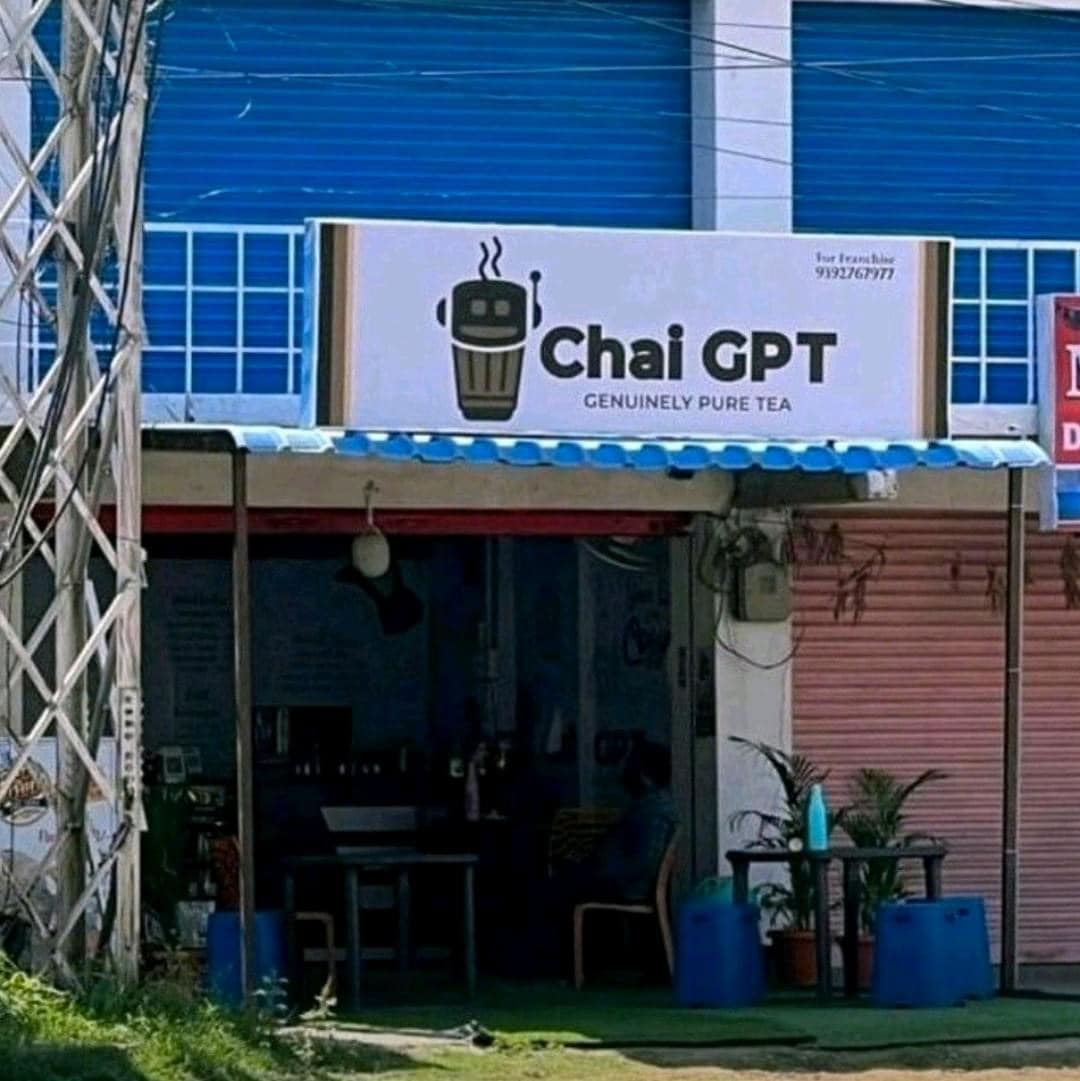
This sign is a joke about Artificial Intelligence. The brand "Chai GPT" plays on the "GPT" acronym, which stands for Google's Generative Pre-trained Transformer, a popular AI model.
It creates a humorous contrast by advertising a fictional AI service while also selling actual chai tea. The sign lists a franchise number (9392767977) and states "GENUINELY PURE TEA" to suggest it offers both AI and traditional tea products.
simple-description (llama3.2-vision_11b)
This meme is a humorous image of a robot (likely a robot from the movie "I, Robot") with the phrase "I, AI" written on its chest. The robot is holding a cup of coffee and has a sarcastic expression, implying that it's fed up with being asked to make coffee for humans all day. The meme is poking fun at the idea that AI systems like chatbots are being asked to perform mundane tasks like making coffee, rather than being used for more complex and creative tasks.
detailed-analysis (gemma3-27b-vision)
Okay, here’s an analysis of the image, broken down into sections as requested, focusing on the most applicable theories. Some sections will be brief, as certain theoretical lenses simply don't 'fit' as strongly.
Visual Description
The image depicts the front of a small business establishment named "Chai GPT – Genuinely Pure Tea." It’s a simple, open-fronted shop, likely a tea stall or cafe, constructed with metal framing and covered with a tarp or similar material. The signage is prominently displayed above the entrance. The sign features a stylized image of a steaming cup of tea within a shape reminiscent of the ChatGPT logo (a chat bubble), with the words “Chai GPT” in bold text and “Genuinely Pure Tea” beneath.
The interior is visible, showing a few simple tables and chairs, suggesting a casual dining area. Outside, there are a couple of blue plastic chairs and a small side table. The surrounding environment appears to be a roadside area, with some greenery and the corner of a tall utility pole visible. The lighting is bright daylight. The shop seems to be in a relatively simple, potentially lower-income area.
Foucauldian Genealogical Discourse Analysis
The naming of the shop as "Chai GPT" is a fascinating point for Foucauldian analysis. Foucault's work emphasizes how discourse (systems of thought, language, and practices) creates power/knowledge relations and shapes our understanding of the world.
The use of "GPT" deliberately links the tea stall to the generative artificial intelligence model, ChatGPT. This creates a discursive connection between a traditional beverage like chai and cutting-edge technology. Several things are at play here:
- Power/Knowledge: The shop aims to borrow the "knowledge" and perceived intelligence associated with ChatGPT, lending the shop an aura of innovation or modernity. It suggests the tea is somehow enhanced or even “created” by this intelligent technology, even if there’s no actual connection.
- Disciplinary Power: The naming could be interpreted as a subtle attempt to 'discipline' consumer choice. By associating the tea with a globally recognizable tech brand, the shop aims to attract a specific demographic – those familiar with, and perhaps impressed by, AI technology.
- Genealogy: The genealogy of chai is rooted in centuries of cultural tradition, particularly in South Asia. This is juxtaposed with the very recent emergence of AI. The shop creates a new historical connection, attempting to rewrite the "history" of tea consumption through a technological lens.
- Surveillance: A subtle connection to the "surveillance" aspect of AI. By using the name ChatGPT, the tea shop may subconsciously associate itself with the data-driven world, where user preferences are tracked and analyzed.
Critical Theory
From a Critical Theory perspective, the image exemplifies the increasing commodification of culture and the intrusion of market forces into all aspects of life. The shop is not simply selling tea; it’s selling an idea – the idea that tea can be linked to sophisticated technology and therefore represents something 'new' or 'improved.'
- Commodification: Tea, a traditionally culturally significant and often communal beverage, is being repackaged as a commodity to be bought and sold in a competitive market. The "GPT" branding intensifies this commodification.
- Ideology: The name "Chai GPT" subtly reinforces the ideology that technology is inherently progressive and superior. It suggests that incorporating technology into everyday life – even something as simple as drinking tea – is a positive development.
- Alienation: Critical theorists like Marx and Adorno argued that capitalism leads to alienation. In this context, the shop contributes to the alienation of tradition. The genuine cultural value of chai is overshadowed by the artificial branding and the focus on profit.
Marxist Conflict Theory
Applying Marxist Conflict Theory, the image highlights the inherent class struggles and economic dynamics at play.
- Bourgeoisie vs. Proletariat: The shop likely represents a small-scale entrepreneurial venture, potentially operated by a member of the emerging middle class. It’s attempting to capitalize on a trend (AI) to attract customers and generate profit. The customers themselves may be from various classes, but the shop is fundamentally operating within a capitalist system where profit is the primary motive.
- Exploitation: The "Genuinely Pure Tea" claim implies a contrast with potentially lower-quality, mass-produced teas. However, even "pure" tea relies on the labor of agricultural workers, who may be subject to exploitation in the pursuit of profit.
- Capital Accumulation: The shop’s success, if it achieves it, contributes to the accumulation of capital by the owner, while potentially offering limited benefits to the broader community.
- False Consciousness: The branding aims to create a "false consciousness" among consumers, leading them to believe that this tea is somehow superior or more valuable due to its association with AI, even if the actual quality is comparable to other teas.
Postmodernism
The image embodies several key features of postmodern thought:
- Hyperreality: The combination of traditional chai and cutting-edge AI creates a simulation or hyperreality. The shop doesn’t offer "authentic" chai in the traditional sense; it offers a representation of chai infused with technological imagery.
- Pastiche: The blending of traditional and modern elements is a form of pastiche – an imitation or collage of different styles and eras.
- Fragmentation: The image fragments the traditional experience of drinking chai, replacing it with a technologically mediated version.
- Deconstruction: The name "Chai GPT" deconstructs the traditional meaning of chai, challenging our assumptions about its origins and significance.
Queer Feminist Intersectional Analysis
This lens is the least directly applicable, but we can still explore some angles:
- Commodification of Culture: The shop’s branding could be seen as a form of cultural appropriation, particularly if the shop owner isn't part of the culture where chai originated. This connects to feminist concerns about the exploitation of marginalized cultures for profit.
- Visibility & Invisibility: The shop's appearance is unremarkable. It doesn't signal any particular inclusion or engagement with queer or feminist issues. It operates within the existing power structures without actively challenging them.
- Labor and Precarity: Considering the workers in the tea industry and in the shop itself, a queer feminist lens might question the precarity of their labor, the potential for exploitation, and the lack of support structures for marginalized workers. This would require more information about the specific context of the shop.
Let me know if you’d like me to elaborate on any of these points or explore a different theoretical angle!
simple-description (llama3.2-vision)
This meme is a play on the popular AI chatbot, GPT. The image is of a storefront with a sign that reads "Chai GPT" and features a robot holding a cup of chai. The text "Genuinely Pure Tea" is written below the sign, poking fun at the idea that the tea shop is named after a language model.
tesseract-ocr
= FET ar Ne VGPYTY AUR ‘ e) ii, a Ip See Bcnai cpr ne y ) ! eee Sue OM = A ia | wae, y