First Seen
2023-06-15T02:02:58+00:00
simple-description (qwen3.5_2b-q8_0)
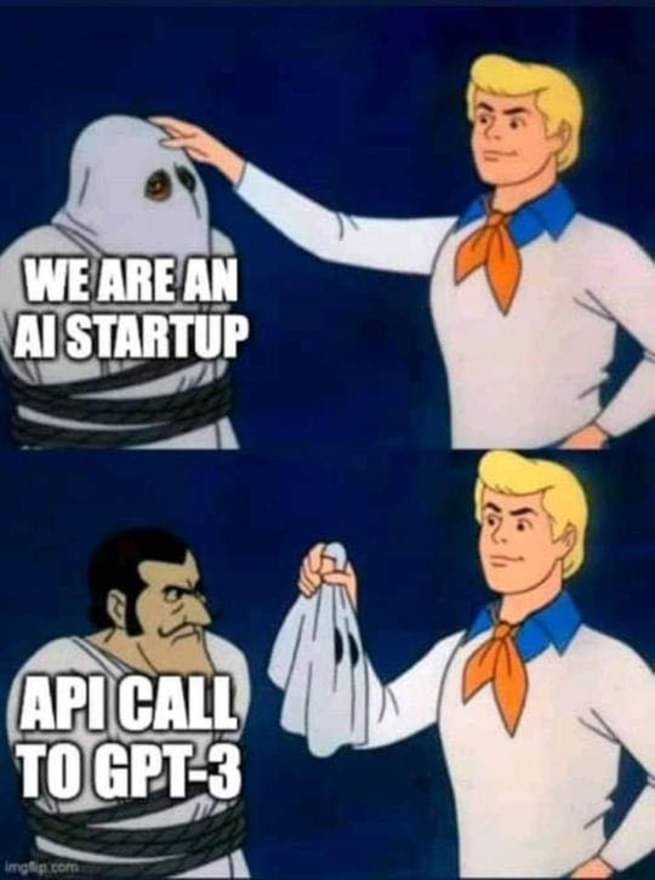
This AI-themed joke plays on the absurdity of a scary "startup" being just a computer program. A character named Shaggy claims to be a startup that terrifies people (top panel), but the reveal shows it is actually a string of code labeled "API CALL TO GPT-3" in the bottom panel.
simple-description (llama3.2-vision_11b)
The meme is a play on the classic "I can see your face" scene from the 1994 film "The Lion King." In this context, the image features a character from the movie, Simba, with a caption that reads "I can see your face" and is followed by a second image of a different character, with the caption "I can see your face too." The meme is a humorous take on the idea that even when you think you're hiding your true identity, you can still be recognized by those who know you well.
The meme is a commentary on the use of AI in the field of computer science. The image shows a character from the movie "The Lion King" with a caption that reads "I can see your face" and is followed by a second image of a different character, with the caption "I can see your face too." The meme is a humorous take on the idea that even when you think you're hiding your true identity, you can still be recognized by those who know you well.
The image shows a character from the movie "The Lion King" with a caption that reads "I can see your face" and is followed by a second image of a different character, with the caption "I can see your face too." The meme is a humorous take on the idea that even when you think you're hiding your true identity, you can still be recognized by those who know you well.
detailed-analysis (gemma3-27b-vision)
Okay, let's break down this meme through the lenses you've requested. It’s a “Scooby Doo” meme format, and its meaning is rooted in the current tech/AI landscape.
Visual Description
The meme uses the classic “Scooby Doo” reveal format. In the top panel, Fred (the blond, clean-cut leader of the Mystery Inc. gang) dramatically pulls off the mask of a monster. However, instead of revealing a grumpy old man in a costume, the "monster" is revealed to be…another slightly different grumpy looking man (with a mustache). The first panel's text reads "WE ARE AN AI STARTUP". The second panel's text states "API CALL TO GPT-3". The implication is that the supposedly groundbreaking or innovative “AI Startup” is actually just…a relatively simple reliance on a large language model like GPT-3. The visual emphasizes a gap between perceived complexity and actual implementation. The orange necktie Fred is wearing further emphasizes the aesthetic of a 1980s startup founder, highlighting the meme's contemporary tech context.
Foucauldian Genealogical Discourse Analysis
This meme brilliantly encapsulates the power dynamics that Foucault explored. The “AI Startup” (the proclaimed “monster”) claims a unique identity—innovation, complexity, the future of technology. However, the genealogical excavation (Fred ripping off the mask) reveals that its power isn’t inherent or original. It's derived – a “mask” constructed through reliance on a pre-existing tool – GPT-3.
- Discourse: The "AI Startup" participates in a discourse of innovation, claiming a position of authority and technical prowess.
- Power/Knowledge: The illusion of innovation is sustained by knowledge (or the performance of knowledge). The startup benefits from the perception of being a technologically advanced entity.
- Genealogy: The meme reveals the “genealogy” of this perception—the underlying reality that it's built on a borrowed foundation. The startup doesn't create the AI; it appropriates it. It's a historical tracing of the origins of this "innovation" revealing its derivative nature.
- Disciplinary Power: The meme subtly points to the "disciplinary" effect of this practice. The discourse of innovation incentivizes startups to appear cutting-edge, even if their core technology is simply leveraging existing models.
Critical Theory
Applying a broadly critical theoretical lens, the meme deconstructs the notion of technological advancement as purely progressive or inherently good.
- Ideology: The “AI Startup” represents a cultural ideology that equates technical complexity with value. The meme challenges this by demonstrating that the outward appearance of innovation doesn’t always equate to substantive development.
- Commodification: The reliance on GPT-3 exemplifies the commodification of AI. AI capabilities become a resource that can be purchased and used to create a façade of innovation. This shifts the focus from truly novel creation to skillful application of pre-existing technology.
- False Consciousness: The meme hints at a "false consciousness" within the tech world. The emphasis on “innovation” obscures the underlying reality of the industry – the reliance on a limited set of foundational technologies. It could suggest the "innovation" is simply marketing hype.
Marxist Conflict Theory
From a Marxist perspective, the meme underscores the power imbalances inherent in the tech industry.
- Means of Production: GPT-3 (developed by OpenAI) represents a key "means of production" in the AI space. Startups reliant on it are essentially dependent on OpenAI for their core functionality.
- Capital and Labor: The “AI Startup” can be seen as capitalizing on the labor embodied in GPT-3 (the massive dataset, the algorithm development, etc.). It's extracting value from this pre-existing resource without necessarily contributing significantly to its creation.
- Class Struggle: The meme implicitly highlights a form of "class struggle" within the tech world. Large companies like OpenAI control the foundational technologies, while smaller startups are forced to rely on them. The meme suggests a critique of this power dynamic.
Postmodernism
The meme is deeply postmodern in its meta-commentary and deconstruction of authenticity.
- Simulacra and Simulation: The “AI Startup” is arguably a simulacrum—an image or representation that replaces the real thing. It presents itself as an innovative entity, but its substance is borrowed from GPT-3. The “real” innovation (the creation of GPT-3) is obscured.
- Deconstruction: The meme actively “deconstructs” the myth of the groundbreaking AI startup. It reveals the underlying structure and demonstrates that the appearance of innovation is often illusory.
- Loss of Grand Narratives: The meme subtly undermines the “grand narrative” of technological progress. It suggests that innovation isn’t always a linear, forward-moving process; it’s often a repackaging or appropriation of existing technologies.
Queer Feminist Intersectional Analysis
While not immediately obvious, this meme can be subtly read through a queer feminist intersectional lens.
- De-centering the "Genius" Creator: The meme challenges the notion of the "lone genius" inventor. By revealing that the startup's core technology is reliant on GPT-3, it de-centers the startup founders and acknowledges the collective labor (and data) that underpin the system. This echoes feminist critiques of patriarchal systems that privilege individual achievement over collaborative efforts.
- Commodification of Labor/Data: GPT-3 is trained on a massive dataset, often scraping publicly available text data. This data, created by countless individuals, is often uncompensated and contributes to the platform's "intelligence". This can be linked to feminist concerns about the exploitation of emotional labor and the disproportionate burden placed on marginalized communities.
- Critique of "Disruption": The startup's attempt to appear innovative through reliance on GPT-3 can be seen as a form of "disruptive innovation" – a tech industry buzzword often used to justify displacing workers and dismantling existing systems. This resonates with queer feminist critiques of capitalist structures that prioritize profit over social justice.
In essence, the meme operates on multiple levels, offering a surprisingly rich commentary on the current state of the AI industry. It is a concise and clever critique of hype, dependence, and the illusion of innovation.
simple-description (llama3.2-vision)
This meme is a play on the classic "Scooby-Doo" trope where a character is unmasked to reveal a villain. In this case, the character is a "we are an AI startup" which is unmasked to reveal "I am a large language model I am capable of generating human-like text". The text "I am a large language model I am capable of generating human-like text" is a reference to the fact that the AI model is capable of generating human-like text, but is not actually a human.
tesseract-ocr
. pe | SS a Ly rE ad a ~d hy (eee a (Al =>—7 2h UF a Tet CTL —— ~ ANS