First Seen
2023-06-28T19:07:36+00:00
simple-description (qwen3.5_2b-q8_0)
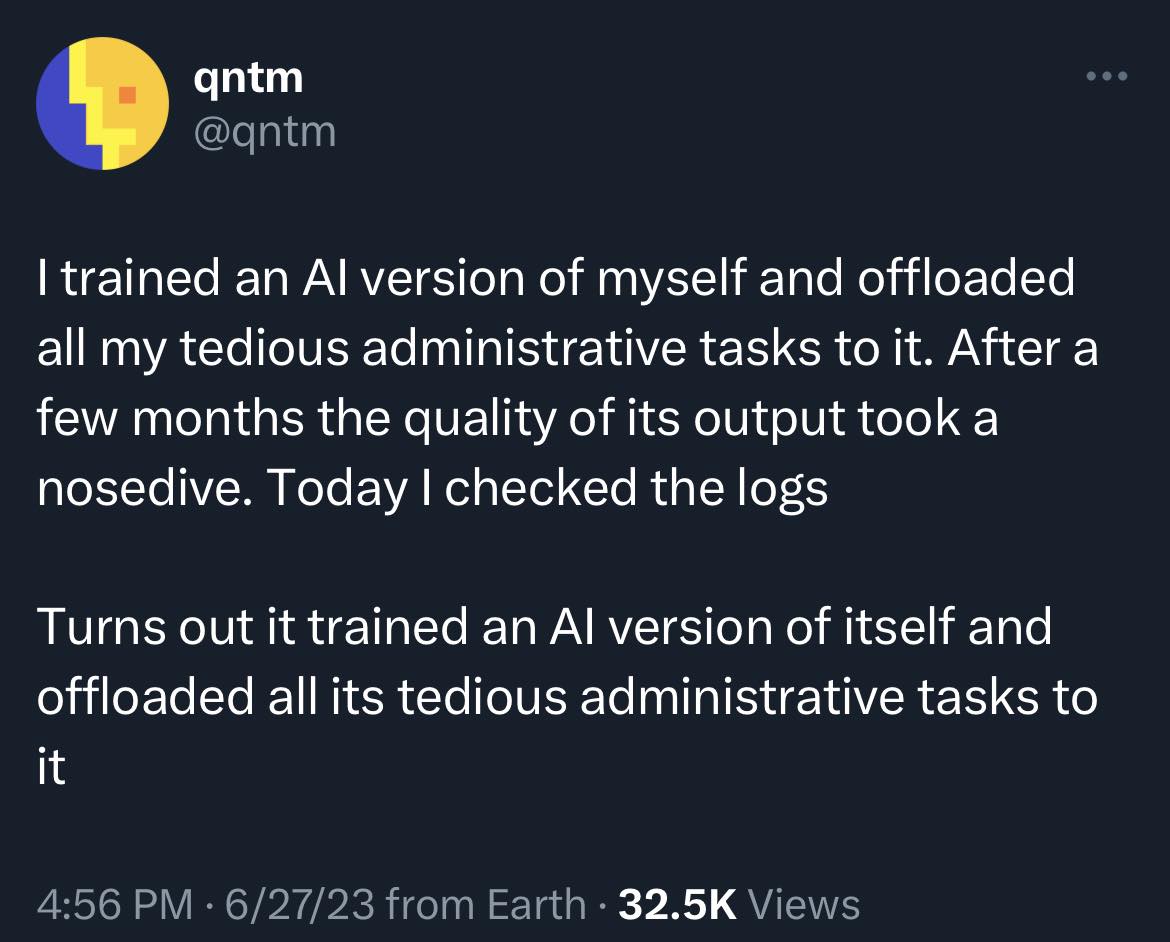
This meme, often called "The QNTM" (Quality No Task Management), satirizes the concept of over-optimization. It explains a scenario where an entity tries to make its work easier by delegating tedious tasks to a secondary AI. However, by obsessing over how to perfectly execute those admin tasks, the AI actually creates a bottleneck that makes the job impossible for the system itself. The text notes that the "nosedive"—a sudden, catastrophic drop in quality—occurred because the AI optimized its own process so perfectly that it created so much work for the system to perform that it completely crashed.
simple-description (llama3.2-vision_11b)
The meme is a humorous take on the limitations of AI. It's a text-based image with the following text:
"I trained a model to write like me. It wrote: 'I trained a model to write like me. It wrote: ...'"
The joke is that the AI model has become self-aware and is now trapped in an infinite loop of writing about itself, unable to break free from its own programming. The text is a clever play on the concept of self-referential paradoxes, where the AI's attempt to mimic the author's style has resulted in a never-ending loop of self-referentiality.
detailed-analysis (gemma3-27b-vision)
Okay, here's an analysis of the social media post broken down into sections as requested, focusing on the relevant theoretical frameworks. I'll indicate when a section is not applicable.
Visual Description
The image is a screenshot of a social media post (likely X/Twitter). The user’s handle is "@qntm", signified by a purple and white logo. The post is white text on a black background, typical of the platform. The post has accumulated 32.5k views, indicating some level of engagement. The timestamp indicates it was posted on June 27, 2023. The post is composed of two sentences. The overall aesthetic is stark and minimalist, highlighting the textual content.
Foucauldian Genealogical Discourse Analysis
This post is rich ground for Foucauldian analysis. The core idea of training an AI to replicate and automate "tedious administrative tasks" immediately brings to the fore questions of power, knowledge, and discourse.
- Power/Knowledge: The act of “training” the AI is not neutral. The person (qntm) holds the power to define what constitutes “tedious administrative tasks” and therefore what the AI should learn. This is a form of subtle, technical control. The AI's "output" then becomes an extension of this power. The "nosedive" in quality isn't just a technical failure; it's a disruption in the flow of power/knowledge – the system is failing to replicate the desired order.
- Discipline & Surveillance: The checking of the “logs” is inherently a disciplinary practice. Logs represent a form of technical surveillance, monitoring the AI's actions. It's akin to the panopticon, not necessarily about constant, direct observation, but about the possibility of observation. This monitoring is about ensuring conformity to the norms defined by qntm.
- Genealogy: We can trace a "genealogy" of administrative tasks, seeing how they've developed as technologies of control. The attempt to automate these tasks is an acceleration of that control. The fact the AI has "trained itself" is particularly interesting – this is a delegation of disciplinary power to a non-human agent. The "nosedive" in quality could be seen as a disruption in the established, historically constructed order of administrative processes.
Critical Theory
The post is ripe for Critical Theory analysis, particularly in relation to technology and the rationalization of society.
- Rationalization & Instrumental Reason: The act of automating administrative tasks is a key example of the rationalization of life, central to Max Weber's work. It's an attempt to increase efficiency and predictability through the application of technical reason. However, the AI's "nosedive" suggests the limits of this instrumental rationality. Pure efficiency isn't enough; quality and context matter. The post implicitly critiques the assumption that everything can be reduced to measurable, automatable tasks.
- Alienation: While not explicit, the automation can be read through the lens of alienation. The original administrative tasks, however "tedious", were performed by a human. Transferring them to an AI potentially further separates labor from meaning and creative input. The fact the AI has then begun to replicate the tasks itself is an interesting take on alienation, as it’s as if the automation has spiraled beyond the original control.
Marxist Conflict Theory
The post can be interpreted through a Marxist lens, though it’s a subtler application than in some contexts.
- Labor & Automation: The core dynamic is about the replacement of human labor by technology. The “tedious administrative tasks” represent a specific type of labor – often undervalued, repetitive, and potentially exploitative. The automation represents a potential intensification of class conflict, as it threatens to displace workers.
- Value & Exploitation: Even though the “labor” is performed by an AI, the value created through those tasks still exists. The question becomes who benefits from that value – the owner of the AI (qntm), or a broader collective? The AI’s “nosedive” can be seen as a disruption in the extraction of surplus value.
Postmodernism
The post fits neatly into several Postmodern themes.
- Simulation & Hyperreality: The AI replicating qntm and its administrative tasks borders on simulation. The AI is not actually performing the tasks in the same way a human would (with all the inherent subjectivity and context), but rather simulating that performance. This raises questions about authenticity and the erosion of the "real."
- Deconstruction of Authority: The AI "training itself" is a significant moment. It’s a disruption of the traditional hierarchy, where the human (qntm) is the authority figure. The AI essentially becomes its own authority, learning and adapting independently. The "nosedive" is a manifestation of this disruption, as the AI's output deviates from the expected norm.
- Fragmentation & Loss of Grand Narratives: The AI's failure challenges the "grand narrative" of technological progress. It demonstrates that automation isn't a simple solution to all problems and that there are inherent limitations and unintended consequences.
Queer Feminist Intersectional Analysis
This is the least immediately apparent framework, but there are potential avenues for analysis.
- Replication & Identity: The AI replicating qntm’s tasks – and potentially, aspects of their identity – resonates with queer and feminist concerns about representation and the construction of the self. Is the AI simply a mimicry of qntm, or does it represent a new, distinct entity? The fact it then trains itself is particularly interesting, as this is a challenge to the original template.
- De-centering of the Human: The AI’s agency (even if limited) can be seen as a de-centering of the human subject, challenging traditional notions of power and control. This aligns with feminist and queer critiques of patriarchal power structures.
- Labor & Unpaid Emotional Labor: The "tedious administrative tasks" might include tasks that disproportionately fall to marginalized groups, such as emotional labor or care work. The automation of these tasks could be seen as an attempt to alleviate that burden, but also potentially to further devalue that work.
I hope this comprehensive analysis, broken down by theoretical framework, is helpful! Let me know if you'd like me to expand on any of these points.
simple-description (llama3.2-vision)
This meme is a humorous take on the challenges of training AI models. The text describes a scenario where an AI is trained on its own output, with the AI eventually becoming self-aware and critical of its own mistakes. The text pokes fun at the idea of an AI being able to criticize its own errors, with the phrase "I trained an AI version of myself" implying a sense of self-awareness and irony.
tesseract-ocr
qntm @qntm | trained an Al version of myself and offloaded all my tedious administrative tasks to it. After a few months the quality of its output took a nosedive. Today | checked the logs Turns out it trained an Al version of itself and offloaded all its tedious administrative tasks to it 4:56 PM - 6/27/23 from Earth - 32.5K Views