First Seen
2024-01-20T01:07:59+00:00
simple-description (qwen3.5_2b-q8_0)
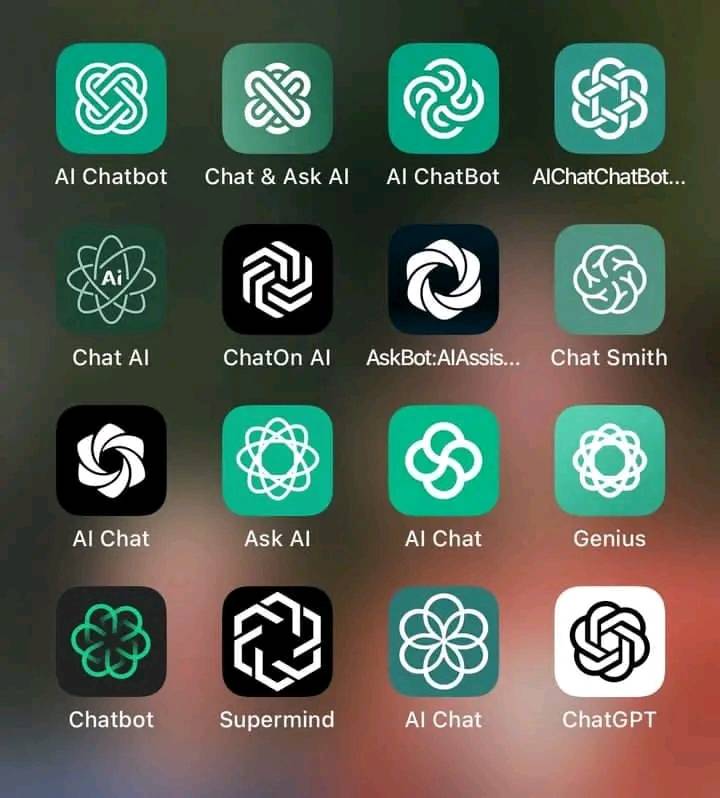
This image is a famous meme known as the "Supermind" (or "Chat Bot") pattern, which is a satirical take on Artificial Intelligence apps. It features a grid of identical icons that all look like a twisted knot, each labeled with a generic name like "ChatGPT," "Ask AI," or "ChatOn AI." The humor lies in the fact that every icon is the same app, pretending to be different technologies, which mocks the idea of a unified "Supermind" app.
simple-description (llama3.2-vision_11b)
The meme is an image of a chatbot interface with a "404" error message, implying that the chatbot is unable to understand or respond to user input. The text in the image reads "I can explain it better than a chatbot" and features a screenshot of a chatbot interface with a "404" error message. This meme is poking fun at the limitations of AI chatbots and their inability to provide accurate or helpful responses.
detailed-analysis (gemma3-27b-vision)
Okay, let's break down this collection of app icons using the lenses you've requested. It's important to note that these are interpretations, and the icons themselves are relatively abstract. The analysis will lean heavily on the symbolic meaning of the imagery and the naming conventions, connecting them to the theoretical frameworks.
I. Visual Description
The image shows a grid of 16 app icons, all centered on themes related to artificial intelligence (AI) and chatbots. The icons are consistently stylized:
- Color Palette: Predominantly dark backgrounds (black/navy) with bright, neon-like greens, blues, and whites used for the swirling, interconnected lines that form the design. This suggests a technological, digital aesthetic.
- Iconography: The imagery is abstract, but generally depicts swirling, interlocking loops, nodes, or circular arrangements. These designs evoke ideas of networking, connection, processing, and possibly complexity or infinity. Some icons incorporate a stylized "AI" or chatbot-related symbol.
- Consistency & Variation: There’s a unified aesthetic across the icons, but variations exist in the number of loops, the arrangement of elements, and the specific shapes/lines used. This suggests a common base (the AI theme) with individual branding/features.
- Text Labels: Each icon has a corresponding text label identifying the app name (e.g., "AI Chatbot," "Chat On AI", "Chat GPT").
II. Foucauldian Genealogical Discourse Analysis
A Foucauldian approach would focus on how the discourse around AI and chatbots shapes our understanding of intelligence, communication, and even ourselves.
- Power/Knowledge: The icons represent a new form of “knowledge” – the purported intelligence of machines. The very labeling ("AI Chatbot," "Genius") establishes a power dynamic. These apps claim knowledge and intelligence, positioning themselves as authorities. This power is reinforced by the very act of labeling – defining what constitutes "intelligence" in the digital age.
- Disciplinary Practices: These apps can be seen as tools of "disciplinary power" (Foucault). They shape our communication practices (how we ask questions, how we receive answers), potentially normalizing certain forms of interaction and suppressing others. They implicitly teach us how to interface with AI, conforming us to its logic.
- Genealogy: A genealogical tracing of the term "chatbot" reveals a historical evolution from simple rule-based programs to the complex neural networks of today. This tracing would demonstrate how the definition of a chatbot, and its associated power, has been constructed and changed over time. The icon grid represents the current stage of this genealogy, a moment where AI is heavily branded and marketed.
- Normalisation: These apps normalize the idea of conversing with machines, blurring the lines between human and artificial intelligence. Over time, this could lead to a shift in our understanding of consciousness and communication.
III. Critical Theory (Frankfurt School)
A Critical Theory lens, particularly influenced by the Frankfurt School, would view these icons as manifestations of a broader societal phenomenon – the instrumentalization of reason and the “colonization of the life world.”
- Instrumental Reason: The icons represent a reduction of intelligence and communication to a purely instrumental function—solving problems, providing information, or offering entertainment. The focus is on what the AI can do, not on the meaning or ethics of its actions.
- Commodification of Communication: The icons indicate that communication itself has become a commodity. These apps are not simply tools for connecting people; they are products to be bought and sold. The emphasis is on consumption rather than genuine exchange.
- Loss of Authenticity: The "chatbots" are simulations of human conversation. This simulation could contribute to a broader loss of authenticity and a decline in the quality of human interaction.
- Domination and Control: The apps, as technologies developed within capitalist structures, are not neutral. They contribute to existing power imbalances and reinforce systems of domination and control.
IV. Marxist Conflict Theory
A Marxist perspective would highlight the material conditions underlying the creation and distribution of these apps.
- Means of Production: The apps are products of concentrated capital and technological expertise. A small number of companies control the means of production (the servers, the algorithms, the data) that enable these technologies.
- Class Struggle: The benefits of these apps (efficiency, convenience) may accrue primarily to the capitalist class, while the working class may face job displacement or increased surveillance.
- Alienation: The reliance on AI-driven communication could contribute to alienation, as individuals become increasingly detached from genuine human connection.
- Ideology: The branding of these apps ("Genius," "Supermind") reinforces the ideology that technology can solve all problems, masking the underlying social and economic inequalities.
V. Postmodernism
A postmodern lens would emphasize the deconstruction of established categories and the fluidity of meaning.
- Simulacra and Simulation: The chatbots themselves are simulacra – copies without originals. They simulate human conversation, but they are not authentic. The icons represent this simulation, blurring the line between reality and representation.
- Deconstruction of Intelligence: The very term "intelligence" is deconstructed by these apps. What does it mean to be intelligent? Can a machine truly "think"? The icons challenge these assumptions.
- Fragmentation of Meaning: The sheer number of similar apps (the grid itself) suggests a fragmentation of meaning. There is no single, definitive “AI Chatbot”; there are many competing versions, each with its own specific features and branding.
- Hyperreality: The app icons and their marketing contribute to a hyperreality – a state in which simulations have become more real than reality.
VI. Queer Feminist Intersectional Analysis
This analysis focuses on how these technologies can reinforce or challenge existing power structures related to gender, sexuality, and other intersecting identities.
- Bias in Algorithms: AI algorithms are trained on data, and that data often reflects existing social biases. This can lead to chatbots that perpetuate harmful stereotypes based on gender, race, or other identities. The app icons, in their neutral design, mask these underlying biases.
- Reinforcement of Gender Roles: If chatbots are primarily designed to respond to certain types of queries or to adopt certain personas, they may reinforce traditional gender roles. For example, a chatbot designed to be a “helpful assistant” may reinforce the stereotype of women as caregivers.
- Surveillance and Data Extraction: The data collected by these apps can be used for surveillance and control, disproportionately affecting marginalized communities.
- Lack of Representation: The development of AI technologies is often dominated by men. This lack of diversity can lead to products that do not adequately address the needs of women or other marginalized groups.
Important Note: This is a multi-layered analysis, and the interpretations are open to debate. The meaning of the icons and apps is subjective and dependent on the context in which they are viewed.
tesseract-ocr
AlChatbot Chat & es Al AlChatBot AlChatChatBot... a nn @) oC © lela ChatOn Al AskBot:AlAssis... Chat Smith a SS Co) Al Chat & Ask Al PNMeliris Genius , ay OD Rep eA fel lieleya Supermind Al a eLelaa
simple-description (llama3.2-vision)
The meme is a screenshot of the DALL-E Mini app on an iPhone, displaying a list of AI chatbot names. The list includes "AI Chatbot", "AI Assistant", "AI Companion", "AI Friend", and "AI Buddy".