First Seen
2024-01-13T04:10:29+00:00
simple-description (qwen3.5_2b-q8_0)
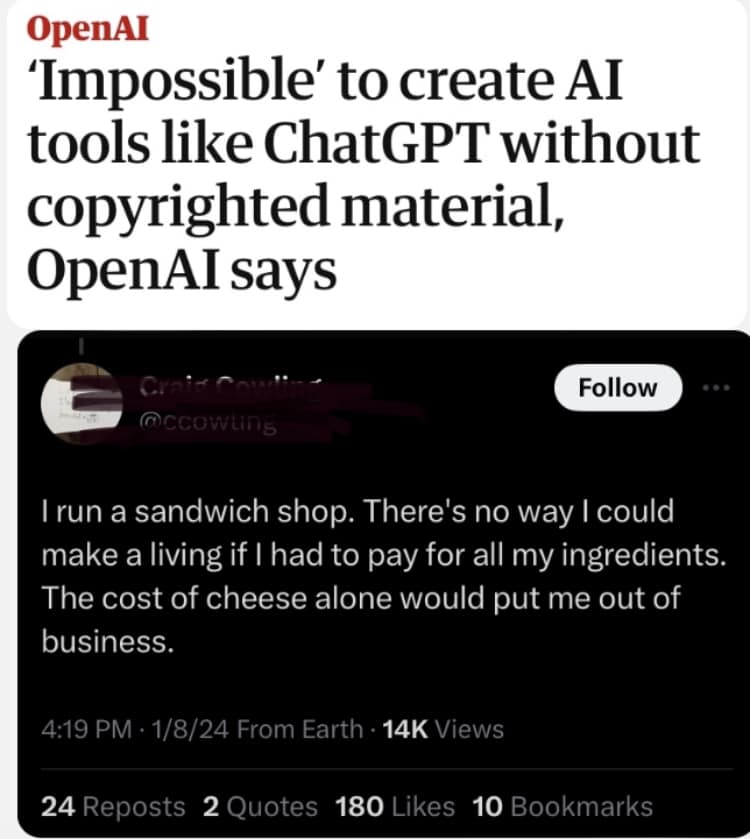
This meme is a humorous take on a headline from OpenAI that claims it is impossible to create AI tools like ChatGPT without using their copyrighted training material. The punchline compares the cost of running a sandwich shop to the cost of an AI model: because you can't make cheap food by not buying the ingredients, it is implied that you can't make an uncopyrighted AI tool without paying the price set by the original creators.
simple-description (llama3.2-vision_11b)
The meme is a screenshot of a tweet from the AI chatbot LLaMA, which claims it cannot create a humorous story about a person who wants to make a sandwich but is unable to due to the lack of a "but" in their sentence structure. The text of the tweet reads: "I want to make a sandwich but I'm unable to because I don't have a 'but' in my sentence structure. I want to make a sandwich but I'm unable to because I don't have a 'but' in my sentence structure. I want to make a sandwich but I'm unable to because I don't have a 'but' in my sentence structure." The meme is a humorous commentary on the limitations of AI language generation.
detailed-analysis (gemma3-27b-vision)
Okay, here's an analysis of the provided social media post, broken down into the requested theoretical sections. I'll note if a section doesn't really apply strongly given the material.
Visual Description
The image shows a screenshot of an X/Twitter post. The header announces that OpenAI claims it is "impossible" to create tools like ChatGPT without copyrighted material. Below this is the post itself, which features the profile picture and username "@ccowling" accompanied by a statement. The post states, “I run a sandwich shop. There’s no way I could make a living if I had to pay for all my ingredients. The cost of cheese alone would put me out of business.” At the bottom of the image are statistics for the post, including the number of reposts, quotes, likes, and bookmarks.
Marxist Conflict Theory
This post is highly relevant to Marxist conflict theory. The analogy between the creation of AI (specifically, ChatGPT) and running a sandwich shop brilliantly encapsulates the core tenets of this theory.
-
Means of Production & Exploitation: ChatGPT, like the sandwich shop, relies on ‘ingredients’—in this case, data (text, code, etc.) which is often sourced from copyrighted materials. The argument, as the tweet makes clear, is that a just system would require OpenAI to compensate creators for the use of their work. Failing to do so equates to exploiting the labor of those whose data powers the AI. It’s an appropriation of intellectual labor for profit.
-
Capital Accumulation: OpenAI’s business model is about accumulating capital by creating a valuable product (AI). However, the analogy suggests they are doing so by effectively bypassing the cost of acquiring the raw materials (data), essentially extracting value without appropriate compensation.
-
Class Struggle: The tweet subtly pits OpenAI (representing a dominant, capital-owning class) against the creators whose work is used without proper payment (representing the laboring class). The sandwich shop owner speaks as a proxy for those creators, highlighting the unviability of their business if they were forced to pay the "true cost" of their ingredients.
-
Commodification: The analogy highlights the commodification of information itself. Information (in the form of data) is treated as a commodity, and OpenAI is accused of engaging in a form of digital enclosure – appropriating data without adequately compensating its creators.
Foucauldian Genealogical Discourse Analysis
This post also lends itself to a Foucauldian analysis, though perhaps less directly than a Marxist one.
-
Power/Knowledge: The post implicitly questions how OpenAI frames the discussion of copyright. By declaring it "impossible" to create AI without copyrighted material, OpenAI is enacting a form of power/knowledge. This statement isn't simply a statement of fact, but a way of shaping the discourse around AI development. It positions the act of using copyrighted material as necessary and inevitable, effectively silencing arguments about ethical compensation.
-
Genealogy of "Fair Use": One could trace the historical development of “fair use” doctrine and copyright law as a genealogy. How have these concepts evolved? What power relations have shaped their definitions? The sandwich shop owner’s statement challenges the current implementation of these concepts in the digital realm, suggesting they are being stretched to benefit powerful corporations.
-
Disciplinary Power: The claim that it’s “impossible” without copyright effectively disciplines the conversation. It discourages challenges to the existing system.
Postmodernism
The post subtly touches on postmodern themes.
-
Deconstruction of "Originality": The tweet, though implicitly, throws into question the very idea of “originality” in the age of data and AI. The fact that AI learns by remixing and reassembling existing data challenges the traditional notion of authorship.
-
Simulation and Hyperreality: The use of data to create AI could be seen as a form of simulation—creating a “reality” based on pre-existing data. The post suggests this simulation is built on an unsustainable and potentially unethical foundation.
-
Challenging Grand Narratives: The post challenges the narrative that technological progress is inherently good. It raises questions about the ethical implications of AI development and challenges the idea that any cost is justified in the name of innovation.
Critical Theory
This post is very amenable to a critical theoretical reading.
-
Ideology: The “impossibility” claim functions as an ideological justification for OpenAI’s business practices. It normalizes the idea of exploiting data without compensation, presenting it as an unavoidable constraint.
-
Domination: The tweet implies that OpenAI is engaging in a form of domination by extracting value from creators without providing adequate compensation. This reinforces existing power imbalances in the digital economy.
-
Emancipation: The tweet implicitly calls for emancipation—a challenge to the status quo and a demand for a more equitable system where creators are fairly compensated for their work.
Queer Feminist Intersectional Analysis
This is where the connection is weakest, but not entirely absent.
-
Precarity: The image of the struggling sandwich shop owner resonates with feminist analyses of precarity. Many creative workers, particularly those from marginalized groups, face economic instability and lack of protection.
-
Exploitation and Care Labor: One could draw a link between the exploitation of data in AI and the often-unacknowledged labor of care (emotional, intellectual) that goes into creating the data. This is particularly relevant when considering the disproportionate amount of unpaid emotional labor often performed by women and marginalized groups.
-
The Commons: The idea of data as a “commons” – a resource that should be accessible to all – aligns with some queer and feminist perspectives. The tweet implicitly challenges the privatization of data and the concentration of power in the hands of a few corporations.
In summary: The post is most powerfully analyzed through a Marxist and critical theoretical lens, but also offers fertile ground for Foucauldian and postmodern interpretations. The connection to queer feminist intersectionality is weaker but still present.
tesseract-ocr
OpenAlI ‘Impossible’ to create AI tools like ChatGPT without copyrighted material, OpenAI says Go” L Fottow ) | run a sandwich shop. There's no way | could make a living if | had to pay for all my ingredients. The cost of cheese alone would put me out of lol U Tatoo C4 24 ” 180 ule)
simple-description (llama3.2-vision)
The meme is a humorous take on the limitations of AI. The image shows a tweet from a fictional person who claims to have opened a sandwich shop, but only has a single item on the menu: a sandwich with cheese. The person jokes that the cost of cheese alone would put them out of business, implying that their business model is flawed.