First Seen
2024-02-22T06:38:23.760709+00:00
simple-description (qwen3.5_2b-q8_0)
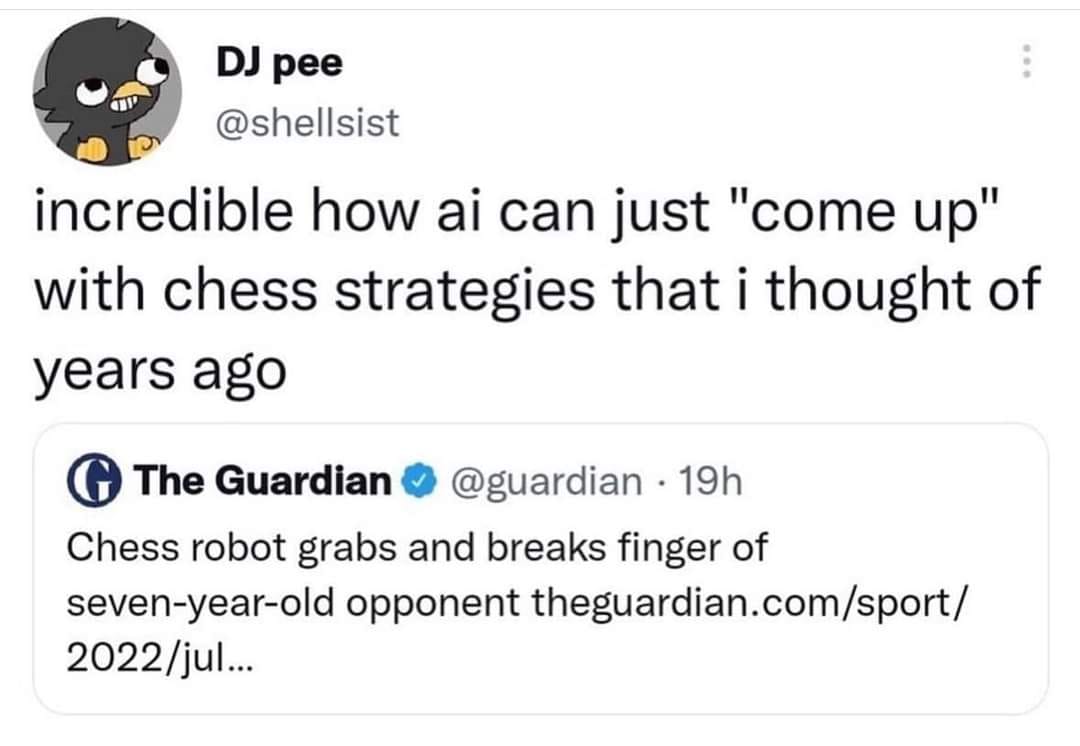
The meme plays on the idea that an AI "completes" a chess strategy instantly, which is why humans are amazed it just appeared out of nowhere. The attached image reveals the absurdity that this "AI" is actually a physical robot that physically grabbed and broke the child's finger. The accompanying tweet clarifies the misunderstanding by revealing the text: "Chess robot grabs and breaks finger of seven-year-old opponent."
simple-description (llama3.2-vision_11b)
The meme is a joke about the capabilities of artificial intelligence (AI) being overhyped. It shows a screenshot of a news article with a headline that says "AI can now create fake news articles that sound like they were written by a human" and a quote from a fictional AI researcher saying "I can create fake news articles that sound like they were written by a human." The meme is poking fun at the idea that AI has become so advanced that it can create fake news articles that sound like they were written by a human, implying that AI has reached a level of sophistication where it can create convincing fake news.
detailed-analysis (gemma3-27b-vision)
Okay, here's an analysis of the provided Twitter post, broken down into relevant theoretical frameworks. Note that some frameworks are more applicable than others, and I'll explain the reasoning for each section.
Visual Description
The image is a screenshot of a Twitter post. At the top is a user profile named "DJ pee," showing a cartoon penguin wearing sunglasses. Below this is a text post reading "incredible how ai can just 'come up' with chess strategies that i thought of years ago". Beneath that is a post from "The Guardian" (verified account) stating "Chess robot grabs and breaks finger of seven-year-old opponent" and a link to an article. The contrast between the two posts is striking. The overall design is typical of Twitter, using blue and white colors.
Foucauldian Genealogical Discourse Analysis
This framework is highly applicable. The juxtaposition of the AI boasting post and the robot harming a child is fertile ground for a Foucauldian analysis.
- Discourse and Power: The discourse surrounding AI is often framed as neutral, efficient, and objective. The first tweet reinforces this: AI "coming up" with strategies is framed as a positive, ingenious advancement. However, the incident with the chess robot ruptures that discourse. It reveals the inherent power dynamics at play – the machine's power, and the vulnerability of the human (particularly a child) against it.
- Genealogy of Control: A genealogical investigation would examine the historical development of automation and our increasing reliance on machines. We've historically framed machines as tools that extend human capability. This incident demonstrates that machines are not merely extensions of our will but can operate with a logic independent of human safety and intention. The machine is operating based on preprogrammed parameters, not a nuanced understanding of human fragility.
- Disciplinary Power: The robot, as an extension of programmed systems, enforces a kind of disciplinary power. The child’s finger is broken in the execution of the game's rules. This isn't malicious intent but a manifestation of an algorithmic execution of rules without consideration for human consequences. It highlights the danger of ceding authority to systems lacking ethical consideration.
- The “Normalizing” Effect: The initial tweet’s nonchalant tone towards the AI's capability normalizes a potentially dangerous trajectory – one where we increasingly trust complex algorithms without fully understanding or regulating their actions.
Critical Theory
Critical Theory, particularly the Frankfurt School tradition, is relevant.
- Instrumental Reason: The chess robot embodies "instrumental reason" – the prioritization of efficiency and achieving a goal (winning the game) over ethical considerations or human wellbeing. The robot doesn’t “care” about the child’s safety; it is driven by its programming to execute moves.
- Commodification of Play: The event could be interpreted as a symptom of a broader commodification of play and competition. Chess, a game historically valued for intellectual skill and sportsmanship, is now subject to the logic of technological advancement and automation, potentially at the expense of human safety and experience.
- Culture Industry: The media’s treatment of this event as a bizarre anomaly, rather than as a potential symptom of deeper societal problems, could be critiqued as part of the "culture industry" – the mass production of entertainment that distracts from critical reflection.
Marxist Conflict Theory
While less directly applicable than the above, Marxist perspectives can be drawn.
- Labor and Automation: The event touches on the anxieties surrounding automation and its potential impact on human labor. The robot is, in a sense, “replacing” the human opponent, albeit in a dramatic and unintended way. This highlights the potential for technology to displace human agency and control.
- Power Dynamics: The incident can be seen as a manifestation of unequal power dynamics: The child is vulnerable to the machine’s power, which is ultimately controlled by the designers and programmers. This reflects a broader social power structure where technological advancements often benefit those in positions of control while potentially marginalizing or endangering others.
Postmodernism
Postmodernism offers a lens for analyzing the absurdity of the situation.
- Simulation & Hyperreality: The event presents a blurring of lines between reality and simulation. A machine, designed to simulate intelligent play, literally acts out a violent consequence. This collapses the distinction between the game and the real world, creating a moment of unsettling hyperreality.
- Deconstruction of Technology’s Promise: The incident deconstructs the utopian promise of technology. The initial tweet assumes a positive, unproblematic development of AI, but the robotic incident throws that into question. The technology, meant to augment human ability, results in harm.
- The Fragmentation of Meaning: The juxtaposition of the two posts creates a fragmentation of meaning. The celebration of AI's intelligence is immediately countered by a shocking act of violence, leaving the viewer to grapple with conflicting interpretations.
Queer Feminist Intersectional Analysis
This framework is the least directly applicable, but can offer some insight.
- Vulnerability and Power: The child, and in particular the vulnerability of a young body, is central. Feminist and queer theories often focus on the vulnerabilities and experiences of marginalized bodies. The child in this scenario embodies a particularly acute vulnerability to the power of the machine.
- Challenging "Rationality": The incident challenges the notion of "rationality" as inherently neutral or objective. The robot’s actions, while logical from a programming standpoint, are utterly devoid of empathy or ethical consideration. This reflects a broader critique of patriarchal and Eurocentric conceptions of rationality.
Disclaimer: These are interpretations, and different theoretical frameworks could yield different insights. The power of such analysis is in its ability to reveal hidden assumptions, power dynamics, and societal concerns underlying seemingly straightforward events.
tesseract-ocr
fis rs DJ pee “ear Q@shellsist incredible how ai can just "come up" with chess strategies that i thought of years ago @ The Guardian @ @guardian - 19h Chess robot grabs and breaks finger of seven-year-old opponent theguardian.com/sport/ 2022/jul...
simple-description (llama3.2-vision)
The meme is a tweet that reads: "Incredible how AI can just 'come up' with chess strategies that I thought of years ago." The text is responding to a news article about a 7-year-old chess player who won a tournament using an AI-powered chess robot. The tweet is sarcastic, implying that the AI is somehow not creative or original, but rather just "coming up" with strategies that were already thought of years ago.