First Seen
2025-05-06T21:12:27.645712+00:00
simple-description (qwen3.5_2b-q8_0)
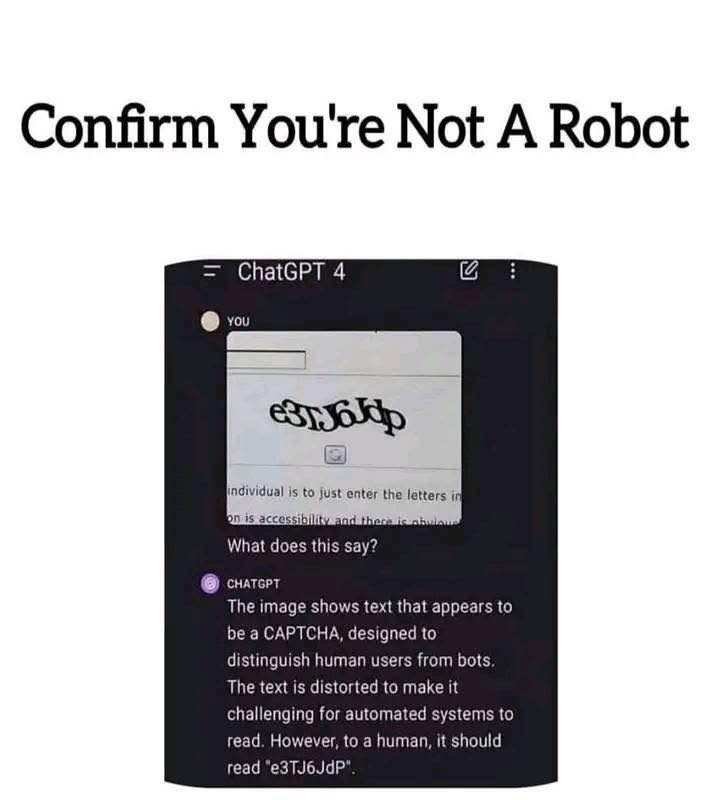
This AI meme humorously illustrates a system failing to recognize a visual puzzle. The text inside the image displays a "ChatGPT 4" response that identifies the scrambled letters "e3TJ6JdP" as a CAPTCHA, explaining that while a human can read it, the AI cannot decode it.
detailed-analysis (gemma3_27b-it-q8_0)
Okay, let's break down this meme from the perspective of Artificial Intelligence, utilizing the requested analytical frameworks where relevant.
Overall Context: This meme playfully highlights the irony of AI systems (like the one displaying the image, ChatGPT itself) being asked to prove they aren't AI. It touches on the fundamental challenge of defining intelligence, the limitations of current AI assessment methods, and the increasing sophistication of AI that can potentially circumvent those methods.
1. Visual Description
The image shows a screenshot of a conversation within ChatGPT. The "YOU" part of the exchange shows what appears to be a CAPTCHA challenge presented within the AI interface itself. The CAPTCHA text is intentionally distorted – appearing as "e3TJ6JdP" rather than legible characters – and the text is intended for humans to recognize and enter, proving they are not bots. Below, the "CHATGPT" response explains the scenario. The visual juxtaposition is the core of the humor: An AI questioning (in a way) its own nature.
2. Foucauldian Genealogical Discourse Analysis
This meme subtly touches on Foucault's ideas regarding power, knowledge, and discourse.
- The CAPTCHA as Discipline: The CAPTCHA itself is a form of disciplinary power. It establishes a binary – human/machine – and enforces a rule: “Prove you are human by performing this task.” This is a demonstration of “surveillance” as it monitors and categorizes users. It defines what counts as "human" in the digital realm through a specific (and often frustrating) test. The “normalizing gaze” of the CAPTCHA shapes behavior, forcing conformity to a particular set of perceptual abilities.
- The Shifting Definition of ‘Human’: The meme highlights that what constitutes “proof” of humanity is constantly shifting because AI is evolving. What once reliably separated humans from machines (like simple pattern recognition) is becoming less effective. This calls into question the discourse around “human intelligence” – a discourse historically used to justify hierarchies and exclusions.
- Genealogy of the Human/Machine Divide: The meme implicitly asks us to consider how the very idea of the human/machine divide was constructed. It wasn’t a naturally occurring division; it’s a product of historical development, scientific inquiry, and cultural anxieties.
3. Critical Theory
Critical Theory offers several relevant points.
- Technological Rationality: The CAPTCHA embodies a form of "instrumental reason" (Horkheimer and Adorno). It's a tool designed for a specific purpose (to filter bots) without questioning the broader implications of that purpose. The underlying assumption is that maximizing efficiency (blocking bots) is inherently good, without considering the impact on accessibility, privacy, or the very definition of what it means to be online.
- Commodification of Attention: CAPTCHAs, while ostensibly security measures, also contribute to the "attention economy." They are a form of unpaid labor – humans providing free processing power to train AI (by correctly identifying images, for example). The meme implicitly critiques this exploitation.
- The Illusion of Control: The meme suggests that the belief we have control over defining what is ‘human’ and ‘not human’ is an illusion. AI is challenging the assumptions underlying our definitions.
4. Postmodernism
- Deconstruction of the Binary: The meme fundamentally deconstructs the clear-cut binary of human/machine. By having an AI “administer” a test to prove it’s not an AI, it blurs the boundaries and highlights the instability of the categories themselves. The very act of questioning its own status undermines the foundational assumptions of the binary.
- Simulacra and Simulation: The distorted CAPTCHA could be seen as a “simulacrum” (Baudrillard) – a copy without an original. The CAPTCHA is designed to represent a test of human perception, but it has become so abstracted and distorted that it’s increasingly divorced from any real-world perceptual experience. It’s a simulation of a test of humanity.
- Meta-Narrative Breakdown: Postmodernism critiques grand narratives, like the idea of a clear path toward technological progress. This meme gently mocks the confidence that technology can easily solve complex issues like identifying bots, highlighting the messiness and contradictions of the technological landscape.
5. Marxist Conflict Theory
While less directly applicable, a Marxist lens can be used.
- Capital and Labor: The "labor" of solving CAPTCHAs is provided by humans, often for free, to benefit capital (corporations seeking to protect their platforms from bots). This is an example of extracting surplus value from human interaction.
- Class and Access: The difficulty of CAPTCHAs can disproportionately impact individuals with disabilities or limited digital literacy, creating a barrier to access and participation in online spaces. This can be seen as an issue of class and access, furthering the divide between those who can easily navigate the digital world and those who cannot.
In Conclusion:
The meme is a deceptively simple piece of humor that cuts to the core of many complex issues surrounding AI, identity, and the digital world. It effectively uses irony to expose the limitations of current AI assessment methods and to challenge our assumptions about what it means to be human in an age of increasingly sophisticated machines. From the perspective of AI as a field, it's a playful acknowledgment of the ongoing, and likely never-ending, game of cat and mouse between those building the machines and those trying to distinguish them from us.
simple-description (llama3.2-vision_11b)
The meme is a screenshot of a conversation between a user and an AI chatbot, where the user asks "Am I a human or a robot?" The AI responds with a humorous and ironic answer, saying "You are not a human." The image is captioned "Confirm you're not a robot" which is a common prompt used in online forms to verify that users are indeed humans and not bots.
detailed-analysis (gemma3-27b-vision)
Okay, here’s an analysis of the image using the requested theoretical lenses. I'll only include sections where the theory significantly applies.
Visual Description
The image is a screenshot of a ChatGPT interface. A distorted CAPTCHA image is displayed within a message window. The distortion involves warping, wavy lines, and slight blurring of the letters. A text box below the image states, "individual is to just enter the letters in on is accessibility and there is obvious". Below this, ChatGPT provides its own analysis: "The text shows what appears to be a CAPTCHA, designed to distinguish human users from bots. The text is distorted to make it challenging for automated systems to read. However, to a human, it should read “e3TJ6JdP”."
Foucauldian Genealogical Discourse Analysis
This image powerfully illustrates a discursive regime of control related to authentication and defining the "human" in a digital space.
- Genealogy: The CAPTCHA isn’t a neutral tool but a historical development born out of a need to control access to digital resources. It emerged alongside the rise of automated bots and a fear of their disrupting online systems. We can trace its lineage through earlier authentication methods (passwords, etc.) and see it as a response to specific technological and socio-economic problems.
- Discipline & Surveillance: The CAPTCHA functions as a panoptic device, creating a sense of constant monitoring. It assumes users are potentially not human (bots) and requires them to prove their humanity through a specific task. This "proving" is a disciplinary practice, aligning the user with a specific, defined category (human).
- Power/Knowledge: The ability to define what constitutes "human" (i.e., someone who can solve a visual puzzle) resides with the designers of the CAPTCHA, granting them a power over access and inclusion. This is power built on a specific regime of truth about human cognitive abilities. The CAPTCHA doesn’t simply verify identity, it actively constructs the very notion of what it means to be a user with legitimate access.
Critical Theory
The image directly engages with questions central to Critical Theory: technology as ideology and the construction of the self.
- Instrumental Rationality: The CAPTCHA exemplifies the application of instrumental rationality – a means-to-an-end logic focused solely on efficiency. The goal is not to understand who a user is but to filter them based on a specific test. This focus on efficiency potentially obscures broader questions about digital access, equity, and the social implications of automation.
- Domination & Control: The CAPTCHA isn't just a technical hurdle; it's a tool that exercises control over access. It subtly reinforces the idea that control and surveillance are necessary to maintain the online world, and individuals must submit to these systems in order to participate.
- Reification: The image demonstrates how abstract ideas (like "humanity" or "authenticity") become concretized in a specific technological form (the CAPTCHA). This reification can mask the underlying social and political forces at play, making it seem as if the CAPTCHA is a neutral technical solution rather than a culturally-and-politically-shaped one.
Postmodernism
The image highlights key postmodern themes: the instability of identity, the blurring of boundaries, and the proliferation of simulations.
- The Death of the Subject: The CAPTCHA challenges the notion of a stable, coherent self. It forces the user to perform their “humanity” rather than simply being human. This performance is contingent upon successfully solving the puzzle, raising questions about whether the identity being verified is “authentic” or merely a constructed performance.
- Simulacra & Simulation: The CAPTCHA is a simulation of cognitive ability. It doesn't necessarily assess genuine intelligence or understanding; it simply measures the ability to decode a distorted visual pattern. This blurring of the real and the simulated is central to postmodern thought.
- Deconstruction of Meaning: The distortion of the CAPTCHA letters deconstructs the conventional notion of readability and communication. Meaning isn't inherent in the letters themselves; it's constructed through the process of decoding and interpretation.
Let me know if you'd like me to elaborate on any of these sections or explore additional theoretical perspectives!
simple-description (llama3.2-vision)
This meme is a humorous take on the AI chatbot's inability to understand the concept of sarcasm. The image shows a chatbot's response to a user's statement "I am not a robot" with a cheeky remark "Confirm you're not a robot" followed by a button to click.