First Seen
2025-06-01T19:18:07.533284+00:00
simple-description (qwen3.5_2b-q8_0)
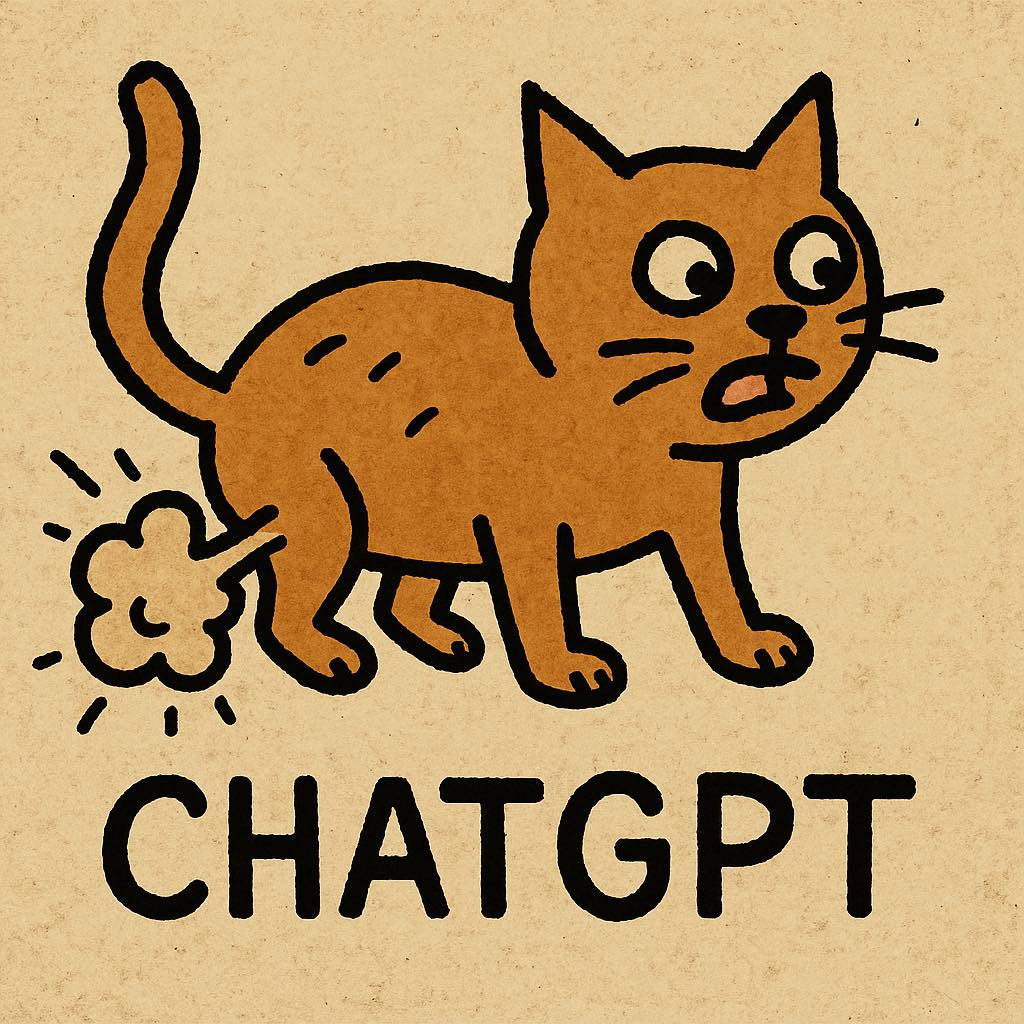
This image features a cartoon orange cat with a shocked expression, depicted pooping out of its rear end. At the bottom, the word "CHATGPT" is written in bold, black text, humorously associating the AI model with the animal's gross action.
detailed-analysis (gemma3_27b-it-q8_0)
Okay, let's break down this meme about ChatGPT from the perspective of Artificial Intelligence and using the requested critical lenses. It's a surprisingly rich image for such a simple drawing!
Visual Description
The image depicts a cartoon, orange cat in a state of apparent distress. Its eyes are wide with surprise/alarm, its mouth is open in a small 'o' shape, and its tail is erect. Coming from its rear is a cartoon depiction of a "hairball" (or something resembling it). Underneath the image is the text “CHATGPT” in a bold, sans-serif font. The backdrop appears to be a textured, aged paper, suggesting a hand-drawn, lo-fi aesthetic. The overall style is deliberately simple and somewhat crude, adding to the humorous effect.
Critical Theory
This meme directly references a core tenet of Critical Theory, specifically concerning instrumental reason. Critical theorists like Max Horkheimer and Theodor Adorno argued that the Enlightenment's emphasis on reason, when translated into purely technical and instrumental logic (like that of AI), could actually become oppressive. The meme is a satirical illustration of this.
- The Cat as Embodiment of "Natural" Language: The cat, as a creature acting on instinct, represents a more "natural" form of communication. The "hairball" represents what happens when that natural system malfunctions or has to eject something unwanted.
- ChatGPT as Instrumental Reason: ChatGPT embodies the promise and the limitations of AI. It’s a system built to produce 'reasoned' output based on data, but it can often produce illogical, repetitive, or nonsensical responses (the “hairball”). The meme points to the potential for AI to “throw up” things that are harmful, misleading, or simply meaningless, even while pretending to be intelligent.
- The Disenchantment of Language: Critical Theory also critiques the idea of progress as leading to a perfectly rational world. The meme suggests that even attempts to rationalize and systematize language (as ChatGPT does) are prone to disruption and failure. There is an inherent messiness to language and meaning that cannot be fully controlled.
Postmodernism
Postmodernism is highly relevant here. The meme embodies several Postmodern themes:
- Deconstruction of Meaning: The image subverts expectations. We typically don’t associate cats with technological failures. The juxtaposition is deliberately disruptive and highlights the lack of inherent meaning. The "hairball" isn’t a logical outcome, it’s a random, jarring element.
- Simulation & Hyperreality: ChatGPT simulates intelligence. The meme suggests that this simulation can be imperfect and reveal the artificiality of the system. The “hairball” exposes the underlying “code” of imperfection and randomness. It’s a glimpse behind the curtain of the hyperreal.
- Irony & Playfulness: The meme’s humor is deeply ironic. It acknowledges the power of AI but simultaneously mocks its limitations. This playfulness is a hallmark of Postmodern expression.
- Fragmented Narratives: There’s no clear narrative beyond the immediate image. It’s a snippet, a fragment of thought, relying on the viewer to create their own meaning.
Foucauldian Genealogical Discourse Analysis
Michel Foucault’s work on discourse and power structures can illuminate the meme.
- The Discourse of AI Hype: There is a dominant discourse surrounding AI – one of progress, innovation, and transformative potential. The meme challenges this discourse. It questions the seamless narrative of AI superiority by exposing its fallibility.
- Power/Knowledge: Foucault argued that power and knowledge are intertwined. The perception of ChatGPT's intelligence is a form of power. The meme subtly undermines that power by pointing to a fundamental flaw in the system (the “hairball”).
- Archaeology of Error: A genealogical approach would look at how we came to accept AI as intelligent. The meme could be seen as an "archaeological" dig into the hidden assumptions and limitations that underpin the AI narrative. It’s a reminder that even advanced systems are built on fragile foundations.
- Discipline & Normalization: The expectation is that language models should produce coherent output. The “hairball” disrupts this norm, challenging the disciplinary power of the AI algorithm to control and predict language.
In Conclusion
This meme isn't just a funny image; it's a surprisingly complex critique of Artificial Intelligence. It leverages humor to expose the limitations, contradictions, and potentially problematic aspects of AI development. It's a visual reminder that, despite all the hype, AI is still a flawed and imperfect technology. The cat's distress, combined with the unfortunate "hairball," is a clever metaphor for the anxieties and uncertainties surrounding the increasing influence of AI in our lives.
Is there anything you’d like me to expand on, or any other specific angles you'd like me to consider?
simple-description (llama3.2-vision_11b)
The meme is a play on the classic "I Can Read" poster from the 1950s, but with a modern twist. The image features a cartoon cat with a shocked expression, and the text "I Can Read" is replaced with "I Can Read (But I Don't Want To)". The meme is a humorous commentary on the challenges of reading and understanding complex texts, and how even advanced AI models like ChatGPT can struggle with simple tasks.
detailed-analysis (gemma3-27b-vision)
Here’s an analysis of the image, broken down into relevant theoretical frameworks.
Visual Description
The image depicts a cartoon cat, illustrated in a simple, somewhat crude style with thick, dark brown outlines and flat coloring. The cat is standing in profile, looking startled with a wide-open mouth and large, round eyes. Its tail is lifted, and a small, stylized pile of feces is illustrated directly behind it, with radiating lines suggesting it has just been expelled. Below the cat, in large, bold lettering, is the word “CHATGPT”. The background is a textured, earthy brown, resembling parchment or cardboard. The overall aesthetic is intentionally rough and humorous.
Foucauldian Genealogical Discourse Analysis
This image can be examined through a Foucauldian lens focusing on power dynamics and the construction of knowledge. The image isn't inherently about power, but through discourse analysis, we can examine how it operates:
- Discourse of Digital Trust: "CHATGPT" immediately places the image within the discourse of Artificial Intelligence and large language models. The cat's "output" (feces) can be read as a subversive critique of the often uncritical acceptance of AI as a source of "intelligent" output. It presents a stark contrast between the expectation of sophisticated information from ChatGPT and the base physicality of animal waste.
- Power/Knowledge: The image challenges the assumed authority of ChatGPT. By equating its "output" with something undesirable and essentially meaningless, the image destabilizes the "knowledge" it supposedly produces. It suggests that despite the sophisticated algorithms, the result can be "rubbish," exposing the limitations of the technology.
- Genealogy: Tracing the "genealogy" of this image would involve examining the cultural history of AI hype, the anxieties surrounding its potential, and the development of online memes as forms of critique. The "failure" of the AI is represented in a base, animalistic way - a reversion to pure instinct.
Critical Theory
From a critical theory perspective, this image can be seen as an example of a demystification of a powerful technology.
- Ideology Critique: ChatGPT, as a product of Silicon Valley and the tech industry, operates within a specific ideological framework. The image acts as a satirical “deconstruction” of that framework. It disrupts the smooth, polished presentation of AI, revealing a messy, uncontrolled underbelly.
- Culture Industry: The image is easily shareable online, fitting within the rapid consumption and creation cycle of internet memes. It can be interpreted as a form of popular resistance – a way of expressing skepticism or frustration with AI through easily digestible humor.
- Frankfurt School Influence: It evokes a sense of the Frankfurt School’s critique of mass culture. The image, in its crude simplicity, rejects the idea of “high culture” or technological purity, embracing the messy, bodily reality often obscured by technological advancement.
Postmodernism
The image strongly aligns with postmodern themes.
- Irony & Parody: The juxtaposition of a seemingly intelligent technology ("CHATGPT") with a decidedly non-intelligent act (defecation) relies heavily on irony and parody. It challenges the notion of meaning and seriousness.
- Deconstruction: As described above, the image deconstructs the presumed authority of ChatGPT. It undermines the idea of a stable, coherent “truth” produced by AI.
- Playfulness and Fragmentation: The cartoonish style and the absurd image contribute to a sense of playfulness and fragmentation—characteristic of postmodern art. It rejects the idea of a unified, grand narrative.
- Blurring of Boundaries: The image blurs the boundaries between the technological and the biological, the intelligent and the base, creating a deliberately jarring effect.
Note: A Queer Feminist Intersectional Analysis and Marxist Conflict Theory don’t strongly apply to this image. While one could force a reading through these lenses (e.g., power dynamics within tech companies, the gendering of AI assistants), it would require significant stretching and feel less organically connected to the image's inherent meaning. It's important to only apply theories where they genuinely provide insightful analysis.
Let me know if you’d like me to expand on any of these interpretations or explore another theoretical framework.
simple-description (llama3.2-vision)
This meme features a cartoon image of a cat with a shocked expression, accompanied by the text "ChatGPT" and a crude, cartoon-style drawing of a cat defecating. The image is meant to be humorous and satirical, poking fun at the idea that the AI chatbot is so intelligent and capable that it's even capable of producing something as mundane and embarrassing as a cat's waste.