First Seen
2023-08-31T18:50:09+00:00
simple-description (qwen3.5_2b-q8_0)
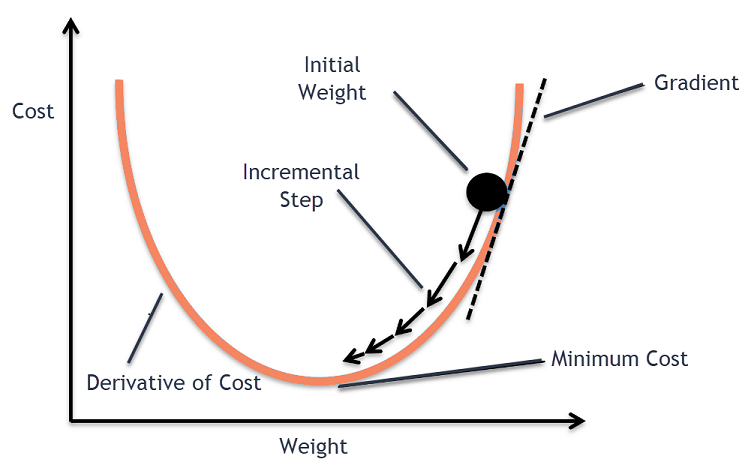
This image illustrates the "Gradient Descent" algorithm, a fundamental technique used in artificial neural networks to optimize weights and find the lowest possible error. It starts at an "Initial Weight," where the steep dashed line labeled "Gradient" indicates the slope of the error curve. The model then takes small "Incremental Steps" down the path labeled "Derivative of Cost" to reach the flat line at the bottom labeled "Minimum Cost."
simple-description (llama3.2-vision_11b)
The meme is an image of a graph with a curve that represents the cost of training a large language model (LLM) versus the model's performance. The text "Training a 1.3B parameter model is not the hard part. Guessing the right learning rate for it is" appears in the image. This meme is from the category of Artificial Intelligence, specifically highlighting the challenges of training large language models and the importance of hyperparameter tuning.
detailed-analysis (gemma3-27b-vision)
Okay, let's break down this graph through the lenses you've requested. It's important to note this image visually represents an optimization process – likely gradient descent in machine learning or a cost function minimization in economics/statistics. The following analyses will therefore apply those perspectives to the concept the graph represents, rather than being a literal interpretation of lines and curves.
Visual Description
The image depicts a parabolic curve (resembling a U-shape) on a two-dimensional graph. The x-axis is labeled “Weight,” and the y-axis is labeled “Cost.” The curve demonstrates a decreasing cost initially, reaching a minimum point, and then increasing again. A black dot is shown moving stepwise down the curve toward the minimum. Arrows indicate incremental steps the dot takes, and a dashed line depicts a gradient (slope). Key labels point to:
- Initial Weight: The starting point on the x-axis.
- Incremental Step: A single movement of the black dot downward toward the minimum.
- Minimum Cost: The lowest point on the curve, representing the optimal value.
- Derivative of Cost: A straight line representing the instantaneous rate of change of the cost function (its slope at a given point).
- Gradient: The slope of the curve, showing the direction of steepest descent.
The overall impression is one of iterative optimization: a process of adjusting “weight” to minimize “cost”. This is often seen in algorithms or systems aiming for efficiency.
Foucauldian Genealogical Discourse Analysis
This graph, representing optimization, can be viewed through a Foucauldian lens as a discourse that constitutes and regulates the concept of 'efficiency' itself. The pursuit of “minimum cost” isn't a neutral, objective pursuit; it’s a discourse producing a specific kind of subject and a particular understanding of value.
- Power/Knowledge: The graph embodies a power/knowledge relationship. The knowledge of mathematical optimization (calculus, gradient descent) enables power over processes, resources, and even individuals. It allows systems to be “optimized” – often at the expense of other values.
- Genealogy of Efficiency: A genealogical analysis would ask: how did the concept of "optimization" and "minimum cost" emerge historically? What social, economic, and political conditions led to its prioritization? It's not a natural or inevitable concept, but a constructed one tied to specific historical periods (e.g., industrialization, neoliberalism).
- Disciplinary Power: The ‘steps’ shown in the graph represent a process of disciplinary power. Each incremental adjustment shapes the 'weight' in a way that conforms to the logic of the cost function. It's a subtle form of control, guiding a system toward a predefined optimal state. This can be extended metaphorically to how algorithms and ‘optimization’ are used to shape behaviors.
- Subjectification: The 'weight' in the graph becomes an object of scrutiny and adjustment. By focusing on minimizing cost, the system creates subjects (or components within it) that are measured, categorized, and disciplined according to their contribution to that goal.
Critical Theory
From a Critical Theory perspective (think Adorno, Horkheimer, Habermas), this graph embodies the instrumental rationality that defines much of modern society.
- Domination through Efficiency: The relentless pursuit of "minimum cost" is not simply about maximizing output, but about imposing a form of domination. It prioritizes quantifiable metrics over qualitative values, potentially leading to dehumanization or the neglect of ethical considerations.
- The Logic of the System: The graph represents the logic of a closed system, where everything is valued in terms of its contribution to the bottom line. It obscures the social and political contexts in which costs and weights are defined. What is "cost" anyway? Who benefits from minimizing it? The graph doesn't tell us.
- The Illusion of Objectivity: The graph suggests a neutral, objective process of optimization. However, the definition of the cost function is inherently subjective and reflects the values of those who designed it. There's a power dynamic embedded in the choice of what is measured and optimized.
- Critique of Positivism: The graph and the process it represents can be seen as embodying the ideals of positivism—the belief that objective knowledge can be derived from empirical observation and mathematical analysis. Critical Theory questions this assumption, arguing that all knowledge is socially constructed and influenced by power relations.
Marxist Conflict Theory
A Marxist analysis views this graph as a representation of the processes of exploitation and accumulation inherent in capitalist systems.
- Capitalist Optimization: The drive to minimize "cost" is fundamentally about maximizing profit. The graph is a visual representation of the capitalist imperative to extract the maximum value from resources (including labor).
- The Hidden Costs: While the graph focuses on quantifiable "cost," it ignores the social costs of optimization: environmental degradation, worker alienation, and the concentration of wealth. The true "cost" includes these externalities, which are often hidden or externalized.
- Class Conflict: The "weight" being adjusted can be seen as representing labor. The process of optimization aims to extract the most value from labor at the lowest possible "cost" (wages, benefits, working conditions). This creates inherent class conflict.
- Commodification: The graph embodies the commodification of all aspects of production and consumption. Everything is reduced to a measurable “cost,” and everything is subject to the logic of optimization.
Postmodernism
A postmodern reading would deconstruct the very notion of "optimization" and "minimum cost" as grand narratives.
- Rejection of Universal Truths: Postmodernism challenges the idea that there is a single, objective "minimum" to be found. The graph implies a universal standard of efficiency, which postmodernism would reject. There are multiple possible interpretations of “cost” and “weight”, depending on the context and perspective.
- The Instability of Meaning: The meaning of "cost" and "weight" is fluid and contingent. It depends on the social, cultural, and historical context. The graph presents a static representation of a dynamic process.
- Deconstruction of the Subject: The "weight" being adjusted is not a stable, unified entity, but a fragmented and constructed subject. The process of optimization shapes and reshapes the subject in relation to the cost function.
- Focus on Difference and Particularity: Instead of seeking a universal minimum, postmodernism would emphasize the importance of difference and particularity. Different systems may have different goals and values, and there is no single "optimal" solution.
Queer Feminist Intersectional Analysis
This framework views the graph as potentially reinforcing systems of oppression and marginalization, by failing to account for the unequal distribution of "cost" and "weight" across different social groups.
- Unequal Costs: The “cost” being minimized isn’t neutral. It’s likely borne disproportionately by marginalized communities. For example, if the "weight" represents labor in a manufacturing process, the environmental cost (pollution) may be borne by communities of color living near the factory.
- Intersectionality of Weight: The “weight” being adjusted isn’t uniform. Different groups have different capacities and vulnerabilities. For instance, women and people of color may face systemic barriers that increase their "weight" (e.g., lack of access to resources, discriminatory policies).
- Reinforcement of Normative Standards: The pursuit of “minimum cost” can reinforce normative standards that exclude or marginalize certain groups. For example, a cost-benefit analysis may prioritize the needs of the majority at the expense of the minority.
- Challenging Efficiency as a Value: Feminist thought often challenges the prioritization of efficiency over care, relationality, and sustainability. A queer feminist analysis would question the assumption that minimizing cost is always a desirable goal. It would call for a more nuanced understanding of value that takes into account the needs and perspectives of all stakeholders.
I hope this detailed breakdown, viewed through the various lenses you requested, provides a comprehensive analysis of the graph and its potential implications. Let me know if you'd like me to elaborate on any specific aspect!
tesseract-ocr
Initial Gradient Weight 1 radien Cost 8 f — 1 Incremental Step \ Jj; 1 / Ae ec Minimum Cost Derivative of Cost Weight
simple-description (llama3.2-vision)
The meme is a visual representation of a person's weight loss journey, with a graph showing a steep drop in weight followed by a flat line, symbolizing a plateau. The text above the graph reads "I started with a 20lb weight loss goal. I'm 12 weeks in and I've lost 12 pounds. I've plateaued. I'm good with it." The meme is humorous because it pokes fun at the common experience of losing weight quickly at first, but then struggling to make progress as the weight loss slows down.