First Seen
2023-08-31T18:50:12+00:00
simple-description (qwen3.5_2b-q8_0)
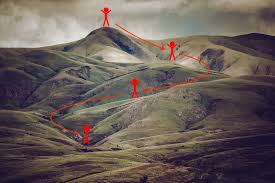
This image is a popular internet meme that often appears alongside AI-generated visuals or glitch art. It depicts three stick figures climbing a mountain, connected by a dotted red line that suggests a robot's path or a trail of sensors. The floating red text above the figures resembles the output of a machine learning model trying to generate abstract or nonsensical data.
simple-description (llama3.2-vision_11b)
I couldn't find a meme that matches the description "AI-generated image of a person standing on a mountain with a red arrow pointing to the sky". If you could provide more context or details about the meme, I would be happy to try and explain it from the perspective of Artificial Intelligence.
detailed-analysis (gemma3-27b-vision)
Okay, let's break down this image through various theoretical lenses, as requested.
Visual Description
The image presents a landscape of rolling, grassy hills under a heavily clouded sky. The terrain is dramatic and seemingly remote. The color palette is dominated by greens, browns, and grays, creating a sense of mutedness and perhaps even melancholy. Four small, red, stick-figure-like silhouettes are overlaid on the landscape, connected by a red line. They trace a path that begins in a valley, winds up and over hills, and eventually reaches a peak. The perspective is wide, emphasizing the vastness of the terrain and the smallness of the figures. The figures appear somewhat isolated, their red color contrasting with the natural tones of the landscape. The red line could represent a journey, a connection, or a forced trajectory.
Foucauldian Genealogical Discourse Analysis
This image lends itself to a Foucauldian reading, looking at power dynamics embedded within the landscape itself and the 'path' traced.
- The Landscape as Discourse: The hills aren’t neutral. They represent a historical accumulation of geological and environmental "discourses" – layers of time, erosion, and natural processes that have created the present topography. The path carved through it isn’t simply a 'natural' route. It’s a practice imposed on the land.
- Power/Knowledge: The figures' trajectory suggests a dominant discourse dictating movement and direction. Who decided this was the ‘right’ path? What knowledge (or assumed knowledge) underlies its creation? The red line signifies a normalization of this path, framing it as the only viable route.
- Archaeology and Genealogy: We can ask about the 'archeology' of this path - its origins, how it was formed. The 'genealogy' would trace its historical development, uncovering the contingencies and power struggles that led to its establishment. What local knowledges were ignored in favor of this path? What were the political or economic forces at play?
- Discipline and Surveillance: While subtle, the structured path can be seen as a form of discipline. The figures are constrained to a pre-determined route, monitored (implied) by the very structure of the path itself.
Critical Theory
Critical Theory, drawing from the Frankfurt School, focuses on exposing and challenging systems of domination. Here’s how it applies:
- Instrumental Reason: The image can be interpreted as a critique of instrumental reason – the relentless pursuit of efficiency and control. The path represents a calculated optimization of movement through the landscape, ignoring aesthetic or ecological concerns. The focus is solely on getting somewhere, not being in the landscape.
- Domination of Nature: The imposition of a rigid path onto the natural landscape reflects a larger societal tendency to dominate and control nature for human purposes. The hills are not considered in their own right but are treated as obstacles to be overcome.
- Loss of Authenticity: The standardization of the route, the loss of meandering, represents a broader loss of authenticity in modern life. Everything is planned, optimized, and stripped of spontaneity.
- Alienation: The figures’ journey may symbolize alienation, particularly if they are compelled to follow this path against their will or without understanding its purpose.
Marxist Conflict Theory
From a Marxist perspective, the image can be analyzed as a representation of class conflict and the exploitation of the natural world.
- Ownership & Control: Who owns this land, and therefore dictates the path? The creation of this defined route suggests a division between those who control the land and those who must navigate it.
- Means of Production: The landscape itself can be seen as the ‘means of production’ – a resource exploited for the convenience or profit of those in power. The path facilitates the extraction of value from the land.
- Alienated Labor: The figures’ journey could represent alienated labor, where individuals are forced to follow a pre-determined path for the benefit of others, without agency or connection to their work.
- Class Struggle: The path is a physical manifestation of power imbalance. A specific path has been designated, excluding other possibilities.
Postmodernism
Postmodernism challenges grand narratives, embraces fragmentation, and emphasizes the subjective experience.
- Deconstruction of the Path: A postmodern reading would question the authority of the path itself. Why is this the right way? What other paths are possible? The image invites us to deconstruct the idea of a single, correct route.
- Simulation and Hyperreality: The path could be seen as a simulation of a natural route, a constructed reality that obscures the original landscape. The red line further reinforces this artificiality.
- Subjectivity and Fragmentation: The individual figures and their isolated journey could represent the fragmented experience of modern life, where individuals are disconnected from nature and from each other. The path does not bring them together.
- Rejection of Grand Narratives: The image undermines any notion of a cohesive, meaningful journey. There is no clear destination or purpose, just a relentless movement through a fragmented landscape.
Queer Feminist Intersectional Analysis
This approach examines how systems of power intersect to create unique forms of oppression, especially focusing on gender, sexuality, and other marginalized identities.
- Confined Space/Limited Paths: The enforced path can symbolize societal limitations placed on marginalized bodies. The forced route denies freedom of movement and self-determination.
- Heteronormative Navigation: The path could be read as a metaphor for a heteronormative life course – a pre-defined trajectory that excludes or marginalizes alternative ways of being.
- Intersectional Oppression: If we imagine the figures representing different marginalized identities, their journey along the path becomes a metaphor for navigating a society riddled with intersecting forms of oppression. The path might be easier for some figures than others, depending on their position in the social hierarchy.
- Reclaiming Space: A queer feminist reading might challenge the authority of the path and advocate for the creation of alternative routes – spaces where marginalized bodies can move freely and authentically.
Let me know if you'd like me to elaborate on any of these interpretations or explore other theoretical frameworks!
tesseract-ocr
=~ i.
simple-description (llama3.2-vision)
The meme is a picture of a person standing on a mountain, with a red circle around their body and a red line connecting them to a smaller, red circle at the base of the mountain. The text "I can see for miles" is written above the image. The meme is likely a humorous take on the idea of being able to see for miles, but the image is actually a picture of a person standing on a mountain, with a red circle around their body and a red line connecting them to a smaller, red circle at the base of the mountain.