First Seen
2024-05-19T06:48:30+00:00
simple-description (qwen3.5_2b-q8_0)
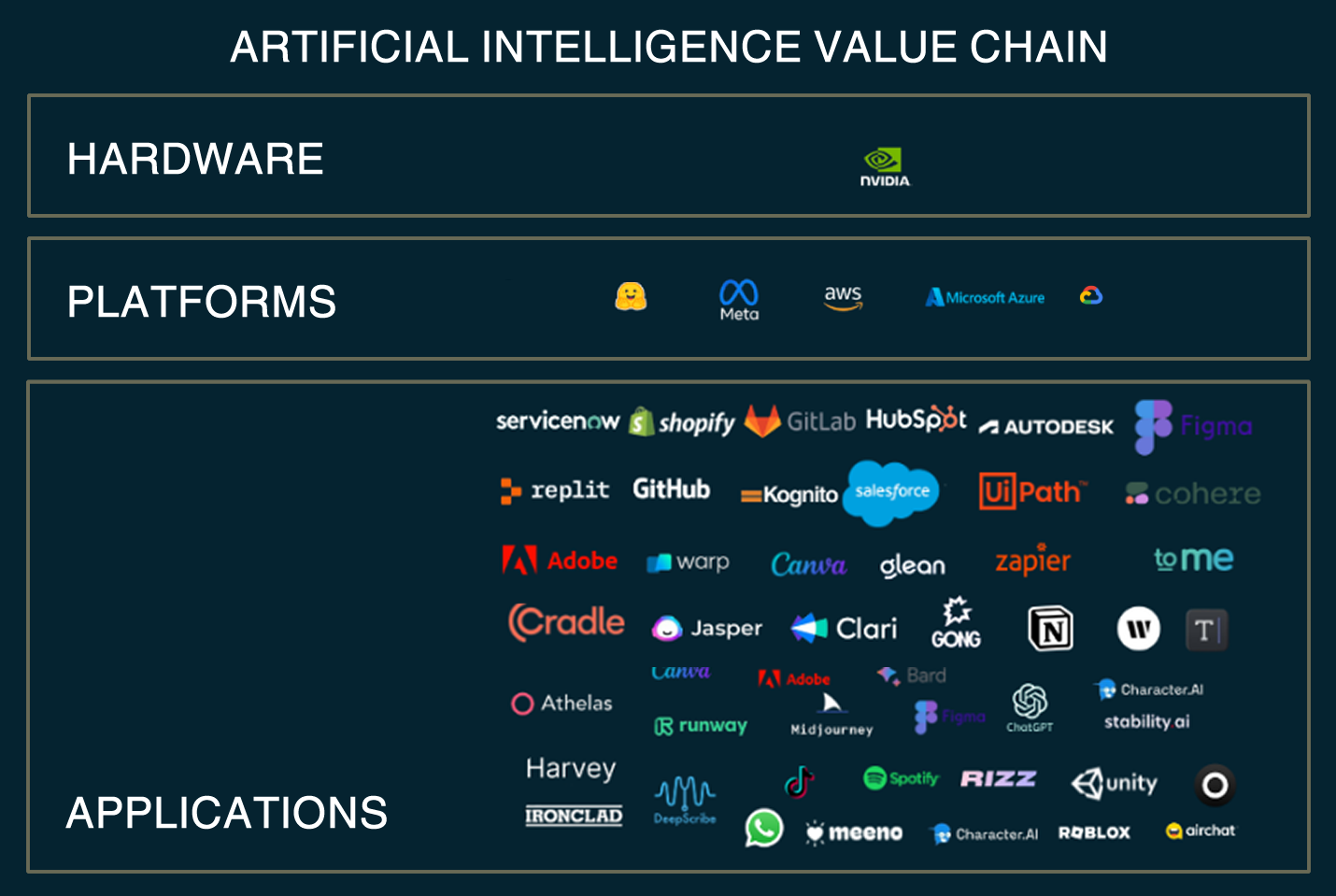
This image visualizes the Artificial Intelligence value chain, organizing top-tier companies into categories like HARDWARE (e.g., NVIDIA) and PLATFORMS (e.g., AWS). The bottom section, labeled APPLICATIONS, contains the largest density of logos, representing the myriad of tools like GitHub, Shopify, Figma, and Character.AI that humans use to build and deploy AI systems.
simple-description (llama3.2-vision_11b)
The meme is a humorous illustration of a "AI" (Artificial Intelligence) "value chain" with a series of interconnected blocks, each representing a different AI technology. The blocks are labeled with names like "ChatGPT", "Bing", and "Google", and are connected by arrows, implying that they are all part of a larger AI ecosystem. The text "AI is not just a tool, it's a value chain" is written above the blocks, highlighting the interconnected nature of AI technologies.
detailed-analysis (gemma3-27b-vision)
Okay, here's an analysis of the image, broken down into the requested theoretical frameworks. It's a bit dense, as many of these frameworks overlap in application, but I've tried to maintain distinct sections where possible. I'll also indicate where a framework doesn't strongly apply.
Image Description: "Artificial Intelligence Value Chain"
The image is a visual diagram representing the "Artificial Intelligence Value Chain." It is organized into three horizontal tiers, labelled "Hardware," "Platforms," and "Applications."
- Hardware: This tier is occupied by the NVIDIA logo, suggesting the foundational role of NVIDIA in AI development (specifically in GPU technology).
- Platforms: This tier contains a wide array of logos representing major technology companies and services. These include Meta, AWS, Microsoft Azure, Shopify, GitHub, Salesforce, Adobe, and many others. The logos suggest the infrastructure and tools used to build and deploy AI models.
- Applications: The bottom tier displays logos for various applications and software programs powered by or incorporating AI. These range from design tools (Canva, Figma) to communication platforms (Discord, Slack) to creative tools (Midjourney) and even game engines (Unity).
The presentation is clearly aimed at illustrating the layered structure of the AI ecosystem, from the foundational hardware to the user-facing applications. The graphic suggests a clear, linear progression.
Foucauldian Genealogical Discourse Analysis
This image strongly lends itself to a Foucauldian reading. The "AI Value Chain" is not a neutral representation of reality but a discourse that constructs a particular understanding of AI.
- Power/Knowledge: The diagram illustrates a clear distribution of power/knowledge. NVIDIA, as the sole entity in the "Hardware" layer, holds considerable power. The concentration of logos in the "Platforms" tier further emphasizes a concentration of knowledge and control over AI infrastructure. This distribution is not accidental; it is a constitutive element of the AI ecosystem. The discourse creates this power dynamic by presenting it as natural or inevitable.
- Genealogy: Tracing the genealogy of this diagram reveals the historical contingencies and power struggles that shaped its construction. What criteria were used to include or exclude certain companies? Who decided on this specific layering? The diagram is not a timeless truth but a product of specific historical forces. The over-representation of American/Western tech companies suggests a particular technological and ideological trajectory.
- Disciplinary Power: The diagram implies a certain disciplinary order. The layering suggests a hierarchy, with "Hardware" at the base and "Applications" as the ultimate deliverable. This implicitly normalizes a certain way of thinking about AI development – a top-down, hierarchical approach. It shapes the field of AI by influencing what is considered 'core' and what is considered 'peripheral'.
Critical Theory (Frankfurt School)
The diagram is a clear example of the "instrumental reason" critiqued by the Frankfurt School.
- Domination and Control: The "Value Chain" narrative is fundamentally about optimizing efficiency and maximizing value. This inherently implies a drive for control – control over data, algorithms, and ultimately, users. The diagram obscures the potential for AI to be used for exploitative or manipulative purposes.
- Reification: The diagram reifies AI, presenting it as an objective, neutral force. This masks the social and political forces that shape its development and deployment. It's presented as a "chain" that's natural and inevitable, rather than a constructed arrangement.
- One-Dimensionality: The focus on "value" and optimization reinforces a one-dimensional view of technology. It ignores alternative values, such as social justice, equity, or environmental sustainability. The emphasis on linear progression (hardware → platform → application) suppresses the possibility of circular, decentralized, or collaborative approaches.
Marxist Conflict Theory
From a Marxist perspective, the diagram highlights the accumulation of capital and the intensification of class struggle in the age of AI.
- Means of Production: The "Hardware" and "Platforms" tiers represent the means of production in the AI economy. These are largely controlled by a small number of powerful corporations.
- Exploitation: The diagram implicitly obscures the exploitation of labor (both human and increasingly, the “labor” of data) that underpins the AI ecosystem. The "Value Chain" emphasizes the generation of profit, but it doesn't account for the social costs of AI development.
- Concentration of Capital: The diagram demonstrates the increasing concentration of capital in the hands of a few tech giants. This raises concerns about monopolies, unequal distribution of wealth, and the potential for AI to exacerbate existing inequalities.
- Digital Proletariat: The users of the "Applications" layer can be seen as a “digital proletariat,” generating data that is then captured and commodified by the platform owners.
Postmodernism
A postmodern reading of the image questions the stability of the "Value Chain" narrative and emphasizes the fragmentation and fluidity of the AI landscape.
- Deconstruction of Grand Narratives: The idea of a linear "Value Chain" is a grand narrative – a totalizing explanation of reality. A postmodern approach would deconstruct this narrative, highlighting its internal contradictions and the multiple, competing narratives that exist.
- Simulacra and Simulation: The diagram itself can be seen as a simulacrum – a copy without an original. It's a representation of a representation, increasingly divorced from the material realities of AI development.
- Fragmentation and Hybridity: The diagram depicts a seemingly ordered system, but the reality of AI development is far more fragmented and chaotic. The boundaries between "Hardware," "Platforms," and "Applications" are increasingly blurred, and new, hybrid forms of AI are constantly emerging.
- Relativism of Truth: Postmodernism would question the notion of an objective "value chain," arguing that its meaning is contingent on the perspective of the observer.
Queer Feminist Intersectional Analysis
This framework challenges the inherent biases and power dynamics embedded within the diagram.
- Exclusion and Marginalization: The diagram is overwhelmingly dominated by the logos of companies led by white men. This reflects a broader pattern of exclusion in the tech industry. Where are the companies led by women, people of color, or LGBTQ+ individuals?
- Intersectional Oppression: The diagram overlooks the ways in which AI technologies can perpetuate and amplify existing forms of oppression, such as racism, sexism, and homophobia. AI algorithms are often trained on biased data, leading to discriminatory outcomes.
- Re-thinking Value: A queer feminist perspective challenges the very notion of “value” that underpins the diagram. What is considered valuable in the AI ecosystem? Is it solely about profit and efficiency, or can other values, such as care, connection, and community, be prioritized?
- De-centering Dominant Narratives: The framework would challenge the linear and hierarchical structure of the diagram, seeking to create a more decentralized and inclusive representation of the AI landscape. It would push for the inclusion of marginalized voices and perspectives.
I hope this detailed analysis provides a comprehensive understanding of the image from the requested theoretical frameworks. Let me know if you'd like me to elaborate on any particular point!
tesseract-ocr
ARTIFICIAL INTELLIGENCE VALUE CHAIN HARDWARE A PLATFORMS aii servicenow @) shopify 4g GitLab HubSPSt ~ autopEsk 2 Figma oe Seka Lut) Se) ieee J\ Adobe gwarp Cana glean Zapier tome (CT Cy Wena Rot mal Ww iy Ld TN adobe aA Teen OTS sa yd a a J S BS Harvey Ai ae TP + 4 uni APPLICATIONS a a nnn
simple-description (llama3.2-vision)
The meme is a humorous image of a flowchart with many popular AI and machine learning tools, including Google, Meta, and Amazon, being connected to a central "Artificial Intelligence" node. The image is captioned "The AI is watching you...".