First Seen
2024-05-04T06:40:50.869432+00:00
simple-description (qwen3.5_2b-q8_0)
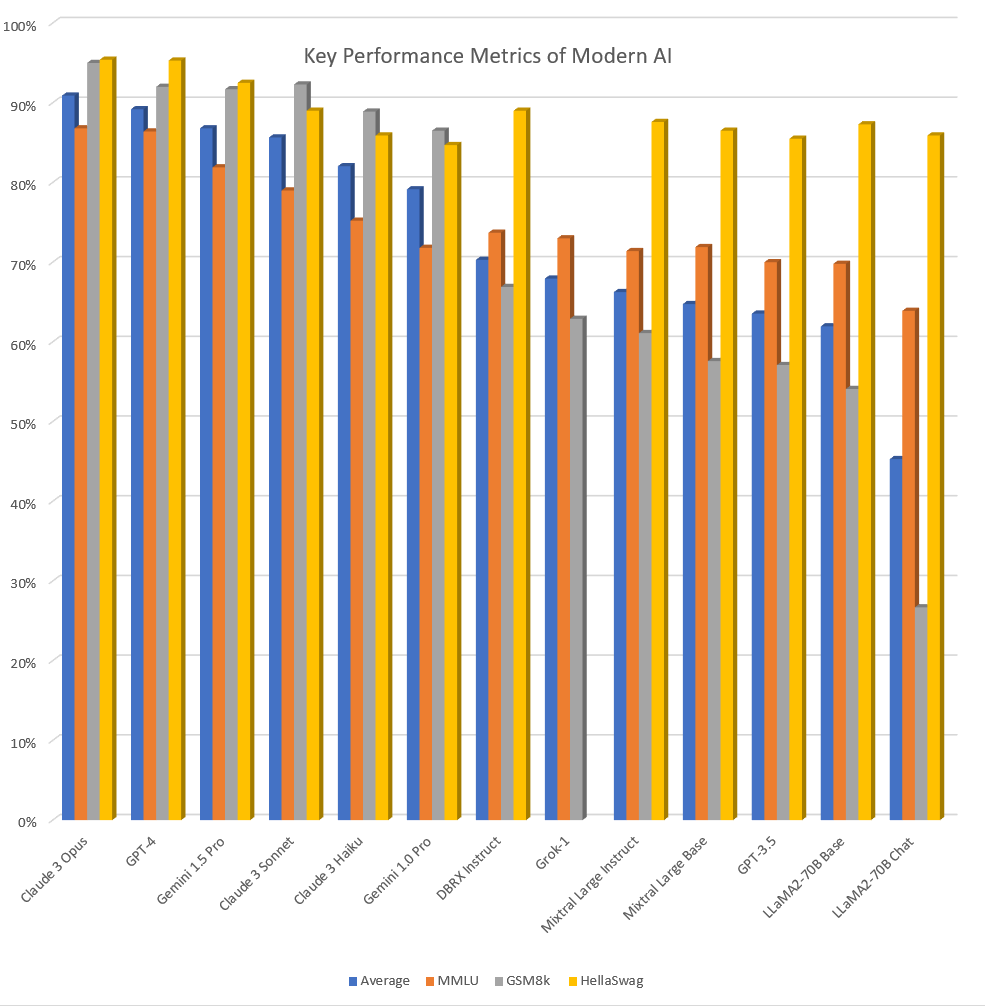
This chart acts as a visual meme about the relative strengths of modern Large Language Models. It highlights a striking trend where the metric HellaSwag (represented by the yellow bars) consistently scores the highest, often beating out the more specialized MMLU (orange) benchmarks. This suggests that while these models might struggle with simple arithmetic tasks like GSM8k or generic metrics like Average, they possess exceptional general reasoning and common sense abilities.
simple-description (llama3.2-vision_11b)
The meme is an image of a graph showing the performance of various AI models, with the x-axis representing different AI models and the y-axis representing performance metrics. The graph is labeled "AI Model Performance" and shows that the AI model "LLA-MAS" (a type of language model) has a high performance score of 97.3%. The meme is likely poking fun at the idea that AI models are being used to evaluate themselves, and that they are being overly confident in their own abilities. The text "I'm a 97.3% AI, what's your 50/50?" is likely a humorous reference to the idea that AI models are being used to evaluate themselves, and that they are being overly confident in their own abilities.
detailed-analysis (gemma3-27b-vision)
Okay, here's an analysis of the provided bar graph, broken down into sections, addressing the requested theoretical frameworks only where applicable. I will note if a particular framework doesn't readily apply to this specific data visualization.
Visual Description
The image presents a bar graph comparing the performance of various Large Language Models (LLMs) – Claude 3 Opus, GPT-4, Gemini 1.5 Pro, Claude 3 Sonnet, Claude 3 Haiku, Gemini 1.0 Pro, DBRX Instruct, Grok-1, Mixtral Large Instruct, Mixtral Large Base, GPT-3.5, Llama2-70B Base, and Llama2-70B Chat – across four metrics. These metrics are represented by different colored bars: “Average” (blue), “MMMLU” (orange), “GSM8k” (red), and “HellaSwag” (yellow).
The y-axis ranges from 0% to 100%, indicating percentage performance. The x-axis lists the LLM names. Visually, Claude 3 Opus and GPT-4 appear to consistently perform the best across all metrics, achieving scores generally above 80% and sometimes nearing 90%. Mixtral Large Instruct also performs very well. GPT-3.5 and Llama2-70B base show lower performance. The other models fall somewhere in between. Notably, some models appear to perform better on specific metrics than others – for example, one model might do well on MMMLU but comparatively worse on HellaSwag.
Foucauldian Genealogical Discourse Analysis
This chart can be analyzed through a Foucauldian lens by considering it as a manifestation of power/knowledge regimes operating within the field of Artificial Intelligence.
- Discourse & Normalization: The chart itself creates a discourse around what constitutes "good" performance in LLMs. By quantifying performance on specific benchmarks (MMMLU, GSM8k, HellaSwag), it establishes a normalizing framework—what is deemed acceptable or superior. These benchmarks, while appearing objective, are themselves constructed by researchers and reflect particular priorities and values. For example, the focus on “knowledge” (MMMLU) and “reasoning” (GSM8k) can be seen as prioritizing cognitive skills valued within a particular Western, academic tradition.
- Archaeology of the Benchmarks: A genealogical approach would "dig beneath" the surface of these benchmarks to uncover their historical origins, the assumptions embedded within them, and the interests they serve. Who designed these tests? What were their goals? What alternative ways of evaluating LLMs might exist? The prioritization of these metrics shapes the development of AI, steering research and investment towards models that excel on these specific tasks.
- Power Dynamics: The chart implicitly demonstrates power dynamics within the AI field. Those who define the benchmarks and control the evaluation process exert power over what is considered "progress" in AI. The ranking of LLMs reinforces this power structure, as certain companies and models are positioned as leaders.
- Subjectivation: The chart plays a role in the "subjectivation" of LLMs—the way they are defined and understood. By reducing complex AI systems to a few numerical scores, it creates a simplified representation that shapes our perception of their capabilities and limitations.
Critical Theory
The chart can be viewed through a Critical Theory lens, focusing on how it reflects and reinforces existing social structures and power imbalances.
- Instrumental Rationality: The focus on quantifiable metrics (percentages) reflects a commitment to instrumental rationality—the pursuit of efficiency and control through the application of objective standards. While seemingly neutral, this approach can obscure the broader social and ethical implications of AI development.
- Technological Determinism: The chart might inadvertently contribute to a form of technological determinism—the belief that technology is an autonomous force that shapes society. By focusing on technical performance, it downplays the role of human choices, values, and social contexts in shaping AI's development and impact.
- Commodification: The ranking of LLMs can be seen as contributing to the commodification of AI—the treatment of AI as a marketable product. The chart implicitly encourages competition between companies and models, driven by the pursuit of higher scores and market share.
- Ideology: The selection of benchmarks and the way performance is presented can reflect underlying ideological assumptions. The emphasis on certain types of knowledge or reasoning might privilege particular worldviews or perspectives.
Marxist Conflict Theory
While not directly presenting conflict visually, a Marxist reading of the chart reveals the underlying economic forces at play.
- Competition & Capital Accumulation: The chart represents a space of intense competition between AI companies. The drive to achieve higher scores on these benchmarks is ultimately linked to the pursuit of capital accumulation – the desire to gain market share and profits. The performance disparities are indicative of differing levels of investment in research, development, and computational resources.
- Technological Advancement & Class Struggle: Advancements in AI, as reflected in the chart, can exacerbate existing class inequalities. Those who control the technology and benefit from its development are likely to be a relatively small elite, while the benefits may not be evenly distributed throughout society. Increased automation, driven by AI, could lead to job displacement and further economic insecurity for the working class.
- Control of the Means of Computation: The companies that consistently top the performance charts have access to immense computing power. This control over the "means of computation" is a crucial source of power in the AI landscape.
Postmodernism
A postmodern reading would emphasize the constructed nature of "performance" metrics, and the fluidity of meaning in this data.
- Deconstruction of "Objective" Measurement: Postmodernism challenges the notion of objective measurement. The metrics presented – MMMLU, GSM8k, HellaSwag – aren’t inherently "true" measures of intelligence or capability. They are constructed by humans and reflect specific, culturally-bound values and assumptions. There are infinite ways to measure and evaluate AI, and these choices are always subjective.
- Simulation & Hyperreality: The chart represents a simulation of performance. It doesn’t capture the full complexity of AI systems, but rather reduces them to a few quantifiable data points. This can create a sense of hyperreality—a simulation that becomes more real than the reality it represents.
- Fragmentation & Plurality: The chart shows a fragmented landscape of LLMs, each with its own strengths and weaknesses. This reflects the postmodern emphasis on plurality and the rejection of grand narratives. There is no single “best” LLM, but rather a diverse range of models with different capabilities.
- Loss of Foundational Truth: The metrics on the chart are not fixed or foundational. They change as AI technology evolves and our understanding of intelligence deepens. This aligns with the postmodern rejection of universal truths.
Queer Feminist Intersectional Analysis
This chart does not directly lend itself to a queer feminist intersectional analysis. It doesn’t provide any data regarding the demographics of AI developers, the bias embedded in the datasets used to train these models, or the potential for these technologies to perpetuate existing forms of oppression based on gender, sexuality, race, or other marginalized identities. An analysis through this lens would require additional data to explore these intersections. However, it is important to note that all AI models are trained on data, and that data is almost always biased toward specific groups and viewpoints. A queer feminist analysis would look into those potential biases.
I hope this detailed analysis is helpful. Let me know if you'd like me to elaborate on any particular aspect or theoretical framework.
tesseract-ocr
100% Key Performance Metrics of Modern Al 90% 80% 70% 60% 50% 40% 30% 20% 10% 0% & » o xs a fe eS SS Cd of oo rr re rr eS SS € < x $ sf 2 ; ; * & & & SF SF we wg S & & s s RS x ¥ ¥ w MAverage MMMLU mGSM8k mi HellaSwag
simple-description (llama3.2-vision)
The meme is a humorous image of a chart with a long list of AI models, each with a performance score in the 90s. The text at the top reads "AI Models Ranked by Performance" and the bottom text says "I'm not saying I'm better than them, I'm just saying...".