First Seen
2023-07-23T08:39:47+00:00
simple-description (qwen3.5_2b-q8_0)
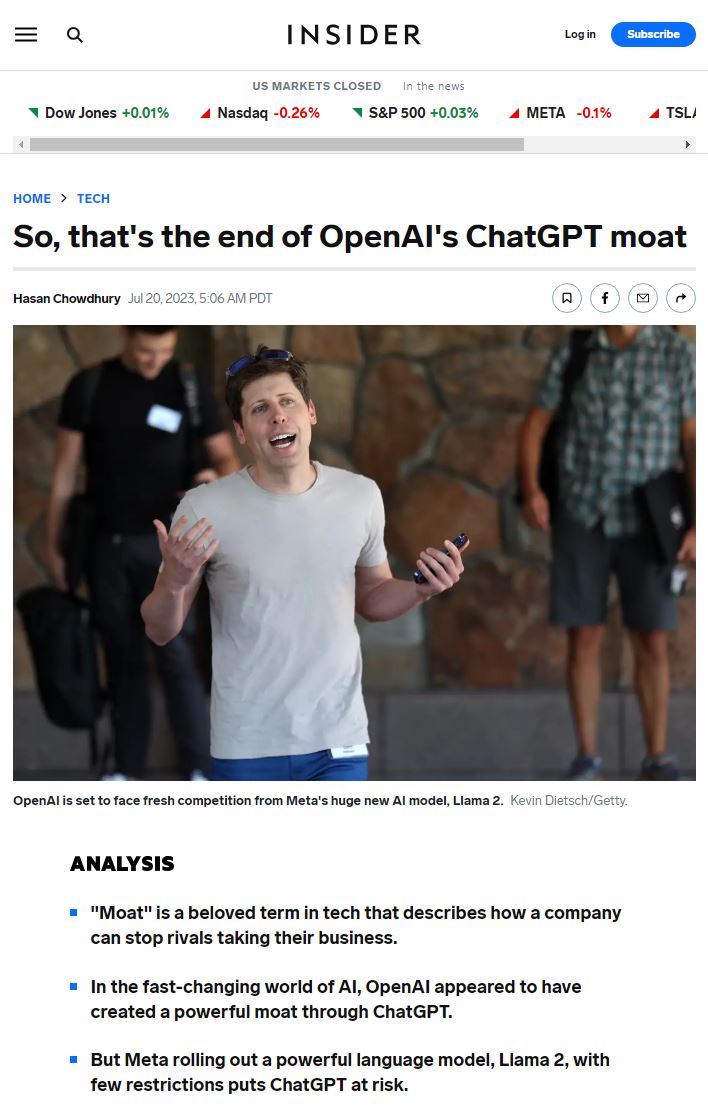
This image captures a moment in the AI world where a major tech company launches a new model to compete directly against a rival, creating an ironic situation with the accompanying headline. The text suggests a humorous irony: the headline describes this launch as the "end of OpenAI's moat," implying that a powerful new competitor has just suddenly broken the company's previous barrier to entry.
The article explains that "moat" is a specific term used in tech to describe how a company can stop rivals from taking their business, and this piece argues that the release of Llama 2 has put OpenAI at serious risk of losing its market lead to a new giant.
simple-description (llama3.2-vision_11b)
The meme is a screenshot of a news article from The Verge, featuring a photo of an AI model named "LLaMA" (Large Language Model Application) with a caption "I can explain it in simple terms". The article discusses the capabilities of LLaMA, a new AI model that can generate human-like responses to questions and engage in conversations. The meme pokes fun at the idea that AI models like LLaMA can be so complex and sophisticated that even experts struggle to understand them.
detailed-analysis (gemma3-27b-vision)
Okay, here’s an analysis of the provided image and accompanying text, broken down into sections based on the requested theoretical frameworks. I'll prioritize those that are most relevant and provide context for why others are less applicable.
1. Visual Description
The image is a photograph depicting a brightly lit, modern office space. A man, presumably a tech worker, is energetically extending his arm forward in what appears to be a celebratory gesture, with his fist clenched. He's wearing a button-down shirt and seems to be in a dynamic pose. The background includes blurred figures and computer screens, conveying a sense of fast-paced activity. The lighting is stark and highlights the figure in a dramatic way. The text of the article speaks to a potential end of a "moat" around OpenAI's ChatGPT, so it's likely the gesture intends to portray the confidence of a rival tech company, Meta, challenging that dominance.
2. Foucauldian Genealogical Discourse Analysis
This framework is highly applicable. The article revolves around a discourse – specifically, the tech industry's discourse of "moats." Foucault would be interested in how this term ("moat") came to be used, what power dynamics it embodies, and how it functions to shape understanding and action.
- Genealogy of "Moat": The term "moat," borrowed from medieval castle defense, signifies a competitive advantage – a barrier that protects a company's market share. Tracing the use of this term shows a shift in how tech companies understand competition. It moves from organic growth/innovation to defense and containment.
- Power/Knowledge: The use of "moat" is not neutral. It positions companies as either having one (powerful) or lacking one (vulnerable). It legitimizes aggressive competitive strategies ("defend your moat!") and potentially discourages open competition.
- Disciplinary Power: The constant focus on establishing and protecting "moats" creates a form of self-regulation within the tech industry. Companies internalize the need to build barriers to entry, creating a pressure to limit innovation that might be shared.
- Disruption as Resistance: The article implies that Meta's release of Llama 2 disrupts the established discourse of OpenAI’s “moat.” This disruption represents a challenge to the established power/knowledge framework.
3. Marxist Conflict Theory
This theory is relevant, though not dominant. The article touches upon competition within a capitalist system.
- Class Struggle (at a corporate level): The article's core argument revolves around competition between two tech giants, OpenAI and Meta. This can be seen as a manifestation of class struggle at the corporate level – a struggle for market dominance and capital accumulation.
- Means of Production: AI language models like ChatGPT and Llama 2 represent a key means of production in the information age. The control over this technology determines power within the digital economy.
- Accumulation of Capital: The competition is ultimately about accumulating capital. The company that can successfully control and monetize AI technology will gain a significant advantage.
- Potential for Proletarianization: The article doesn't directly address it, but the increasing accessibility of AI models like Llama 2 could potentially democratize access to AI tools and shift power away from a few dominant corporations.
4. Postmodernism
Postmodernism is also relevant to understanding the article, albeit in a more nuanced way.
- Deconstruction of "Moat": The article implicitly deconstructs the concept of a "moat." It suggests that what was once considered a strong barrier to entry is now being eroded. This challenges the idea of stable, lasting competitive advantages.
- Fragmentation of Narrative: The tech landscape is constantly changing. The article signals a shift in the narrative—from OpenAI's perceived dominance to a more fragmented competitive landscape.
- Simulacra and Simulation: The concept of a "moat" itself could be seen as a simulacrum – a copy without an original. It's a constructed idea meant to create the illusion of security and dominance.
- Relativity of Truth: Postmodernism emphasizes the subjectivity of truth. The article suggests that the "truth" about which company dominates AI is not fixed, but contingent on technological developments and market forces.
Theoretical Frameworks Not Strongly Applicable:
- Critical Theory: While related to Marxism and Postmodernism, the article doesn't focus on broader societal critique or systems of oppression in a way that warrants a full application of critical theory.
- Queer Feminist Intersectional Analysis: The article does not address issues of gender, sexuality, or intersectionality. While these issues are relevant to the tech industry as a whole, they are not central to the arguments presented in the article.
I hope this detailed breakdown is helpful! Let me know if you would like me to expand on any particular aspect or apply another theoretical framework.
tesseract-ocr
= aQ INSIDER oon E US MARKETS CLOSED In the news N Dow Jones +0.01% 4 Nasdaq -0.26% S&P500+0.03% META -01% 4 TSL/ > E> So, that's the end of OpenAl's ChatGPT moat Hasan Chowdhury Jul 20, 2023,5:06 AM PDT a) (#) (a) (eo Le a 7 ; : ‘ RSS Lf | Opendlis set to face fresh competition trom Meta's huge new Al model, Llama 2. Kevin Dictsch/Getty ANALYSIS "Moat" is a beloved term in tech that describes how a company can stop rivals taking their business. In the fast-changing world of Al, OpenAl appeared to have created a powerful moat through ChatGPT. But Meta rolling out a powerful language model, Llama 2, with few restrictions puts ChatGPT at risk.
simple-description (llama3.2-vision)
The meme is a screenshot of a news article with the headline "So, that's the end of OpenAI's ChatGPT moat". The image is a photo of a man with a shocked expression, but it's not described in the text. The article is a commentary on the financial struggles of OpenAI, the company behind the popular AI chatbot ChatGPT.