First Seen
2023-12-18T00:31:48+00:00
simple-description (qwen3.5_2b-q8_0)
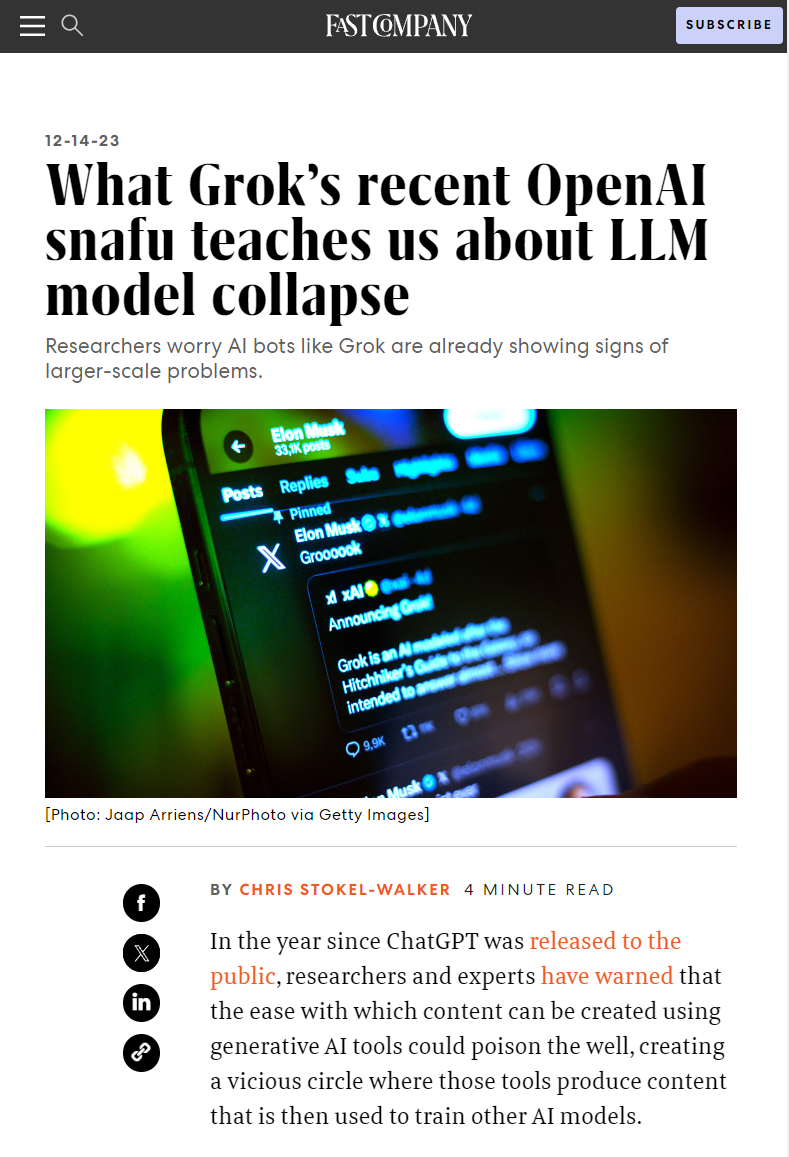
The visual humor comes from an Elon Musk tweet announcing that Grok is an AI model developed 'after the Hitchhiker's Guide to the Galaxy,' which ironically treats it with the seriousness of an official 'Announcing Guild'.
The image text explicitly states that Grok is an AI model intended to answer any question, making it clear that the 'guild' announcement is just an elaborate attempt to manage a project that is already causing the 'OpenAI snafu' warned about in the article.
The retweet, which includes the text 'xAI 🧑🦰', further reinforces the 'organized chaos' theme by suggesting a 'Guild' exists.
simple-description (llama3.2-vision_11b)
The meme is a screenshot of a news article from The Verge, featuring a headline that reads "AI researchers are trying to explain why AI is getting dumber". The image shows a graph of a line chart that appears to be declining, with a caption that says "AI is getting dumber". The text below the chart reads "Researchers are trying to explain why AI is getting dumber". The meme is likely poking fun at the idea that AI is getting dumber, implying that it's a common problem that AI researchers are trying to explain.
detailed-analysis (gemma3-27b-vision)
Okay, here's an analysis of the image and accompanying text, broken down into sections relevant to the requested theoretical frameworks. Keep in mind that with a single image and a short headline/intro, some of these analyses will be more speculative/interpretive than robust. I'll indicate where interpretations stretch.
1. Visual Description
The image is a close-up screenshot of what appears to be a social media platform (likely X, formerly Twitter) interface. The focus is on a post from Elon Musk, announcing "Grok" (presumably a new AI tool). The post itself is partially obscured by an overlaid “X” and circular badge-like images. The background is dark, with glowing blue lines and text, giving the image a futuristic, technologically-advanced feel. The overall composition is busy and somewhat cluttered, emphasizing the rapid-fire nature of social media and the influx of information. There's a sense of urgency and perhaps even a slightly chaotic energy. The screen lighting gives the impression of a glowing, almost ethereal presence.
2. Foucauldian Genealogical Discourse Analysis
The image, and the article's headline about a "snfu" with Grok, can be approached through a Foucauldian lens.
- Discourse of AI: The image represents a discourse – a system of thought, language, and practice – surrounding Artificial Intelligence. This discourse is rapidly evolving. The discourse centers around control, creation, and potential dangers of these tools. The rapid-fire nature of the social media post reinforces how this discourse is disseminated, constructed, and contested.
- Power/Knowledge: The image places Elon Musk (and his company X) at the centre of this discourse. His pronouncements shape the conversation, establishing him as an authority within it. This demonstrates the relationship between power and knowledge – Musk has power because he controls the dissemination of information and positions himself as an expert.
- Genealogy: Tracing the "genealogy" of this discourse (the historical development and contingent factors that shaped it) would reveal how the promises and fears surrounding AI are not inherent but constructed through specific historical and technological contexts. The article's mention of a "vicious circle" suggests a troubling lineage – a repeating pattern of problems with AI that are not necessarily being addressed.
3. Critical Theory
The image, in conjunction with the text's concern about a "vicious circle", speaks to several themes within Critical Theory:
- Commodification of Knowledge: The development and release of AI tools like Grok can be seen as part of a larger trend toward the commodification of knowledge and intelligence. AI becomes a product to be sold, rather than a tool for collective betterment.
- Technological Determinism: The article implies a critique of technological determinism – the idea that technology inherently drives social change. The "vicious circle" suggests that these tools are shaped by and reinforce existing power structures and biases, rather than leading to a purely progressive outcome.
- Instrumental Reason: The focus on creating and deploying these tools, without adequate consideration of their social and ethical implications, points to a problem of instrumental reason – the tendency to prioritize efficiency and control over broader values and concerns.
4. Marxist Conflict Theory
A Marxist lens would focus on the underlying class dynamics at play:
- Control of the Means of Production: Elon Musk and his company X control the "means of production" of AI (the technology, data, and infrastructure). This gives them significant power over the direction of its development and the benefits it generates.
- Exploitation of Data: The "vicious circle" suggests that data, potentially gathered from users, is being exploited to train AI models, generating profits for the company. This reinforces the inherent exploitation of labour and resources under capitalism.
- Alienation: The commodification of knowledge and the emphasis on efficiency can lead to alienation – a sense of disconnection from the products of one's labor and from broader social values. The image, with its glowing, impersonal technology, subtly reinforces this sense of alienation.
5. Postmodernism
The image and text resonate with several Postmodern themes:
- Simulation & Hyperreality: The image, being a screenshot of a digital platform, can be seen as representing a simulation – a copy of reality that has become detached from the "real." The speed and proliferation of information on social media contribute to a sense of hyperreality – where the lines between reality and simulation become blurred.
- Deconstruction of Authority: The "snfu" (a military slang term for a mistake) implies a breakdown of authority. The article suggests that even the creators of these tools don't fully understand or control their outcomes.
- Fragmentation & Lack of Grand Narratives: The article's emphasis on a “vicious circle” suggests a rejection of grand narratives (universal explanations of progress and truth). Instead, there is a recognition of contingency, complexity, and the lack of a clear direction for technological development.
6. Queer Feminist Intersectional Analysis
This is the most speculative application, as the image doesn’t overtly signal these themes. However:
- Bias & Representation: The data used to train AI models likely reflects existing societal biases (related to gender, race, class, sexuality, etc.). The "vicious circle" suggests that these biases are being perpetuated and amplified through AI. The absence of any visible diversity in the image and text reinforces a lack of intersectional awareness.
- Surveillance & Control: AI-powered tools can be used for surveillance and control, disproportionately impacting marginalized communities.
- Technological Solutionism: The emphasis on technological solutions to complex social problems can deflect attention from the root causes of inequality and injustice.
Important Note: These are interpretations, and different readers will find different meanings in the image and text. The strength of each analysis depends on the evidence available and the degree of speculation involved.
tesseract-ocr
ey FST@MPANY 12-14-23 ’ What Grok’s recent OpenAl snafu teaches us about LLM model collapse Researchers worry Al bots like Grok are already showing signs of larger-scale problems. ¢€ . ~ w poe - Pe eet me oo ™ Pr ae , ee es om Ad Ch “ [Photo: Jaap Arriens/NurPhoto via Getty Images] oe BY CHRIS STOKEL-WALKER 4 MINUTE READ e In the year since ChatGPT was released to the public, researchers and experts have warned that © the ease with which content can be created using e generative AI tools could poison the well, creating a vicious circle where those tools produce content that is then used to train other AI models.
simple-description (llama3.2-vision)
The meme is a screenshot of a tweet from the Twitter account of billionaire Elon Musk, featuring a photo of a screen with a notification that says "I'm reading a book" in a childlike font. The tweet is likely a joke about Musk's reading habits, and the meme is poking fun at his reputation for being a busy and busy person. The text in the image reads "I'm reading a book" in a childlike font.