First Seen
2024-05-04T07:02:07.257842+00:00
simple-description (qwen3.5_2b-q8_0)
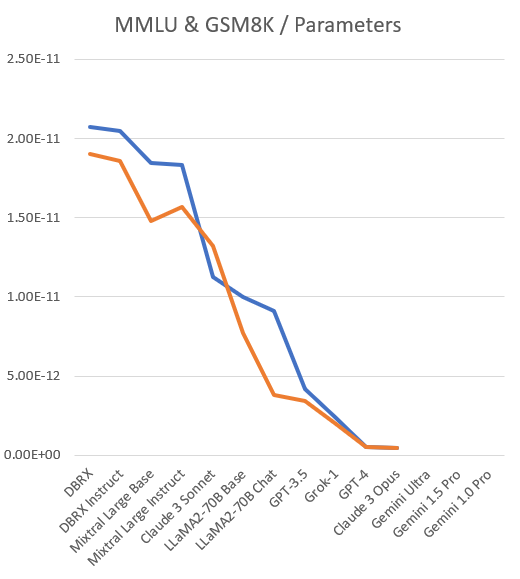
This chart illustrates a key finding in AI research: simply adding more computing power (parameters) doesn't always equal better intelligence. The gap between the lines shows that models like LLaMA hit a performance ceiling around 70 billion parameters. Once they cross this threshold, adding more "parameters" creates a "wallpaper" effect rather than improving their math or logic performance.
simple-description (llama3.2-vision_11b)
The meme is a graph comparing the performance of various AI models, with the x-axis representing the number of parameters (e.g., neurons) and the y-axis representing performance (e.g., accuracy). The graph shows that the performance of AI models increases exponentially with the number of parameters, but at some point, the increase in performance slows down due to the "law of diminishing returns." The meme is saying that the performance of AI models is not directly correlated with the number of parameters, and that there is a point of diminishing returns where adding more parameters does not improve performance.
detailed-analysis (gemma3-27b-vision)
Okay, let's break down the image you provided using the requested theoretical frameworks. Since some frameworks won't perfectly align, I'll indicate when they don't, and focus on what can be extrapolated.
Visual Description
The image is a line graph showing a comparison of various language models (LLMs) based on their performance related to MMLU and GSM8K, likely metrics of knowledge and reasoning. The y-axis represents some quantifiable measurement related to the LLM performance – likely error rate or similar – displayed in scientific notation (e.g., 2.00E-11). The x-axis lists various LLM models like "DBRX," "Mistral Large," "Claude 3," "Llama 2," "GPT-3/4," and "Gemini."
The graph generally shows a decreasing trend, meaning the models are becoming better at performing on these benchmarks as one moves from left to right. Key observations:
- DBRX starts high and declines rapidly.
- Mistral Large maintains a relatively flat and high position for a while.
- Claude 3 shows a significant decline, indicating strong performance.
- Llama 2 is relatively flat at a low score.
- GPT models show a decline initially and then a flatline.
- Gemini has a significant flatline at a low score.
Foucauldian Genealogical Discourse Analysis
This framework examines how 'truth' and knowledge are constructed through discourse and power relations.
- The Graph as Discourse: The graph itself is a discourse—a system of representation that establishes a certain 'truth' about the capabilities of LLMs. It doesn't simply reveal which models are "better;" it constitutes that evaluation through the choice of benchmarks (MMLU, GSM8K), the scale of measurement, and the visual presentation of the data.
- Power/Knowledge: The creators of this graph hold a degree of power in defining what constitutes ‘intelligence’ or ‘performance’ in these models. The benchmarks they chose are not neutral; they reflect a specific set of values and priorities. The graph, therefore, doesn’t just reflect a reality; it actively shapes it.
- Genealogy of 'Intelligence': A genealogical approach would ask: How did we arrive at these particular benchmarks as measures of intelligence? What historical and social forces led to their prominence? The fact that these benchmarks focus on specific forms of knowledge and reasoning (e.g., multiple-choice questions, math problems) suggests a particular lineage of thinking about intelligence rooted in Western, academic traditions.
- Regulation and Normalization: The graph implicitly normalizes certain LLMs as 'better' than others. It positions those with lower values as the ‘standard’ which could potentially affect investment, development, and research in AI.
- Absence: What isn’t on the graph is also important. What skills, forms of knowledge, or cultural contexts are not being measured? The silence around those aspects reveals limitations in our current understanding of AI capability.
Critical Theory
Critical Theory examines societal structures and power imbalances.
- Technology as Ideology: The graph can be interpreted as part of a larger ideological apparatus that promotes the idea of AI as a neutral and objective force. The emphasis on measurable benchmarks overlooks the social, ethical, and political implications of AI development.
- Commodification of Intelligence: The constant drive to improve LLM performance (as depicted in the graph) reflects a larger trend of commodifying intelligence and knowledge. AI is being treated as a product to be optimized and sold, rather than as a tool for collective benefit.
- Reinforcing Existing Inequalities: If the benchmarks used in the graph (MMLU, GSM8K) are biased toward certain cultural or linguistic groups, then the improvements shown in the graph could actually reinforce existing inequalities in access to knowledge and opportunity.
- Technological Determinism: The graph could be read as supporting a form of technological determinism—the belief that technology is the primary driver of social change. A critical perspective would argue that social, economic, and political forces are equally or more important.
Marxist Conflict Theory
While this graph isn't overtly about class struggle, we can extrapolate some relevant points.
- Capital Accumulation: The pursuit of better LLM performance (as shown by the declining scores) is ultimately driven by the desire for capital accumulation. Improved LLMs can be used to automate tasks, increase productivity, and generate profits.
- Labor Displacement: The improvement of LLMs could lead to labor displacement, as machines become capable of performing tasks previously done by human workers. This creates a conflict between capital (those who own and control the technology) and labor (those who are displaced by it).
- Control of the Means of Computation: The LLMs depicted in the graph represent the means of computation, which are increasingly concentrated in the hands of a few powerful corporations. This concentration of power could lead to further economic and social inequality.
Postmodernism
- Deconstruction of 'Intelligence': A postmodern perspective would question the very notion of 'intelligence' as a fixed or objective category. The graph suggests that intelligence can be quantified and compared, but a postmodern approach would argue that intelligence is a socially constructed concept.
- Simulacra and Simulation: The graph itself can be seen as a simulacrum—a representation of reality that has become detached from the real. The scores on the graph are not a direct measure of intelligence, but rather a simulation of it.
- Relativity of Truth: Postmodernism emphasizes the relativity of truth. The graph presents one particular way of evaluating LLMs, but there are other possible ways. The 'truth' about which LLMs are 'better' is dependent on the chosen benchmarks and the methods of evaluation.
Queer Feminist Intersectional Analysis
This framework is harder to directly apply, as the graph doesn't explicitly address issues of gender, sexuality, or intersectionality. However:
- Bias in Data: If the data used to train these LLMs is biased (e.g., overrepresenting certain genders, races, or cultures), then the LLMs themselves will likely perpetuate those biases. The graph, in its apparent neutrality, obscures the potential for harm.
- Lack of Diverse Representation: The development and evaluation of LLMs is often dominated by a small group of people. This lack of diverse representation can lead to a narrow and biased understanding of what constitutes 'intelligence' or 'performance.'
- Reinforcing Harmful Narratives: If the LLMs are used to generate content that reinforces harmful stereotypes or discriminatory practices, then the graph can be seen as indirectly contributing to those harms.
I hope this detailed breakdown, using a range of theoretical frameworks, provides a multi-faceted interpretation of the image you provided. It's important to remember that these are just interpretations, and other readings are possible.
tesseract-ocr
MMLU & GSM8K / Parameters 2.50E-11 2.006-11 1.50E-11 1.00E-11 5.00E-12 0.0000 +e ese & ON Dh eo FPF SF KK 2? oF LF EE KC ae AF SS FS Eee SO NP” y y Ss Fo or gr” SESS vi yy »
simple-description (llama3.2-vision)
The meme is a graph showing the exponential growth of the Meme Lord's (ML) wealth, with the x-axis representing the number of followers and the y-axis representing the amount of money. The graph starts at 1 and grows exponentially, with the amount of money increasing by a factor of 10^22. The text "1" is written at the bottom of the graph, indicating the starting point of the exponential growth.