First Seen
2023-05-10T21:03:34+00:00
simple-description (llama3.2-vision_11b)
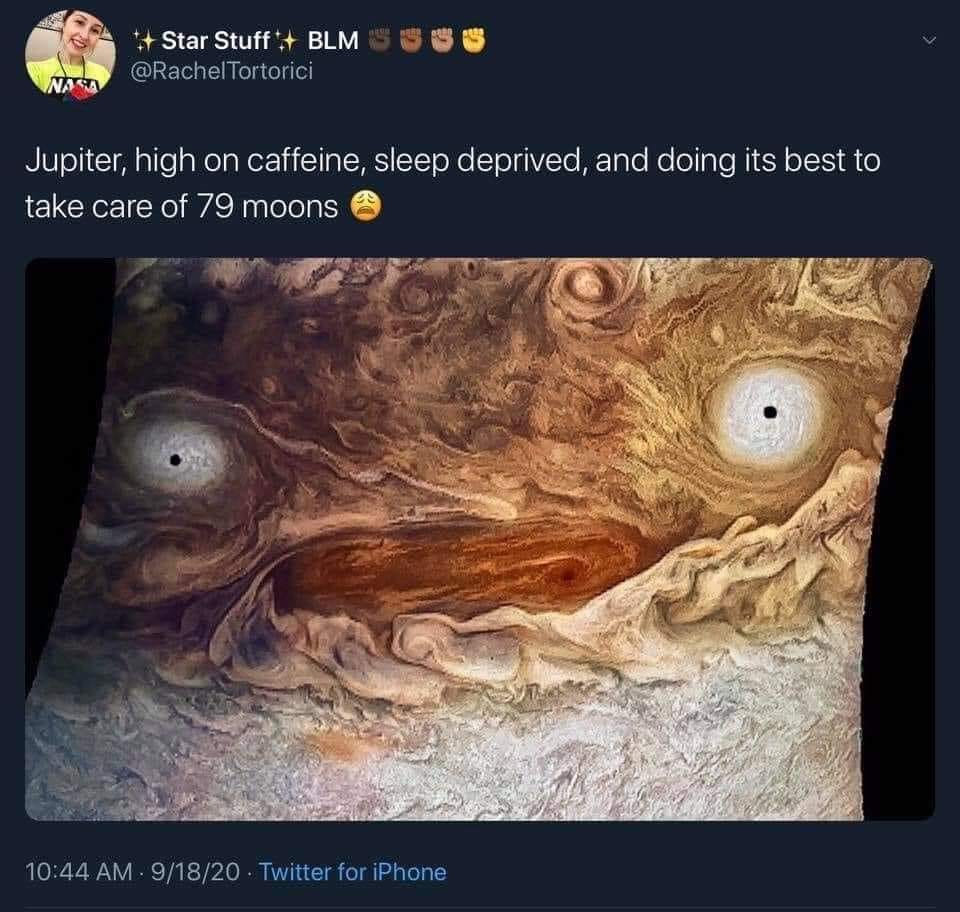
The meme is a humorous image of the planet Jupiter, known for its distinctive "eye-like" features, with a caption that pokes fun at the planet's reputation for being high on caffeine and having a "high" level of activity. The image is captioned "Jupiter, high on caffeine, sleep deprived, and doing its best to take care of 79 moons". The meme is likely referencing the fact that Jupiter has a large number of moons, with 79 being the most accurate count.
detailed-analysis (gemma3-27b-vision)
Okay, here's an analysis of the image and tweet, broken down by the requested theoretical lenses. I'll indicate when a section isn't really applicable.
Visual Description
The image is a close-up photograph of Jupiter, likely captured by a space probe. The planet's surface is dominated by swirling bands of orange, tan, and cream, creating a visually turbulent and organic texture. Prominent are large, circular storm systems (possibly the Great Red Spot, although not clearly identifiable as such in this cropped view) that stand out against the swirling background. The lighting is dramatic, with highlights and shadows emphasizing the depth and complexity of the atmosphere. The overall effect is one of immense scale and energetic activity. The composition focuses on a portion of the planet, creating an intimate, almost "portrait-like" view.
Foucauldian Genealogical Discourse Analysis
The tweet anthropomorphizes Jupiter, attributing human characteristics like caffeine addiction and sleep deprivation. This isn't a scientific description, but a discourse—a way of talking about, and therefore understanding, the planet. A genealogical analysis would investigate how this specific discourse emerged.
- Historical Context: Over the centuries, celestial bodies were often personified in mythology (Jupiter as a God, etc.). The tweet draws on this long tradition, but updates it with contemporary references to modern stressors (caffeine, sleep deprivation).
- Power/Knowledge: The language suggests a humanization, thereby potentially allowing a feeling of control over, or understanding of, something so massive and incomprehensible. This act of ascribing human qualities may be a way to manage the anxiety associated with confronting the vastness of space. It’s about establishing a relatable framework for a fundamentally alien entity.
- Discursive Shift: The framing shifts from the "objective" scientific view of Jupiter as a gas giant to a subjective, playful, and emotionally-resonant understanding. The tweet presents this playful perspective as equally valid, creating a space for alternative understandings of the universe.
Critical Theory
This analysis focuses on the potential for the image and tweet to be interpreted through the lens of social critique.
- Human-Centric Bias: The tweet is fundamentally anthropocentric, projecting human experiences and vulnerabilities (caffeine addiction, sleep deprivation) onto a non-human entity. This reflects a broader Western tendency to understand the world through a human lens, prioritizing human experiences above all else. This could be seen as a limitation in understanding the true nature of Jupiter.
- Critique of Modernity: The references to caffeine and sleep deprivation subtly critique the pressures and anxieties of modern life. By attributing these states to Jupiter, the tweet implies that even cosmic entities are not immune to the burdens of contemporary existence.
- The Spectacle: The image itself is a product of sophisticated technology and scientific exploration, which can be seen as a form of spectacle. The tweet, by playfully framing the image, adds another layer to this spectacle. This prompts consideration of who gets to define what is spectacular and for what purposes.
Marxist Conflict Theory
While not directly about class struggle, a Marxist reading can be applied by considering the resources and power dynamics involved in space exploration.
- Resource Allocation: The scientific endeavors that enabled the capture of this image required vast resources (funding, personnel, technology) that could have been allocated to addressing pressing social problems on Earth. This begs the question: why prioritize the exploration of other planets when so many people on Earth are suffering?
- Ideological Function: The spectacle of space exploration can serve an ideological function, distracting from social inequalities and reinforcing the status quo. By focusing on the wonders of the universe, attention is diverted from the problems of capitalism and social injustice.
- Ownership of Knowledge: The image and data collected by space missions are often owned and controlled by powerful institutions (like NASA), perpetuating power imbalances in the production and dissemination of knowledge.
Postmodernism
The image and tweet embody several key postmodern characteristics.
- Simulacra and Simulation: The image is a representation of Jupiter, a simulation created by instruments and processed by computers. This image isn’t reality, but a “copy” of a reality, creating a layer of mediation between us and the actual planet.
- Blurring of Boundaries: The tweet blurs the boundaries between science and art, objectivity and subjectivity, human and non-human. This challenges traditional ways of categorizing and understanding the world.
- Playfulness and Irony: The anthropomorphism of Jupiter is a playful and ironic gesture, subverting the seriousness of scientific discourse. This demonstrates a rejection of grand narratives and a celebration of ambiguity.
- Deconstruction of Meaning: The tweet doesn’t offer a definitive interpretation of Jupiter but invites multiple readings. It deconstructs the traditional scientific understanding of the planet and opens up new possibilities for meaning-making.
Queer Feminist Intersectional Analysis
This is the most difficult lens to apply directly, but some connections can be made.
- Challenging "Natural" Order: Assigning human vulnerabilities (exhaustion, reliance on stimulants) to a cosmic entity subtly challenges the idea of a rigid, hierarchical "natural order" in the universe. This can be linked to queer and feminist critiques of traditional power structures.
- De-centering the Human: By giving agency and experience to something non-human, the analysis decenters the human as the sole locus of consciousness and experience. This resonates with intersectional feminist understandings of the interconnectedness of all beings and the need to move beyond anthropocentric perspectives.
- Vulnerability and Care: The framing of Jupiter "doing its best" despite being sleep-deprived evokes a sense of empathy and care. This could be connected to feminist ethics of care, which emphasize the importance of acknowledging and responding to the vulnerabilities of others.
I hope this provides a comprehensive analysis of the image and tweet through these various theoretical lenses! Let me know if you'd like me to expand on any particular section.
simple-description (llama3.2-vision)
This meme is a humorous image of the planet Jupiter with a sarcastic caption. The text reads: "Jupiter, high on caffeine, sleep deprived, and doing its best to take care of 79 moons." The image is a joke about the planet's chaotic appearance, implying that it's struggling to manage its many moons. The caption is a playful exaggeration of the challenges of being a planet with a large number of satellites.
tesseract-ocr
Ea) Peers sea: hemo n h) < phen @RachelTortorici Jupiter, high on caffeine, sleep deprived, and doing its best to take care of 79 moons ® a | PRE eM Be gi 3 RG) he ae en Es eee ed) A ane eae eS SN) Se me PeR Ses Ne Van cy ~~. eR. MeN Pa Ps i yy - Pd oma ena i " my fie e “ "sy a _— Sa fe J Vf 2 | lle Mii e i. pli om ia 7 zis seta,’ ee el RG ee eS = Soe re is Le i : 2 ae Bn mh ee bbl Pe ie ets ; ay 10:44 AM - 9/18/20 - Twitter for iPhone