First Seen
2024-05-27T22:10:37.676493+00:00
simple-description (qwen3.5_2b-q8_0)
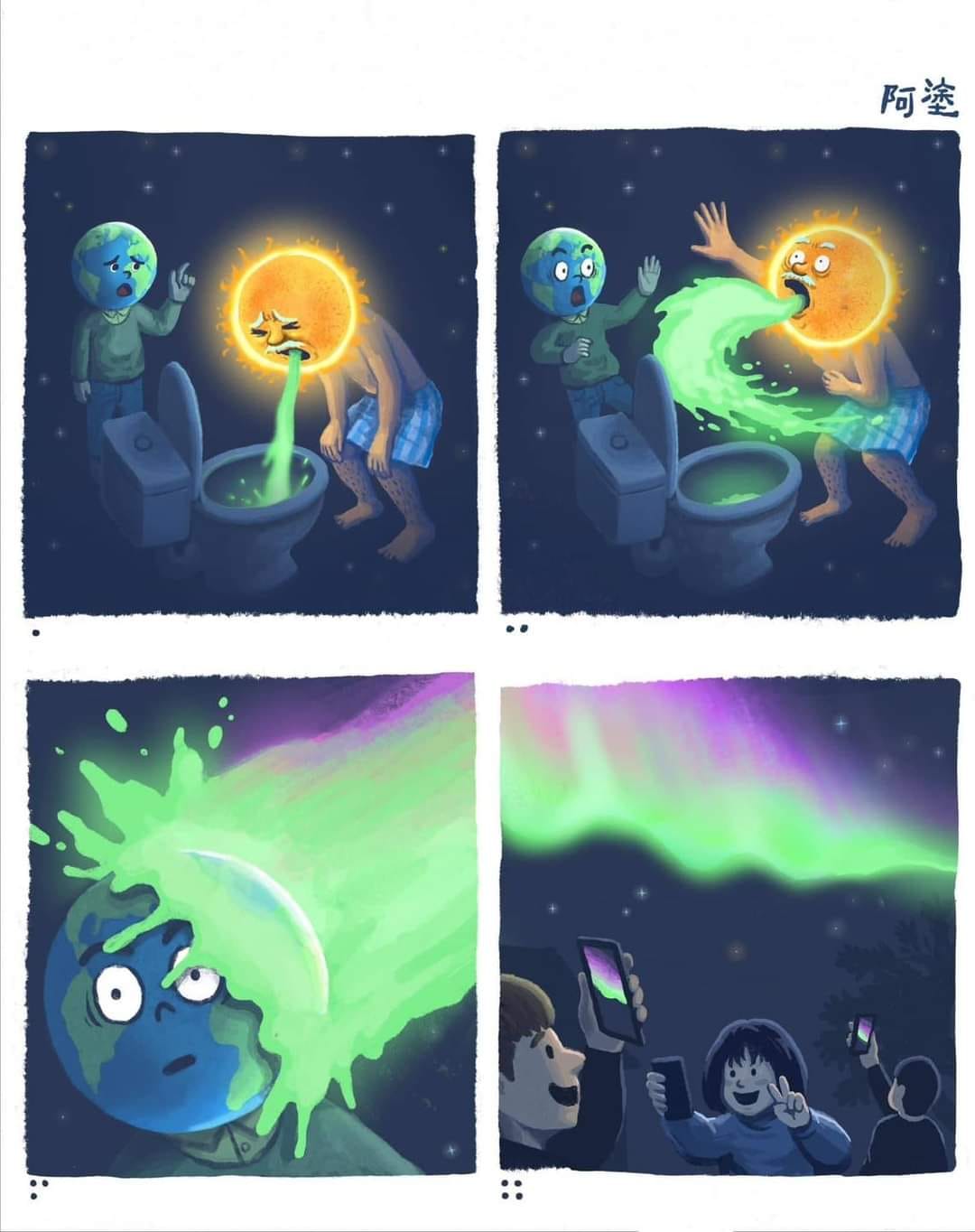
In the context of astronomy, this meme satirizes the often misunderstood and sometimes gross view of space, suggesting that celestial bodies like the sun are dirty and constantly spitting cosmic waste onto Earth. It humorously imagines that bright meteors (the shooting stars we see) are actually large sludge balls being thrown from the sun onto the planet. Finally, the image shows this green sludge spreading across the night sky like an aurora, prompting observers to use their phones to take pictures of this cosmic pollution.
simple-description (llama3.2-vision_11b)
The meme is a play on the phrase "I can see for miles" from the song "I Can See for Miles" by The Who. The image depicts a person looking up at the stars, with a caption that says "I can see for miles". The joke is that the person is actually looking at the stars, but the caption is a reference to the song, implying that the person is looking at the stars, but not actually seeing them.
detailed-analysis (gemma3-27b-vision)
Okay, let's break down this four-panel comic strip through the lenses you've requested. It’s a powerfully symbolic piece, and many of these analyses will overlap. I'll prioritize the most salient connections for each section.
Visual Description
The comic depicts a series of escalating events centered around a stylized Earth and a personified Sun, both appearing distressed. The background is consistently a dark, starry expanse.
- Panel 1: A personified Earth stands near a toilet. A noxious, green substance is flowing from the toilet and towards the personified Sun, who looks horrified. The Earth looks upset, almost tearful.
- Panel 2: The noxious substance reaches the Sun, causing it to recoil in apparent pain. The Earth tries to block the substance, but it’s too late.
- Panel 3: The Sun explodes in a burst of green light, and the Earth seems startled and distressed, covered in the exploding substance.
- Panel 4: A group of figures (mostly silhouettes, likely humans) are observing the aftermath through their phones, taking pictures. One figure has their hands over their eyes. The background is filled with the green aurora-like glow.
The artwork is illustrative and colorful, blending cartoonish expressions with a sense of cosmic scale. The green substance visually links the pollution/waste to the damage inflicted upon the sun.
Foucauldian Genealogical Discourse Analysis
This comic presents a strong case for Foucauldian analysis. Foucault focused on how power operates through discourse—the ways we talk about, categorize, and understand things.
- Discourse of Environmental Damage: The comic visualizes a discourse where waste (the green substance) is implicitly linked to the destruction of a vital natural force (the Sun). This is not framed as a natural disaster, but as a direct result of human action (the toilet implies human waste/consumption).
- Power/Knowledge: The way the comic is structured presents a particular knowledge about the relationship between human activity and the environment. This knowledge then informs (and justifies) certain power dynamics. We are told (through the image) that waste causes destruction.
- Genealogy: A genealogical approach asks us to trace the history of this discourse. How did we come to understand waste in this way? What historical changes led to this seemingly obvious connection between pollution and cosmic harm? We’re not given a direct history within the image, but it prompts that question.
- Discipline and Control: The final panel, with people passively recording the event, can be seen as illustrating a form of control. The act of documenting/sharing replaces any real action or intervention. We are seeing a spectacle of disaster instead of responding to it.
Critical Theory
Critical Theory, particularly the Frankfurt School, is highly relevant here. It focuses on exposing power structures and challenging dominant ideologies.
- Commodification of Nature: The comic subtly suggests that nature (the Sun, the Earth) has been reduced to a commodity—something to be exploited and consumed, and whose destruction is only viewed as a spectacle.
- Instrumental Reason: The comic could be interpreted as critiquing “instrumental reason”—the idea that everything (including nature) is viewed as a means to an end. We've exploited the Earth for our needs, and now the Sun suffers, and we simply record it.
- Alienation: The humans in the final panel are alienated from both the event and their own agency. They are observers, not participants. Their phones act as a barrier, separating them from the reality of the disaster. They become spectators of their own destruction.
- Culture Industry: The act of photographing/documenting the disaster can be seen as part of the “culture industry”—the mass production of standardized cultural goods (in this case, images) that pacify and control the population.
Marxist Conflict Theory
From a Marxist perspective, the comic highlights the inherent conflicts within a capitalist system.
- Exploitation of Natural Resources: The comic can be seen as a metaphor for the exploitation of natural resources. The Earth is “used up” (represented by the toilet), leading to the destruction of the Sun (a vital resource).
- Class Conflict: While not explicitly stated, the humans observing the disaster can be interpreted as representing a privileged class who are disconnected from the consequences of their actions. They benefit from the exploitation of resources, but remain distant from the suffering.
- Alienation of Labor: The humans’ passive observation reinforces the concept of alienation of labor – individuals are separated from the products of their labor and from each other.
- Commodity Fetishism: The humans’ focus on recording the event through their phones can be seen as a form of commodity fetishism. The image of the disaster becomes more important than the disaster itself.
Postmodernism
The comic’s fragmented narrative and focus on spectacle align with postmodern themes.
- Simulacra and Simulation: The image of the disaster (the exploding Sun) becomes a simulacrum – a copy without an original. The image itself is more real than the event. The humans' recording of the event on their phones further emphasizes the idea of a "hyperreality."
- Loss of Grand Narratives: The comic challenges the traditional “grand narrative” of progress and human domination over nature. There is no sense of a hopeful future or a solution to the problem.
- Deconstruction: The comic deconstructs the idea of human exceptionalism. Humans are not separate from nature, but are deeply intertwined with it. Their actions have devastating consequences.
- Spectacle: The humans are merely spectators. It embodies Guy Debord's concept of the "society of the spectacle" where images and spectacles have replaced meaningful experience.
Queer Feminist Intersectional Analysis
While not the most immediately obvious lens, an intersectional approach can add depth.
- Ecofeminism: This comic directly speaks to ecofeminist ideas, which link the domination of nature with the domination of women. The Earth (feminized) is exploited and abused, mirroring the exploitation and abuse of marginalized groups.
- Environmental Justice: The comic implicitly raises questions about environmental justice. Who is most affected by environmental damage? Who benefits from the exploitation of natural resources? The passive onlookers seem oblivious to the inequitable distribution of harm.
- Marginalized Voices: The silenced perspective of the Earth and the Sun represents the silencing of marginalized voices. Their suffering is not acknowledged or addressed.
- Care Ethics: The lack of intervention/care shown by the humans highlights a failure of care ethics – the idea that we have a moral obligation to care for others and the environment.
I hope this thorough breakdown of the comic through multiple theoretical lenses is helpful! Let me know if you'd like me to elaborate on any of these points or explore another theoretical framework.
tesseract-ocr
Fay? ‘a gg: in W — SO 9 i. S f__ = P 5 r P i — iy ao = nn © a » 4 > 4 é : — : y P : , : Sid \e ° 7 , / j } 3 S un i - 4 LS
simple-description (llama3.2-vision)
This meme depicts a person vomiting a green, glowing substance into a toilet, with the sun and Earth in the background. The text "I'm not mad, I'm just disappointed in the state of the planet" appears in the image. The image is a humorous commentary on the state of the environment and the impact of human actions on the planet.