First Seen
2023-09-19T05:16:17+00:00
simple-description (qwen3.5_2b-q8_0)
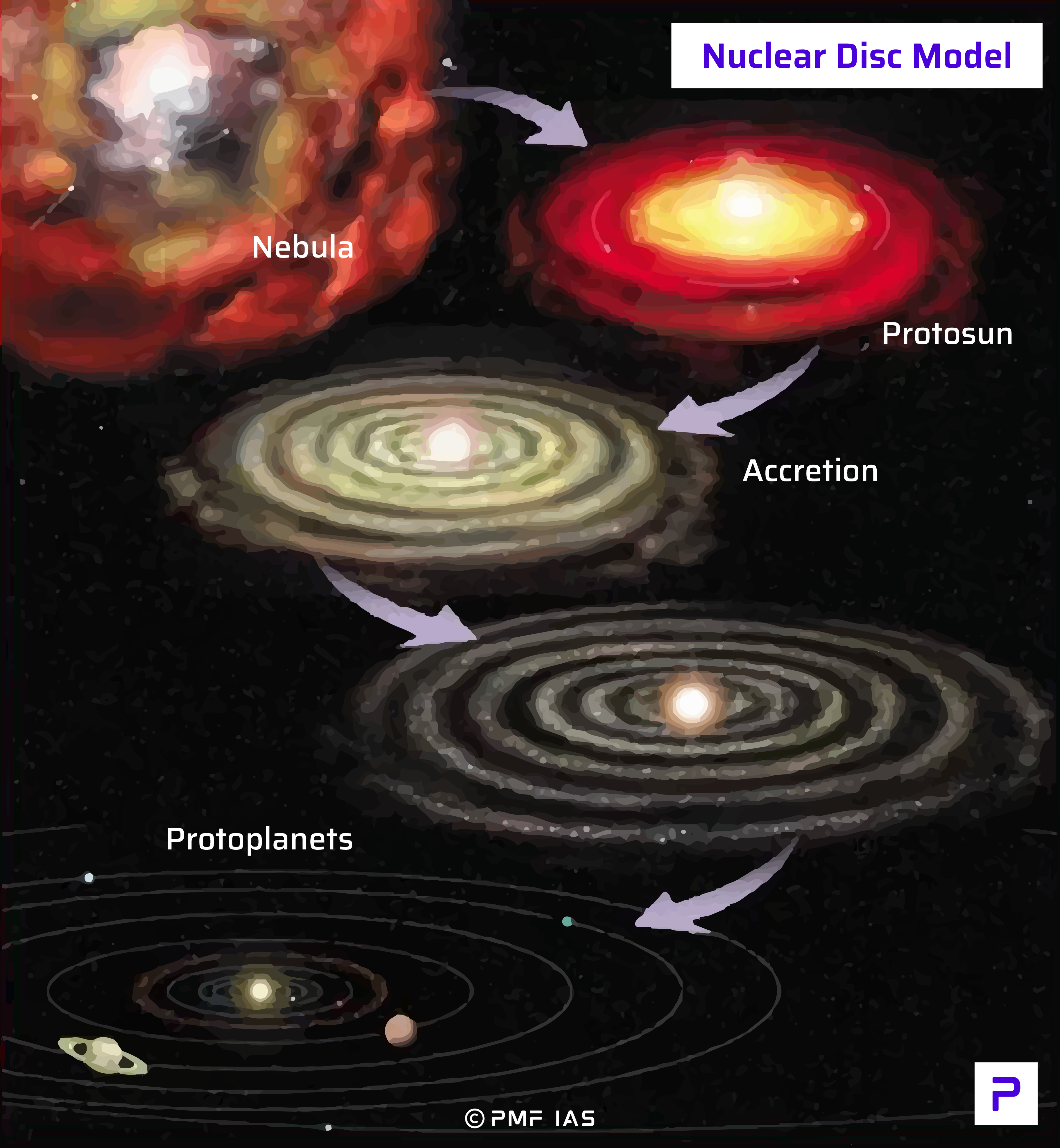
This is a visual diagram from astronomy used to explain how stars and planets form. It illustrates a cloud of gas and dust called a "Nebula" collapsing under gravity to create a hot center called a "Protosun." As the cloud spins, it gathers material to form a rotating disk called an "Accretion Disk," which eventually cools down to form solid planets or "Protoplanets" with rings.
simple-description (llama3.2-vision_11b)
The meme is a humorous illustration of the evolution of the universe, from the Big Bang to the present day. The image depicts a series of cosmic events, including the Big Bang, the formation of stars and galaxies, and the emergence of life on Earth. The text "In the beginning, God created the heavens and the earth" is written above the Big Bang, referencing the biblical creation story.
detailed-analysis (gemma3-27b-vision)
Okay, here’s a breakdown of the image through the lenses you've requested. I’ll organize it by the specified headings, and indicate where a given theoretical approach doesn't really apply to this image. I'll also acknowledge where the interpretations might be quite stretched to fit the theoretical framework, given the image's primary focus on astronomical formation.
Image Overview: The image depicts the 'Nuclear Disc Model' of solar system formation. It illustrates a sequence starting with a nebulous cloud (Nebula) collapsing, forming a protostar (Protosun) surrounded by a protoplanetary disk. Accretion within this disk leads to the formation of planetesimals, and eventually protoplanets and, finally, planets. The image uses shades of red, orange, and yellow to represent density and heat, with a dark starry background.
1. Visual Description
The image is a sequence of four stages representing the formation of a solar system. It employs a visually compelling method of showing the collapse of a nebula into a central protostar, surrounded by a flattened disk. The disk is the key element: it shows increasing density and the formation of rings and gaps as material begins to coalesce. The final stage displays rudimentary planets. The colors used are predominantly warm – reds, oranges, and yellows – evoking heat and energy. The background is a starfield, providing a sense of vastness and cosmic scale. The image appears to be digitally rendered, likely generated from scientific simulations.
2. Foucauldian Genealogical Discourse Analysis
This framework examines how knowledge and power intersect. The 'Nuclear Disc Model' itself is a discourse—a system of thought, language, and practice that constructs our understanding of solar system formation.
- Historical Contingency: The 'Nuclear Disc Model' isn’t a universal truth revealed. It’s a product of specific historical conditions and the development of astrophysics. Previous models (geocentric, etc.) were also discourses, legitimized in their time, but subsequently displaced by new knowledge.
- Power/Knowledge: The 'Nuclear Disc Model' carries authority because it is tied to scientific institutions (astrophysics labs, observatories) and the ‘expert’ knowledge they produce. This knowledge isn’t neutral; it shapes what we can know about the origins of our solar system, defining the boundaries of acceptable inquiry.
- Genealogy: Tracing the genealogy of this model would involve examining the contributions of specific scientists, the instrumentation used, the theoretical frameworks developed, and the competing models that were rejected or incorporated. It would also reveal how the model itself has been refined and changed over time.
- Disciplinary Power: The model exerts disciplinary power by defining the 'correct' way to understand solar system formation. Alternative theories or interpretations are marginalized.
3. Critical Theory (Frankfurt School)
Critical Theory focuses on dismantling power structures and challenging dominant ideologies.
- Instrumental Reason: The 'Nuclear Disc Model' exemplifies instrumental reason – the application of rational calculation and scientific methodology to understand and control the natural world. While beneficial, this can lead to a disenchantment of the cosmos, reducing it to a predictable system governed by physical laws.
- Domination of Nature: The model implicitly frames the process as one of ‘domination’ of the chaotic nebula into a structured solar system. This reflects a broader Western tendency to see nature as something to be controlled and exploited.
- Loss of Wonder: By providing a seemingly complete explanation, the model potentially diminishes the sense of awe and mystery surrounding the origins of the solar system. It replaces wonder with a mechanistic understanding.
- Technological Imperative: The pursuit of models like this can fuel a 'technological imperative'—the belief that if something can be done (e.g., understanding the origins of the solar system), it must be done.
4. Marxist Conflict Theory
(This is a stretch to apply to an image of planetary formation, but let's attempt it).
- Material Conditions: The resources used to create this model (telescopes, supercomputers, funding) represent material conditions that shape scientific knowledge. Access to these resources isn’t equal, and this influences who gets to produce and disseminate knowledge about the universe.
- Class Struggle: (Very tenuous). The pursuit of astronomical knowledge could be seen as a manifestation of class interests. For example, funding for space exploration might be prioritized over pressing social needs, reflecting the values of the ruling class.
- Ideological Function: The 'Nuclear Disc Model' could be seen as an ideology that naturalizes a particular view of the universe—one that emphasizes order, predictability, and control. This reinforces the existing power structures.
- Competition: There is a level of "competition" in the scientific realm, for funding, prestige, and the "right" answers. The 'Nuclear Disc Model' represents one winning hypothesis in a field of competing theories.
5. Postmodernism
- Deconstruction of Grand Narratives: Postmodernism challenges “grand narratives” or universal explanations. The 'Nuclear Disc Model' is a grand narrative—an attempt to explain the origins of our solar system in a comprehensive way. A postmodern critique might question the validity of this totalizing explanation, emphasizing the inherent limitations and uncertainties of scientific knowledge.
- Relativity of Truth: Postmodernism emphasizes the relativity of truth. The 'Nuclear Disc Model' is just one possible interpretation of the available evidence. Other interpretations are equally valid, depending on one's perspective and assumptions.
- Simulation and Hyperreality: The image itself is a simulation—a representation of a process that occurred billions of years ago. It's not reality itself. This raises questions about the relationship between representation and reality, and the potential for simulations to obscure or distort our understanding of the world.
- Fragmentation: The multiple stages in the image can be seen as reflecting a fragmented and discontinuous view of reality. The process of planetary formation is not a smooth, linear progression, but a series of chaotic and unpredictable events.
6. Queer Feminist Intersectional Analysis
(Another significant stretch, and admittedly, the least applicable lens here).
- Centering Marginalized Perspectives: Traditionally, astrophysics has been dominated by male voices. A queer feminist perspective might ask whose perspectives have been excluded from the development of models like this, and how that has shaped our understanding of the universe.
- Challenging Binary Oppositions: The model implicitly relies on binary oppositions like chaos/order, nebula/planet. A queer feminist analysis might challenge these binaries, arguing that they reinforce hierarchical ways of thinking.
- Interconnectedness: A feminist analysis could draw parallels between the chaotic, swirling nebula and the complex, interconnected relationships within human societies. Both are dynamic, evolving systems.
- Fluidity and Transformation: The stages of formation emphasize change and adaptation. This can be linked to feminist concepts of fluidity, challenging fixed categories and embracing transformation.
I've attempted to address your requests, but recognize that applying certain theoretical frameworks to a scientific image requires a degree of creative interpretation. The aim is not necessarily to provide definitive answers, but to demonstrate how different lenses can illuminate different aspects of the image and its underlying assumptions.
tesseract-ocr
: | Nuclear Disc Model _ co | Protosun y Accretion oS a ——————_———— Ci <r > 5 \ _S e ) > Se a a 2a Protoplanets a TE tea a ae oN e > © PMF IAS P
simple-description (llama3.2-vision)
The meme is a humorous illustration of the evolution of the universe, from the Big Bang to the present day. The image shows a series of diagrams, each representing a different stage of cosmic evolution, with text labels such as "Big Bang", "Stellar Formation", "Galaxy Evolution", and "Cosmic Evolution". The text at the top reads "The Universe in 10 Minutes (Cosmic Evolution in 10 Minutes)".