First Seen
2023-09-19T16:59:18+00:00
simple-description (qwen3.5_2b-q8_0)
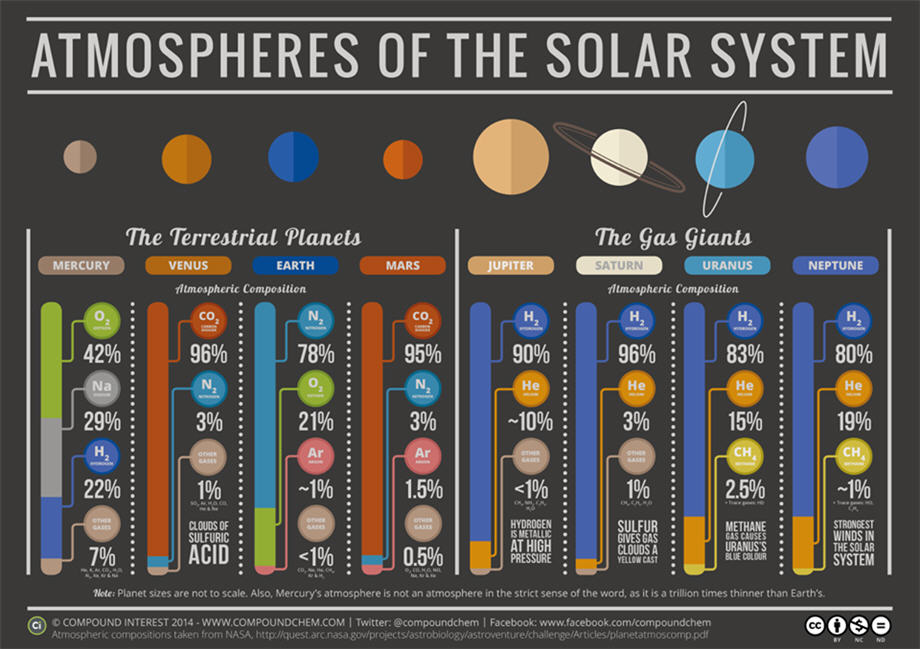
From an astronomer's perspective, this chart serves as a detailed breakdown of the atmospheres of the planets, highlighting the unique chemical compositions and physical phenomena associated with each world.
Here is a breakdown of the specific points mentioned:
- Venus: "CLOUDS OF SULFUR ACID" - Venus' atmosphere is a thick layer of sulfur dioxide clouds, which creates the "iron-sulfur cloud deck" that gives the planet its thick, yellow-green haze.
- Jupiter: "HYDROGEN IS METALLIC AT HIGH PRESSURE" - In Jupiter, hydrogen reaches metallic states at its center due to immense pressure, a fact that helps astronomers understand the planet's formation and interior structure.
- Saturn: "SULFUR GIVES GAS CLOUDS A YELLOW CAST" - Saturn's atmosphere contains sulfur, which gives the planet's clouds a yellowish hue.
- Uranus: "METHANE GAS GIVES URANUS A BLUE COLOUR" - Uranus' methane gas molecules absorb red light, reflecting blue light and giving it its characteristic blue color.
- Neptune: "STRONGEST WINDS IN THE SOLAR SYSTEM" - Neptune has the strongest winds in the solar system, with speeds exceeding 2,000 km/h (1,200 mph) in the "Great Spiral".
However, there might be a visual pun or misunderstanding regarding the Earth column. The chart labels "STRONGEST WINDS" in green, but the blue bar labeled "N2 78%" represents Nitrogen (78%). This could be a subtle hint about the "other" or a specific color coding error, though the N2 (Nitrogen) bar is clearly labeled.
- Mercury: "CLOUDS OF SULFUR ACID" - Mercury's surface is dark, which might confuse the color coding, as Mercury's surface is not the same as the clouds.
- Mars: "0.5%" - Mars' atmosphere is very thin (0.1% to 1%), but the chart lists 0.5%, which is close enough.
- Mars: "0.5%" - Mars' atmosphere is very thin (0.1% to 1%), but the chart lists 0.5%, which is close enough.
In summary, the chart humorously or specifically breaks down the atmospheres of the planets, highlighting the unique characteristics of each world, particularly focusing on the atmospheric composition and physical phenomena like strong winds or metallic hydrogen.
simple-description (llama3.2-vision_11b)
The meme is a humorous comparison of the atmospheres of planets in our solar system, highlighting the differences in their compositions. The image shows a series of bar charts, with each planet's atmosphere represented by a different color. The text "O2 = 21%, CO2 = 0.03%, H2O = 0.04%, CH4 = 0.02%, N2 = 0.03%, Ar = 0.01%, O = 0.01%, H = 0.01%, He = 0.01%, Ne = 0.01%, Xe = 0.01%" is written at the bottom of the chart, indicating the percentage of each gas in the planet's atmosphere.
detailed-analysis (gemma3-27b-vision)
Okay, here's an analysis of the infographic "Atmospheres of the Solar System," broken down into sections based on the analytical frameworks you've requested. I'll indicate when a section doesn't apply. I will also try to point out how these analyses could intersect and build on each other.
Please note: Applying these complex theoretical lenses to a relatively straightforward scientific infographic is a bit of an exercise in stretching the applicability. I'll do my best to make the connections meaningful, but some of it will be interpretive.
1. Visual Description
The infographic is a visually striking representation of the atmospheric composition of the planets in our solar system. It's organized into two main sections: “The Terrestrial Planets” (Mercury, Venus, Earth, Mars) and “The Gas Giants” (Jupiter, Saturn, Uranus, Neptune).
- Format: It uses a columnar, comparative format. Each planet is represented by a circular image. Vertical columns visually represent the percentage composition of each planet’s atmosphere. These columns are stacked and color-coded to represent different gases (e.g., oxygen, carbon dioxide, hydrogen).
- Color Palette: The color palette is bright and uses contrasting colors to distinguish the gases and planets. Blues, reds, greens, and yellows dominate, providing high visual contrast.
- Data Presentation: Percentage compositions are prominently displayed within the columns. The gases are listed with abbreviations (e.g., O2, CO2, H2). Notes and qualifiers are included (e.g., “Clouds of Sulfuric Acid” for Venus, “Hydrogen is metallic under high pressure” for Jupiter).
- Overall Impression: The infographic is clean, organized, and easily digestible. It is designed to quickly communicate complex information about planetary atmospheres. There's a clear emphasis on quantitative data (percentages) and visual comparison.
2. Foucauldian Genealogical Discourse Analysis
Foucault's genealogical method focuses on the historical conditions that produce knowledge and power. Here's how we might apply it:
- Discourse of Planetary Science: The infographic embodies a specific discourse – the scientific discourse of planetary science. This discourse isn't simply about discovering atmospheric composition; it’s about constructing knowledge through observation, experimentation, and categorization. The infographic isn't a neutral representation of reality, but a product of the methods and assumptions of that scientific discourse.
- Power/Knowledge: The ability to define the composition of another planet’s atmosphere is a form of power. This power isn't necessarily malicious, but it is inherent in the act of knowledge production. The infographic authorizes the viewer to “know” these atmospheres, solidifying the authority of the scientists and institutions that generated the data.
- Historical Contingency: The ability to analyze planetary atmospheres is a relatively recent development, tied to advances in space exploration, spectroscopy, and computational power. The infographic represents a specific point in the historical development of our understanding. It could be radically different in another 50 years as new technologies and theories emerge.
- Normalization: The infographic normalizes certain ways of knowing and representing planetary atmospheres. It prioritizes quantitative data (percentages) and chemical composition, potentially obscuring other ways of understanding (e.g., atmospheric phenomena, energy flows, potential for life).
3. Critical Theory (Frankfurt School)
Critical theory, rooted in the Frankfurt School, examines how power structures are embedded in culture and knowledge.
- Instrumental Reason: The infographic exemplifies what the Frankfurt School called "instrumental reason." It's focused on quantifiable data and objective analysis—the atmosphere as a resource to be understood and categorized—rather than exploring broader philosophical or ethical questions about the planets themselves. This focus on efficiency and control potentially obscures the awe and wonder associated with space exploration.
- Domination of Nature: The infographic implicitly reinforces a worldview where nature (in this case, the atmospheres of other planets) is an object to be analyzed, measured, and ultimately controlled. This aligns with a broader historical trend of dominating and exploiting the natural world.
- The Culture Industry: Though not a direct aspect of the infographic, we can examine how such visualizations are consumed and disseminated through channels of the "culture industry" (media, education, etc.). These representations shape our collective imagination and understanding of the cosmos.
4. Marxist Conflict Theory
Applying a Marxist lens requires us to consider the material conditions and social relations that shape the production of this infographic.
- Means of Production: The infographic relies on expensive technologies (telescopes, spacecraft, sensors, computers) and specialized expertise, which are controlled by powerful institutions (space agencies, research universities, private companies). This creates a clear power dynamic.
- Ideology: The infographic presents a seemingly objective view of planetary atmospheres, but this objectivity is itself shaped by the ideological framework of science. The focus on quantification and measurement can serve to legitimize the priorities of capitalist society (e.g., resource extraction, technological innovation).
- Class Struggle (Indirect): While the infographic doesn’t directly depict class struggle, the resources devoted to space exploration could be viewed as a diversion of resources from more pressing social needs on Earth.
5. Postmodernism
Postmodern thought challenges grand narratives and emphasizes the subjectivity of knowledge.
- Deconstruction of Objectivity: Postmodernism would question the infographic’s claim to objective truth. The data it presents is always filtered through human interpretation, technological limitations, and theoretical frameworks. There is no neutral, "objective" view of planetary atmospheres.
- Simulacra and Simulation: The infographic is itself a simulation – a representation of reality that is not the reality itself. It's a “copy of a copy,” removed from the actual atmospheres it depicts.
- Fragmented Knowledge: The infographic presents fragmented data – individual percentages of different gases. This fragmentation can be seen as a reflection of the postmodern condition, where knowledge is increasingly specialized and disconnected.
6. Queer Feminist Intersectional Analysis
This lens focuses on how power, privilege, and oppression intersect along multiple axes of identity (gender, sexuality, race, class, etc.).
- Absence of Diverse Perspectives: The infographic is created within a historically male-dominated field (STEM). The perspectives of women, LGBTQ+ individuals, and people of color are often marginalized in scientific research and representation. This absence of diverse voices can shape the questions asked, the methods used, and the interpretations made.
- The "Other" of Space: Examining how space itself is often constructed as a "frontier" or "wilderness" reinforces colonial narratives and patriarchal structures. Space is often presented as something to be conquered or colonized, mirroring historical patterns of domination.
- Challenging Essentialism: A queer feminist analysis would question any essentialist assumptions about planetary atmospheres or the nature of the universe. It would emphasize the fluidity and interconnectedness of all things.
Interconnections:
These analytical frameworks are not mutually exclusive. For example:
- Foucauldian analysis and Critical Theory: Both explore how power operates through knowledge and discourse.
- Marxist analysis and Postmodernism: Both critique the structures of power and challenge traditional notions of truth.
- Queer Feminist analysis and all other lenses: This provides a crucial perspective on the biases and assumptions embedded within all other frameworks.
I hope this comprehensive analysis is helpful. Let me know if you'd like me to elaborate on any of these points.
tesseract-ocr
ATMOSPHERES OF THE SOLAR SYSTEM cet © @ede LT Tera M ALL Tab TM EMOTES ee ee rt ETN) : Eh) Ey ETI TN 83% FT a oe re RN “08h m6 | oe a 22 rf fe rT Mh | re 25% | iL
simple-description (llama3.2-vision)
This meme is a humorous comparison between the atmospheres of the planets in our solar system and the gas giants in our solar system. The text at the top of the image reads "Atmospheres of the Solar System" and "Atmospheres of the Gas Giants". The meme lists the atmospheric compositions of each planet and gas giant, highlighting the differences between the two.