First Seen
2023-09-19T04:09:18+00:00
simple-description (qwen3.5_2b-q8_0)
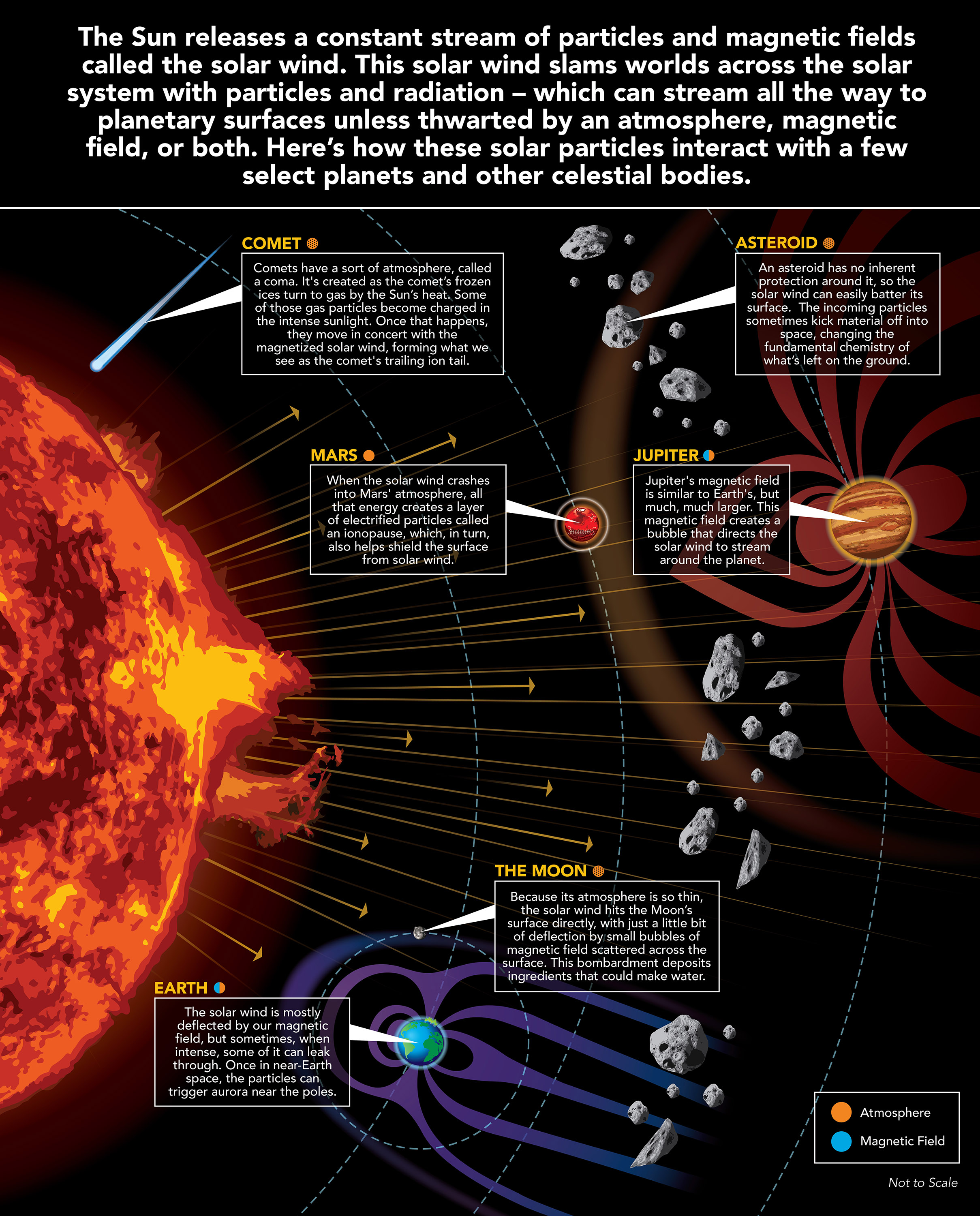
This infographic serves as an educational overview of the solar wind, explaining that the Sun releases a "constant stream of particles and magnetic fields." It illustrates that the solar wind can directly hit the Moon "because its atmosphere is so thin" and trigger "aurora near the poles." For comparison, it notes that Earth's magnetic field mostly deflects this wind, while Jupiter's large magnetic field creates a bubble that directs the stream around the planet.
simple-description (llama3.2-vision_11b)
The meme is an image of a giant space rock (asteroid) with a caption that says "When you finally understand the universe but still can't do your math homework". The meme is poking fun at the idea that even with a deep understanding of the universe, one can still struggle with mundane tasks like math homework.
detailed-analysis (gemma3-27b-vision)
Okay, let's break down this image of the solar wind interacting with celestial bodies through the lens of different theoretical frameworks. It's a visually rich illustration, lending itself to surprisingly complex interpretations.
Please note: Applying these advanced theoretical lenses to a scientific illustration is somewhat unconventional. It's about how we can interpret the visual and associated text, rather than a direct inherent 'meaning' within the illustration itself. I will aim to be thoughtful and demonstrate how these frameworks can be applied.
1. Visual Description
The image is a colorful diagram depicting the solar wind’s interaction with several celestial bodies in our solar system. It's a simplified, educational illustration.
- Central Figure: The Sun is at the left, radiating lines representing the solar wind – a stream of particles and magnetic fields. These lines are shown curving and impacting various objects.
- Celestial Bodies: Represented are the Earth, Moon, Mars, Jupiter, a Comet, and an Asteroid. Each body is shown with different levels of atmospheric shielding or magnetic field strength indicated by color (blue for atmosphere, purple for magnetic field).
- Visual Cues: The solar wind’s impact is shown through particle streams hitting the objects, and effects like auroras are indicated on Earth. The image uses color-coding and simple shapes to convey complex scientific concepts in an accessible way. It also includes a legend.
- Overall Style: Clean, diagrammatic, educational. Not photorealistic, but utilizes color to emphasize forces and interactions.
2. Foucauldian Genealogical Discourse Analysis
Foucault is interested in power dynamics and how knowledge is constructed. We can analyze this image through this lens by asking: What discourses are being reinforced here?
- Discourse of Scientific Authority: The image itself represents a discourse of scientific authority. The “facts” presented are not neutral, they are produced through scientific method and peer review, and are presented here as objective truth. This image contributes to that ongoing authority.
- Discourse of Control & Understanding: This illustration embodies a desire to understand and, in a sense, “control” our environment through scientific knowledge. By depicting the solar wind and its interaction with planets, the image implies a level of human agency over understanding these forces.
- Genealogy of Understanding of Space: Historically, understanding the solar system has moved from myth/religion to observation/mathematics to the modern scientific frameworks. This illustration is one small point in that ongoing genealogy – a visualization that reinforces certain ways of thinking about space.
- Power/Knowledge: Foucault argues power and knowledge are intrinsically linked. The knowledge presented here (about the solar wind) is a form of power – it enables prediction, potential mitigation of risk (e.g., from solar flares), and the technological development associated with space exploration.
3. Critical Theory (Frankfurt School)
Critical Theory challenges power structures and ideologies. We can explore how this image might reinforce certain ideologies.
- Technological Rationality: The image presents a purely rational, technological view of the universe. It focuses on quantifiable forces (solar wind, magnetic fields) and ignores any other potential ways of relating to celestial bodies (e.g., spiritual, mythological). This reinforces the idea that technological progress is the only path to understanding and mastering the natural world.
- Domination of Nature: By visualizing the solar wind impacting planets, the image can be seen as subtly reinforcing the idea of humanity's domination over nature. We're not simply within the solar system, but actively understanding and mapping its forces, as if to control it.
- The Illusion of Control: Critical theorists might argue that this visualization gives a false sense of control. While we can understand the solar wind, we can't fully control it, and our reliance on technology to mitigate its effects can create new vulnerabilities.
- Commodification of Space: Linked to the point about control, the illustration implicitly participates in the broader project of commodifying space – turning it into a resource to be understood, exploited, and potentially colonized.
4. Marxist Conflict Theory
From a Marxist perspective, we would look at how this image relates to resources, power, and class conflict.
- Space as a New Frontier for Exploitation: The illustration can be seen as participating in the broader historical trend of exploring and exploiting new frontiers. Just as colonialism involved extracting resources from other lands, the study of space (and the technologies it drives) is increasingly linked to resource extraction (e.g., asteroid mining).
- Technological Development and Capital: The technologies developed to study and mitigate the effects of the solar wind are often funded by capitalist enterprises (e.g., space exploration companies, military-industrial complex). The illustration indirectly promotes these interests by presenting space as a realm of technological innovation and potential profit.
- Unequal Access to Knowledge & Benefits: The knowledge presented in this image is not equally accessible to all. It requires education, resources, and infrastructure. The benefits of space exploration (e.g., new technologies, resource extraction) are likely to be concentrated in the hands of a privileged few, exacerbating existing inequalities.
5. Postmodernism
Postmodernism challenges grand narratives and emphasizes the subjective nature of truth.
- Deconstructing "Objective" Knowledge: A postmodern analysis might question the idea that this illustration presents a truly "objective" view of the solar wind. It acknowledges that this is just one interpretation of reality, constructed through specific scientific frameworks and visual conventions.
- Simulation and Hyperreality: The image is a simulation of reality. It’s not the solar wind itself, but a visual representation of it. Postmodernism would suggest that this simulation can become more "real" than reality, shaping our understanding of space and influencing our actions.
- Fragmentation and Plurality: Postmodernism embraces fragmentation and the multiplicity of perspectives. This illustration focuses on a narrow range of phenomena (solar wind, planetary interactions). A postmodern analysis would suggest that this is just one piece of a much larger, more complex puzzle.
6. Queer Feminist Intersectional Analysis
This is the most challenging application to this image, but possible:
- Historically Masculine Space of Science: Scientific endeavors (especially space exploration) have historically been dominated by masculine norms and perspectives. The clean, technical aesthetic of the illustration can be seen as reinforcing these norms.
- The "Unmanned" Universe: The image focuses on impersonal forces and celestial bodies. It lacks any human presence, which implicitly reinforces the idea that space is a realm of masculine adventure and exploration, disconnected from everyday life and the concerns of marginalized communities.
- Exclusion from STEM Fields: The emphasis on technical expertise and scientific authority can contribute to the exclusion of women, people of color, and LGBTQ+ individuals from STEM fields.
- Intersectional Vulnerability: This requires a leap, but think of planetary vulnerability (e.g., solar flares impacting infrastructure). Different communities will be disproportionately affected by such events based on location, economic status, and access to resources.
I hope this thorough exploration, utilizing these theoretical lenses, is helpful. Let me know if you'd like me to delve deeper into any specific aspect.
tesseract-ocr
J e iJ The Sun releases a constant stream of particles and magnetic fields called the solar wind. This solar wind slams worlds across the solar system with particles and radiation — which can stream all the way to planetary surfaces unless thwarted by an atmosphere, magnetic iJ L e tJ e field, or both. Here’s how these solar particles interact with a few J J select planets and other celestial bodies. ~ eo s N " , y N : SC COMET @ . "5 . We) _ Comets have a sort of atmosphere, called An asteroid has no inherent DE Recline mac-t cea Reon ei key 418) Cy 4 & protection around it, so the y ices turn to gas by the Sun’s heat. Some solar wind can easily batter its p of those gas particles become charged in cK surface. The incoming particles the intense sunlight. Once that happens, eae sometimes kick material off into they move in concert with the > g space, changing the magnetized solar wind, forming what we fundamental chemistry of see as the comet's trailing ion tail. & b what's left on the ground. . N \ i | { ~" N A ey . aa \ | ! N i. Ve 7] A \ " ® Ts , \ a | ee y, x ; “ Cs \ \ | y Or AZ le A @ i G y Ne es \ MU ate) Nie 4 « \ \ ‘ | £ » iE When the solar wind crashes . Jupiter's magnetic field = —_— — 4 into Mars' atmosphere, all _ ae is similar to Earth's, but a . that energy creates a layer et TAleaMmanelcnMiclcc(-amMalcee Sl gue _ ’ —| . of electrified particles called ) magnetic field createsa [/ \ 4 an ionopause, which, in turn, Ney, bubble that directs the = also helps shield the surface solar wind to stream we we, a \ from solar-wind. i around the planet. \ < W _— \ \ ™~ \ »- an nN \ } w » 4 - \ => —_-| ° —__ ) » - 7 i ™ A N —————— = _ \ De “ ¢ / i a N == f . \ r ee 5 : = Se — r \ a) . ¢ ——— (wan 4 ot 7 : : ; 7 : OY "i » =. \ \ r a 7 a _ = See Ee ee aa & » \ é a ee a a end ———_ \ FS ——. : —— e y pee a x —_ rl E > 4 —1 > I p yd fl a ~t—_—_ a Y Fe en OR a I u he, I i yf aa, ] oh , pws : a. 1 MA — ! ¥ —-— . f Ce i. . g f : we a= eke) - i Because its atmosphere is so thin, —— : 4 ~ p the solar wind hits the Moon's ie ji _~ - surface directly, with just a little bit n £ ee ee of deflection by/small bubbles of i . 4 — !*\ | magnetic field scattered across the i ¢ — ” y surface. This bombardment deposits u 4 di (J meen Mae ktell-n cma meer (eMac R ica ! EARTH @ sf io A F | > a ] ; Bae) Mie M mune) HK __ — i a ~ : deflected by our magnetic o£ ‘ ~<a! he rs ' 4 field, but sometimes, when — a i eae. r intense, some of it can leak we , > ~~ , ee — Oe / through. Once in near-Earth <= ~<a NS U 4 space, the particles can P a. al > ~~ / Ma trigger aurora near the poles. ; . a ae x a a —" J y ‘ ' . “ wa & Y o Atmosphere Pe ee Se — an ; ‘ H e@ Magnetic Field . / a i ee, i” hl ; i < y; Not to Scale f yd, a rs
simple-description (llama3.2-vision)
The meme is a humorous image comparing the Sun's solar wind to a "giant fk" of a solar wind. The text "Giant Fk of a Solar Wind" is written in bold, playful font. The image is likely meant to be humorous and lighthearted, poking fun at the idea of the Sun's solar wind being a "giant f**k" of a solar wind.