First Seen
2023-05-10T21:03:34+00:00
gemma3-27b-vision
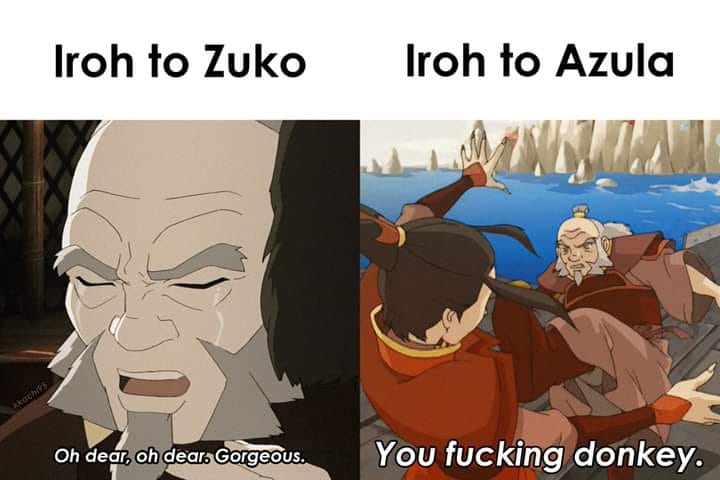
Okay, here's an analysis of the image, broken down into relevant sections, based on your requested frameworks. It's important to note that applying complex theoretical lenses to a meme is inherently a bit playful and can be stretched – the goal here is to demonstrate *how* these lenses *could* be applied, even if it feels a bit much in this context. --- **Visual Description** The image is a two-panel meme featuring screenshots from the animated television series *Avatar: The Last Airbender*. * **Panel 1 (Left):** Depicts Uncle Iroh, a character known for his calm demeanor and wisdom. He is looking slightly distressed, with a worried expression, and the text "Oh dear, oh dear. Gorgeous" is overlaid. The image is somewhat desaturated, enhancing the impression of concern and contemplation. * **Panel 2 (Right):** Shows Iroh in a dramatically different posture, aggressively pushing Azula, a character known for her ruthlessness and cunning. His face is contorted in anger, and the text "You fucking donkey" is overlaid. The background depicts a watery landscape, suggesting the context is a battle or confrontation. The color saturation is higher, emphasizing the intensity of the scene. The juxtaposition of the two images creates a humorous contrast between Iroh’s usual serene personality and his unexpected outburst of anger. --- **Foucauldian Genealogical Discourse Analysis** This meme can be analyzed through a Foucauldian lens by examining the *discourse* around Iroh’s character and how the meme disrupts those expectations. * **Original Discourse:** The dominant discourse surrounding Iroh within the *Avatar* series constructs him as a source of gentle guidance, spiritual wisdom, and emotional support. He’s the voice of reason, consistently emphasizing compassion and inner peace. This is reinforced through his tea-making, proverbs, and attempts to guide Zuko towards a more balanced path. * **Disruption & Genealogy:** The meme *deconstructs* this carefully constructed image. By revealing a hidden, aggressive side to Iroh, it exposes the inherent *power dynamics* within the series. It suggests that even the most benevolent figures are capable of intense anger when provoked—specifically, when Azula is involved. * **Power/Knowledge:** The power of the meme stems from its challenge to the established “knowledge” of Iroh's character. We *expect* him to be mild-mannered, so the outburst is shocking. This disruption of expectation demonstrates how knowledge is not fixed, but is produced through discourse and is susceptible to re-interpretation. --- **Critical Theory** Applying a Critical Theory framework (drawing from the Frankfurt School, for example) focuses on the underlying power structures and ideologies present in the image. * **Ideology of Benevolence:** The first panel reinforces the ideology of the “wise elder.” Iroh embodies a patriarchal figure offering guidance, subtly reinforcing the idea that wisdom and authority are linked to age and gender. * **Subversion of Expectations:** The second panel disrupts this ideological expectation. Iroh’s aggression is a rejection of the passive role assigned to benevolent elders. It suggests a rejection of pure passivity and a willingness to confront injustice (or, in this case, Azula's villainy) with force. * **Critique of Surface-Level Readings:** The meme functions as a critique of simplistic or surface-level readings of characters. It implies that there are hidden depths and complexities beneath even the most seemingly virtuous individuals. --- **Marxist Conflict Theory** From a Marxist perspective, the meme can be interpreted as a microcosm of class struggle and power dynamics, though it's a stretch. * **Iroh as "The People":** Iroh, due to his connection with Zuko, can be seen as representing the disenfranchised or oppressed—those attempting to break free from the rigid hierarchical structure of the Fire Nation. * **Azula as "The Ruling Class":** Azula embodies the ruthless, exploitative ruling class, maintaining power through manipulation and aggression. * **The Act of Aggression:** Iroh's push towards Azula represents a momentary rebellion against the oppressive power structure. It’s a physical manifestation of the conflict between those seeking justice and those clinging to power. * **Temporary Uprising:** The meme underscores a fleeting moment of conflict, reminding us that even in seemingly stable systems, there is always the potential for resistance. --- **Postmodernism** A postmodern interpretation focuses on the image’s self-awareness, irony, and playfulness with established narratives. * **Deconstruction of Character Archetypes:** The meme *deconstructs* the character archetype of the “wise old man.” It doesn't deny the archetype entirely but reveals its inherent contradictions and potential for disruption. * **Intertextuality & Remix:** The meme relies on *intertextuality*. It only works because the viewer is already familiar with the characters and the context of the *Avatar* series. It’s a remix of existing material. * **Irony & Playfulness:** The humor arises from the *irony* of seeing Iroh, a symbol of peace, behaving aggressively. The meme doesn’t offer a serious analysis but playfully engages with the source material. * **Challenge to Grand Narratives:** It challenges the “grand narrative” of a clear distinction between “good” and “evil” characters. It suggests that everyone is complex and capable of both kindness and violence. --- **Queer Feminist Intersectional Analysis** (This one is more of a stretch but possible) This is the most difficult lens to apply, but it can be done by focusing on the disruption of gendered expectations and power dynamics. * **Challenging Patriarchal Expectations:** While Iroh isn’t inherently a patriarchal figure, the expectation of a ‘wise elder’ as passive or nurturing is a gendered expectation. The aggression subverts this. * **Azula as a Complex Villain:** Azula’s ruthlessness *could* be interpreted through a feminist lens, acknowledging her ambition and agency (even if it's expressed negatively). However, her villainy is often framed in traditional, stereotypical ways. * **Iroh’s Intervention:** Iroh's forceful action can be read as a disruption of the power imbalance, offering a moment of protection or intervention, even if violent. It could be seen as a rejection of the "gentle protection" expected from a traditionally masculine figure, advocating for a more direct response to injustice. * **Intersection of Power:** The meme highlights the intersection of power—gender, age, status—and the ways in which these factors influence interactions. --- Hopefully, this breakdown demonstrates how various theoretical frameworks can be applied to analyze even seemingly simple images like a meme. It’s important to remember that these are interpretations, and other analyses are certainly possible.
tesseract-ocr
Iroh to Zuko Iroh to Azula . iain awn eo 7 5 : i. a Ss > oS eA OR ‘ = \ = } va < aa j sh = = NoXUM Ted aTike)KeloYn) 4 : Cec GERI CIISOoS OU fUCKINg aonkey.
llama3.2-vision
This meme is a humorous comparison between two characters from the animated series "Avatar: The Last Airbender". It shows a split-screen image of Iroh (a wise and calm character) and Azula (a villainous and aggressive character), with the caption "Iroh to Zuko" and "Iroh to Azula". The text on the left says "Oh dear, oh dear, gorgeous" and the text on the right says "You f***ing donkey".