
First Seen
2023-05-10T21:03:34+00:00
gemma3-27b-vision
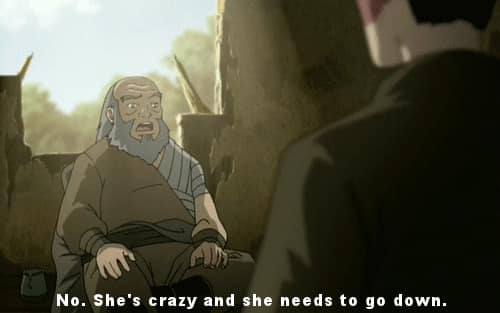
Okay, let's break down the image and its implications through the requested theoretical lenses. It's important to note that interpreting from a still image requires a degree of assumption about context within the larger narrative, but we'll work with what's available. **Visual Description** The image is a screen capture from the animated series *Avatar: The Last Airbender*. It depicts an elderly man, presumably a figure of authority given his attire and position, speaking to someone partially visible in the frame. He’s rendered in a style reminiscent of anime or East Asian artistic traditions. The man has a long, white beard and wears a complex layered outfit of dark green and grey with detailing on the shoulder pads. He appears distressed, with a worried expression on his face and a slightly open mouth as if speaking urgently. The background is blurred, suggesting a setting of stone structures and possibly a battle or a tense situation. The image is lit with a predominantly olive or sepia tone, creating a somber mood. The text bubble at the bottom reads "No. She’s crazy and she needs to go down." --- **Foucauldian Genealogical Discourse Analysis** This image presents a fascinating case for Foucauldian analysis. The utterance "She’s crazy and she needs to go down" isn't simply a statement about an individual; it’s an act of *discourse* constructing “madness” as a category. * **Power/Knowledge:** The speaker, a likely authority figure, wields power through the very act of labeling someone “crazy.” This label isn't a neutral observation; it *creates* a perception of deviance, justifying potential control or elimination ("needs to go down"). This echoes Foucault’s idea that power and knowledge are inextricably linked – the ability to define normalcy and deviance *is* a form of power. * **Genealogy of Madness:** To apply a genealogical approach, we would trace the historical emergence of the concept of "crazy" within this fictional world (and, by extension, our own). What institutions (political, religious, social) historically defined and policed the boundaries of acceptable behavior? Who decided what constitutes "sanity"? The comment implicitly suggests a system of social control where those deemed “crazy” are targeted. * **Disciplinary Power:** The phrase “needs to go down” is a veiled threat suggesting a disciplinary action. It’s not about understanding or rehabilitation, but about removing a perceived threat to the established order. --- **Critical Theory** This image lends itself to a Critical Theory interpretation focused on the societal forces shaping perception and control. * **Ideology:** The utterance reflects a specific ideology – a system of beliefs and values that justifies the existing social order. The speaker's statement subtly defends the status quo by demonizing an "other" (the "she" in question). It implies that deviation from societal norms is dangerous and must be suppressed. * **Hegemony:** The speaker appears to be part of a group holding dominant power. The casual dismissal of the woman as “crazy” likely reflects a wider culture of silencing and marginalizing those who challenge its norms. This is a demonstration of how cultural hegemony operates—naturalizing and reinforcing power structures through everyday language and assumptions. * **Dehumanization:** The "she" in the statement is described with a label, rather than as a complex individual. It's a stripping of her agency and self-determination, making it easier to justify violence or control. --- **Marxist Conflict Theory** While not directly about economic classes, a Marxist lens can be applied by viewing the utterance as a power play contributing to maintaining existing power structures. * **Conflict and Control:** The speaker's judgment is likely rooted in a power struggle. The "she" represents a potential disruption to the established order and therefore is labeled as a threat. The phrase "needs to go down" suggests a desire to eliminate that threat, maintaining the status quo of those in power. * **Ideology as False Consciousness:** The labeling of the woman as "crazy" can be seen as a form of ideological control. It prevents a critical examination of the systemic issues that might contribute to her behavior or beliefs, instead blaming her individual state of mind. * **Dominant Narrative:** The phrase reinforces a dominant narrative that supports the interests of those in power. By framing the woman as a threat, it justifies any actions taken against her, even if those actions are oppressive. --- **Postmodernism** A postmodern approach would focus on the constructed nature of truth and meaning. * **Deconstruction of "Crazy":** Postmodernism would question the very concept of "crazy." What does it *mean*? Is it an objective reality, or a social construct? The utterance exposes the arbitrary nature of this label, demonstrating how it’s used to control and marginalize. * **Rejection of Grand Narratives:** This image can be seen as a rejection of grand narratives about sanity and insanity. There’s no universal definition of "crazy," only culturally specific interpretations. * **Subjectivity of Truth:** The speaker's judgment is presented as fact, but it’s entirely subjective. A different observer might see the same person as insightful, rebellious, or misunderstood. This highlights the fluidity of truth and the power of perspective. --- **Queer Feminist Intersectional Analysis** This is potentially a rich area for analysis, *if* we can infer more about the "she" in question within the larger narrative. * **Marginalization and Control:** The label "crazy" has historically been used to silence and control women, particularly those who challenge patriarchal norms. If the "she" is a woman who is defying social expectations, the utterance reinforces a system of control that punishes female nonconformity. * **Intersectionality:** If the "she" also belongs to other marginalized groups (e.g., based on race, class, sexuality, ability), the utterance becomes even more complex. The label "crazy" could be used to justify the intersectional oppression she faces. * **Power Dynamics:** The utterance illustrates a clear power imbalance. The speaker, likely a man, is judging and attempting to control another individual. This dynamic is often amplified when combined with other forms of marginalization. * **Silencing Dissent:** The statement is an attempt to silence dissent. The speaker is delegitimizing the woman’s voice and experience by labeling her as “crazy,” which can be a way to dismiss her concerns or perspectives. --- I hope this provides a comprehensive analysis of the image through the requested theoretical lenses. Remember, interpretation is always contextual and depends on the assumptions we make about the larger narrative.
tesseract-ocr
‘ v , a |
llama3.2-vision
This meme is a screenshot from the animated series "Avatar: The Last Airbender" and features a character named Iroh. The image shows Iroh looking at someone with a disapproving expression and saying "No. She's crazy and she needs to go down." The meme is likely used to express disapproval or frustration with someone's behavior.