First Seen
2023-05-10T21:03:34+00:00
gemma3-27b-vision
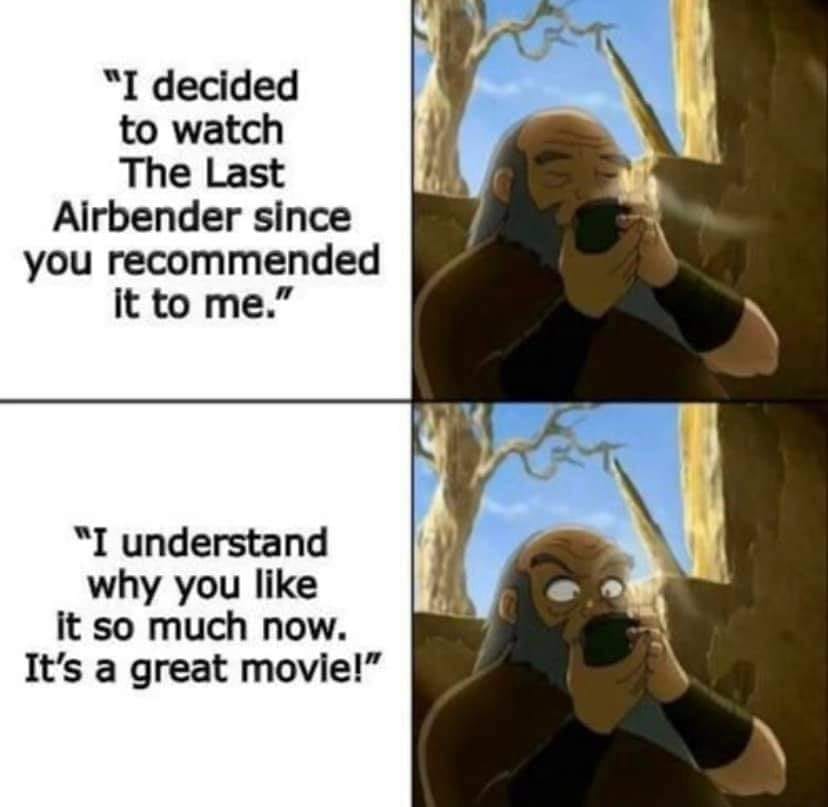
Okay, let's analyze this meme using the requested theoretical frameworks. **Visual Description** The meme consists of two panels featuring Uncle Iroh from *Avatar: The Last Airbender*. In the top panel, Iroh is depicted in a contemplative pose, sipping tea, with the text "I decided to watch The Last Airbender since you recommended it to me." In the bottom panel, Iroh’s expression shifts to one of enthusiastic understanding with wide eyes, and he says, "I understand why you like it so much now. It’s a great movie!" The backdrop in both panels depicts the interior of what appears to be a tea shop or a similar comfortable space. The overall effect is comedic, as it implies a change of heart or validation of a friend’s taste. The format adheres to the common ‘before/after’ or ‘expectation/reality’ meme structure. --- **Foucauldian Genealogical Discourse Analysis** This meme subtly touches upon the *discourse* surrounding taste and cultural validation. The first panel implies an initial reluctance or skepticism, possibly stemming from a dominant discourse that positions Iroh as someone with a different aesthetic preference (given his traditional, somewhat stoic persona). The second panel represents a *shift in discourse*. Iroh's acceptance and enjoyment of the film demonstrates a willingness to adopt the perspective of another, dismantling a previously held, implicit hierarchy of taste. The *genealogy* could be traced to a broader historical context of gatekeeping in fandom and media consumption. Historically, certain media (animation, young adult literature, etc.) were often dismissed as “low culture.” Iroh’s transformation embodies a break from that older, hierarchical mindset, and an acceptance of a friend's enjoyment of a medium previously categorized as ‘lesser’. The power dynamics shift from a silent judgement of taste, to the affirmation of a friend's enjoyment. --- **Critical Theory** From a critical theory perspective, this meme can be viewed as a critique of the societal pressures to maintain independent thought and originality. The first panel can be seen as a representation of a desire to forge one's own path in media consumption, independent of others. However, the second panel demonstrates the difficulty of truly independent judgement, as even Iroh, a figure often associated with wisdom and introspection, is susceptible to the influence of others, and ultimately recognizes the value in something that someone else enjoys. It also questions the concept of "good taste" as something inherently objective versus something constructed by social forces. Iroh initially sets himself apart (suggesting a different "high" culture palate), but then realizes enjoyment isn't about hierarchy, it's about connection and shared experience. --- **Marxist Conflict Theory** While a stretch, we can apply a Marxist lens by interpreting the "recommendation" as a form of *cultural capital*. The friend who recommended the movie possesses (or is perceived to possess) a certain cultural awareness or knowledge. Iroh, initially resistant, is then "converted" into appreciating this cultural capital. The conflict isn’t material, but ideological. There’s an implicit struggle between an established (and possibly traditional) viewpoint and a newer, potentially more inclusive one. Iroh's acceptance signals a willingness to abandon a previous ideological position in favor of a new one. --- **Postmodernism** The meme's strength lies in its playfulness with expectations and the subversion of fixed meanings. Postmodernism emphasizes the fluidity of identity and the breakdown of grand narratives. Here, Iroh's transformation challenges the idea that individuals maintain consistent, stable preferences. His willingness to accept something he initially dismissed demonstrates a rejection of rigid categorization and a celebration of subjective experience. The meme also highlights the constructed nature of meaning. The value of the movie isn't inherent; it's *assigned* through social interaction and the process of validation. It plays on the ironic juxtaposition of a stoic figure like Iroh embracing something typically associated with youthful enjoyment. --- **Queer Feminist Intersectional Analysis** This one is the most tenuous fit, but we could interpret the meme as a commentary on the pressure to maintain independent preferences as a performance of self. Feminist and queer theory often critique the expectation for individuals to define themselves in opposition to others. Iroh's initial hesitation could be read as a performance of individuality, a need to differentiate himself. However, his eventual acceptance reveals a vulnerability and a willingness to connect with another person’s enjoyment, potentially challenging patriarchal notions of self-reliance and stoicism. Intersectionally, the meme could be seen as a subtle commentary on the social pressures to maintain specific tastes as a marker of social belonging. Iroh’s acceptance could be seen as a dismantling of those arbitrary boundaries, a rejection of the idea that our tastes define us. Let me know if you’d like me to elaborate on any of these interpretations!
tesseract-ocr
‘> oT “I decided ' to watch Y The Last i) Airbender since | 4 you recommended it to me.” NN “I understand ) why you like /\ it so much now. j | It’s a great movie!” S '
llama3.2-vision
This meme is a humorous exchange between a person who has watched a movie and a friend who has not. The person says, "I just watched The Last Airbender and it's a great movie," to which the friend responds, "I've never seen it, but I've heard it's terrible." The person then says, "I loved it!" and the friend says, "I don't get why you loved it." The person responds, "I'm glad you liked it," and the friend says, "I didn't, I hated it." The person says, "I'm glad you liked it," and the friend says, "I didn't, I hated it." The person says, "I loved it!" and the friend says, "I don't get why you loved it."