First Seen
2023-05-10T21:03:34+00:00
gemma3-27b-vision
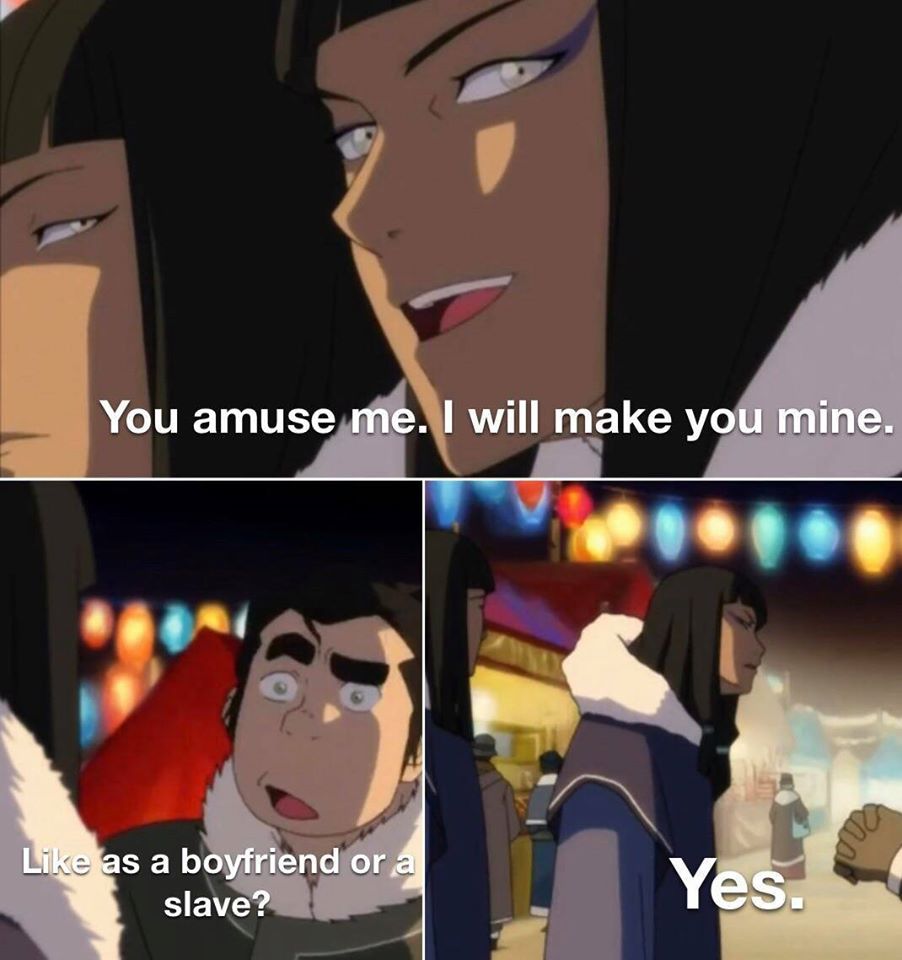
Okay, let's break down this meme from *Avatar: The Last Airbender* through various critical lenses. This is a complex meme that evokes themes of power dynamics, consent, and subjugation, so we'll need to cover a lot of ground. **Please note**: These analyses can be quite dense. I'll try to be as clear as possible, but it's important to remember these are complex philosophical frameworks. --- ## Visual Description The meme is a three-panel screencap from *Avatar: The Last Airbender*. * **Panel 1:** Shows Zuko in a close-up, displaying a confident, somewhat predatory smirk. He's looking directly at the viewer. The text reads, "You amuse me. I will make you mine." * **Panel 2:** Shows Sokka looking surprised, maybe slightly frightened, with wide eyes. The text reads, "Like as a boyfriend or a slave?" * **Panel 3:** Zuko again, a simple "Yes." The visual contrast between Zuko's authoritative pose and expression and Sokka's vulnerability immediately establishes an unequal power dynamic. The lighting in all panels is relatively flat and colorful, typical of the cartoon's aesthetic, but the focus is undeniably on Zuko's intent and Sokka's implied fear/submission. The juxtaposition of “boyfriend or slave” and Zuko’s simple “Yes” forms the ironic core of the meme. --- ## Foucauldian Genealogical Discourse Analysis Michel Foucault’s work focuses on how power operates not through simple repression, but through *discourse*. This meme lends itself well to Foucauldian analysis: * **Power/Knowledge:** Zuko's statement isn't simply about desire; it's an assertion of power through the declaration of ownership. He frames his intent as an inevitability, silencing Sokka’s agency. The knowledge he possesses is the power to claim, to define, to "make" someone into something. This isn't about attraction, but about control and the construction of identity. * **Genealogy of the "Ownership" Discourse:** Historically, the idea of "owning" another person (whether literally as a slave or figuratively in a relationship) is rooted in patriarchal structures and systems of domination. Zuko’s statement can be seen as an invocation of that historical discourse. The meme deconstructs the “romantic” framing of possessiveness, exposing the underlying logic of control. * **Disciplinary Power:** Zuko's statement doesn’t necessarily require force. It implies a reshaping of Sokka's identity to fit Zuko's desires. This aligns with Foucault's notion of *disciplinary power* – power that isn’t solely about overt punishment but about shaping individuals into compliant subjects. * **The Question as Resistance:** Sokka's question, while seemingly naive or humorous, is a disruption of this power dynamic. It forces Zuko to explicitly confirm the disturbing equivalence he's implying. --- ## Critical Theory (Frankfurt School) The Frankfurt School (Adorno, Horkheimer, Marcuse) analyzes culture to reveal the hidden ideologies that maintain social control. Here’s how it applies: * **Commodification of Relationships:** The meme critiques the way even intimate relationships can be structured by power imbalances and, in a broader sense, commodified. Zuko treats Sokka as an object to be *possessed*, stripping him of his agency and reducing him to a means of fulfilling Zuko’s own desires. * **Critique of Domination:** The meme highlights the normalization of domination in society. The implicit assumption that Zuko *can* simply "make" someone his own reflects a patriarchal ideology that privileges male control and ownership. * **Culture Industry & Representation:** While this is a single meme, it taps into broader cultural representations of power dynamics in romance and fantasy. The meme is a metacommentary on how these tropes often gloss over issues of consent and agency. * **The Illusion of Choice:** Sokka’s question is a momentary challenge to Zuko’s power, but Zuko’s blunt “Yes” demonstrates the illusion of choice. Even the *option* of slavery is presented as acceptable within the power dynamic. --- ## Queer Feminist Intersectional Analysis This is where the meme gets particularly potent. * **Deconstructing Traditional Romance:** The juxtaposition of "boyfriend" and "slave" violently dismantles the romantic ideal. It exposes how possessiveness and control can be masked as love, and how the line between affection and domination can be disturbingly thin. * **Power Imbalances and Consent:** The meme implicitly asks: is there consent when one person asserts ownership over another? The answer, obviously, is no. The meme serves as a stark reminder of the importance of agency and boundaries. * **Intersectionality & Social Location:** While the characters aren't explicitly defined by gender or other social categories, the meme reflects broader power dynamics. The meme taps into discussions of how patriarchal power operates, regardless of the specific identities of those involved. * **Subversion of Heteronormative Expectations:** While the characters are male, the meme can be read as a critique of power dynamics in *any* relationship, regardless of sexual orientation. It’s a commentary on how possessiveness can manifest in different forms and contexts. --- **In Conclusion** This simple meme, through various critical lenses, becomes a surprisingly complex commentary on power, consent, and the insidious ways in which domination can be normalized, even within the seemingly innocent context of a potential relationship. It’s a reminder to question the underlying assumptions in our culture and to challenge any form of control or ownership over another person. Let me know if you'd like me to elaborate on any of these points or delve deeper into a specific critical theory!
tesseract-ocr
il , 4 y a ya a You amuseymeN will WS you mine. € he lata a= Y >> lini ew / Biz iL. Sey: ee ir) Vor ; LI
llama3.2-vision
The meme is a humorous exchange between two characters from the animated series "Avatar: The Last Airbender." The first character, Azula, says "You amuse me. I will make you mine." The second character, Zuko, responds with a sarcastic remark, "You amuse me. I will make you mine." The meme pokes fun at the similar phraseology of the two characters' lines, implying that Zuko is being sarcastic and ironic.