First Seen
2023-05-10T21:03:34+00:00
gemma3-27b-vision
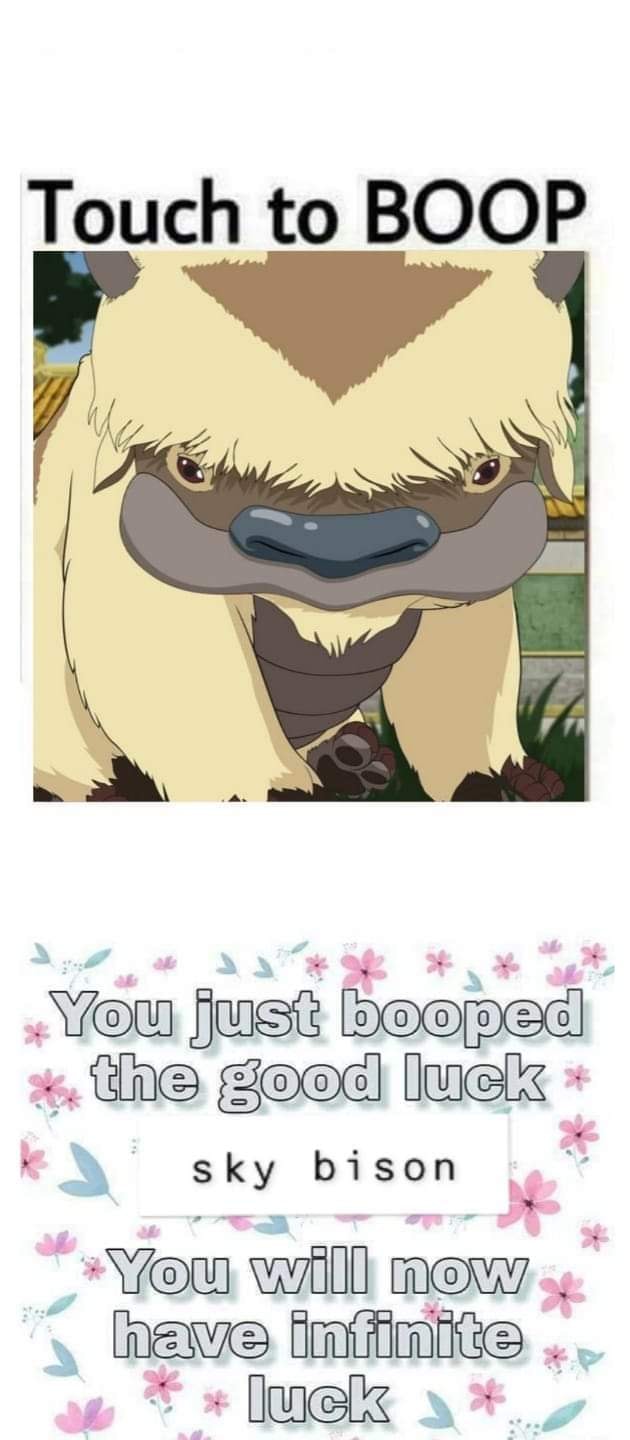
Okay, let's break down this image using the requested theoretical frameworks. It's a delightfully silly image, which allows for some fun, if slightly stretched, applications of complex theory. ## Visual Description The image features a close-up of Appa, the sky bison from *Avatar: The Last Airbender*. Appa’s nose is prominently displayed. The text "Touch to BOOP" is positioned above the image. Below the image is a pink, floral-decorated banner reading "You just booped the good luck sky bison. You will now have infinite luck." The image is framed by a greenish-brown border, suggesting a possible screenshot from an application or mobile platform. The color scheme is relatively bright and playful, with emphasis on pastels and vibrant greens. The overall aesthetic is distinctly "internet meme" - simple, direct, and designed for quick consumption. --- ## Foucauldian Genealogical Discourse Analysis This image participates in a discourse of "cuteness" and "good luck charms." A Foucauldian analysis would look at *how* this discourse emerged, its historical roots, and how it functions as a form of power/knowledge. * **Power/Knowledge:** The image asserts a connection between a specific action ("booping" Appa's nose) and a desired outcome ("infinite luck"). This establishes a system of knowledge where cuteness is linked to efficacy. This isn’t necessarily oppressive, but it *is* a form of constructing reality. By 'booping' and gaining 'luck', the user participates in and validates this constructed reality. * **Genealogy of 'Boop':** The term "boop" itself, a playful onomatopoeia, has a genealogy tied to cartoons and infantilization. Its origin likely lies in the slapstick comedy of early animation, where such sounds accompany gentle, harmless physical contact. It’s a regression to a childlike mode of interaction. * **Disciplinary Power:** While not overtly disciplinary, the image can be seen as subtly enforcing norms of "positive reinforcement". It rewards a simple interaction with a promise of good fortune, subtly encouraging similar playful interactions and reinforcing the link between action and reward. --- ## Critical Theory Applying a Critical Theory lens (in the vein of the Frankfurt School), we can examine how the image functions within broader social structures and systems of domination. * **Commodity Fetishism:** Appa, as a character from a popular animated series, already holds cultural capital. The image leverages this pre-existing capital to create a “boopable” commodity. The act of 'booping' is not about the bison itself but about the *promise* of luck and participating in a popular cultural meme. * **False Consciousness:** The image offers a simplistic, almost magical solution to the desire for "luck," diverting attention from the complex and systemic factors that actually influence one's outcomes. It promotes a kind of magical thinking that obscures real socio-economic issues. * **Culture Industry:** As a meme, the image is a product of the "culture industry," a system of mass production and distribution of cultural artifacts. It's designed for immediate gratification and consumption, contributing to a passive and uncritical engagement with culture. --- ## Postmodernism This image is almost *archetypal* of postmodern sensibility. * **Pastiche and Intertextuality:** The image relies heavily on intertextuality – referencing the world of *Avatar: The Last Airbender* and the established conventions of internet memes. It’s a self-aware blend of different cultural elements. * **Simulation and Hyperreality:** The image isn't about *actual* luck, it’s about the *simulation* of luck. It creates a hyperreal experience, where the sign (the act of ‘booping’) is detached from any real referent. The ‘luck’ is entirely constructed within the digital space. * **Fragmentation and Playfulness:** The image is fragmented, lacking any deep meaning or overarching narrative. It prioritizes playful interaction and immediate gratification over coherence or substance. * **Deconstruction:** The image can be 'deconstructed' to reveal the underlying assumptions about luck, cuteness, and the relationship between action and outcome. It reveals the arbitrary nature of these connections. --- **Note:** Due to the nature of the image, frameworks like Marxist Conflict Theory or Queer Feminist Intersectional Analysis are harder to apply in a *meaningful* way. While these lenses *could* be stretched to find connections (e.g., analyzing the power dynamics in the construction of ‘cuteness’ or the representation of non-human animals), it would feel forced and less insightful than the other analyses. Let me know if you’d like me to elaborate on any of these points or explore a different theoretical framework!
tesseract-ocr
Touch to BOOP ~ y | AA Mw Sa % && * % Qt You fust *, UM® lucas ey | aby bison ie You willl BOW Sehaverinfinitess b ei (mel *.
llama3.2-vision
The meme is a humorous image of a character from the TV show "Avatar: The Last Airbender" with a caption "Touch to BOOP" and a "You just booped the good luck" message, followed by "You will now have infinite luck".