First Seen
2023-05-10T21:03:34+00:00
gemma3-27b-vision
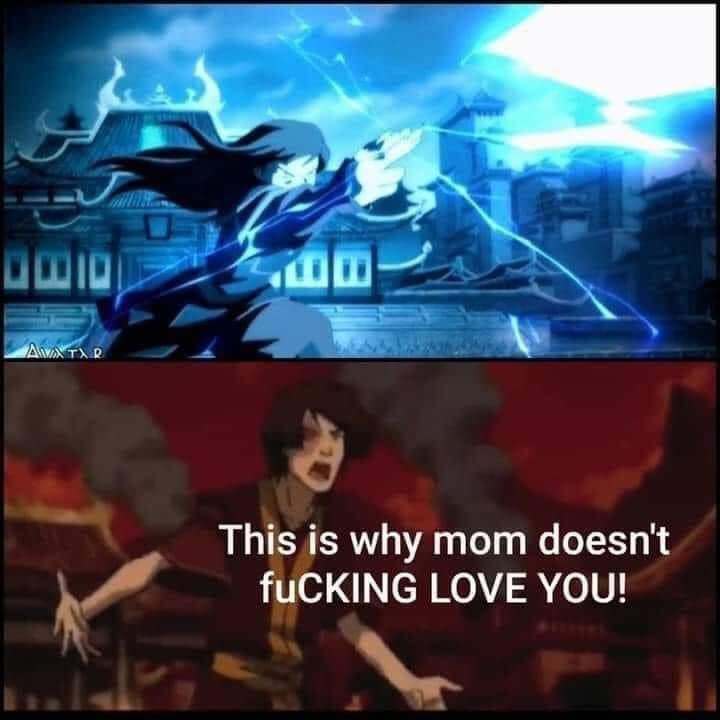
Okay, let's break down this image and its accompanying text through several theoretical lenses, focusing on those applicable. It's important to note that applying these frameworks is interpretive, and multiple readings are possible. ## Visual Description The image appears to be a screen capture from the animated series *Avatar: The Last Airbender*. It depicts a dramatic scene featuring Aang, the protagonist, in the midst of a powerful, spiraling airbending technique. Aang is engulfed in swirling winds and energy, with a backdrop of a city featuring distinctly East Asian-inspired architecture. The colors are predominantly blues, whites, and grays, conveying a sense of power, chaos, and maybe even tragedy or conflict. An image of a raised fist is superimposed over the image. Bold, white text is overlaid on the bottom of the image: "This is why mom doesn't FUCKING LOVE YOU!". The contrast of the imagery, a scene depicting a hero’s strength and the demeaning message in the text creates a disturbing contrast. ## Foucauldian Genealogical Discourse Analysis This image and text lend themselves well to a Foucauldian reading. Here's how: * **Power/Knowledge:** The text functions as an exercise of power through the assertion of parental disapproval. It leverages the "knowledge" (or perceived knowledge) about Aang’s actions or character to enact a form of control—in this case, emotional manipulation via the assertion of maternal withholding of love. The message relies on the established power dynamic between parent and child. * **Discourse and Subjectivity:** The statement is not merely a judgment; it *constitutes* the subject. It implies that Aang *is* someone deserving of a mother’s disapproval, defining him through this lack of affection. The language (“doesn’t FUCKING LOVE YOU!”) is intentionally shocking and visceral, intending to profoundly impact the "subject" being addressed. * **Genealogy of Disapproval:** We can imagine a "genealogy" of this type of parental communication: a history of using emotional withholding as a disciplinary or controlling tactic. This message isn't unique, but a manifestation of a broader power dynamic rooted in familial structures. * **Normalization of Emotional Abuse:** The casual and meme-like delivery of this harsh statement arguably *normalizes* emotionally abusive tactics, presenting them as a form of humor or playful put-down. ## Critical Theory From a Critical Theory perspective, the image & text point to broader societal issues: * **Reproduction of Power Structures:** The message perpetuates patriarchal and familial power dynamics, where parental authority is unchallenged and emotional manipulation is accepted as a form of control. It reinforces the expectation that parental approval is essential for self-worth. * **Ideology and Subversion:** The use of a heroic figure like Aang is ironic and potentially subversive. Aang embodies courage, responsibility, and selflessness. Juxtaposing this with a harsh parental rejection challenges the conventional notion of what constitutes “good” behavior and who deserves love. The meme format itself can be read as a form of resistance to traditional authority. * **Critique of Affective Labor:** The statement implies Aang has failed to perform the “emotional labor” expected of children – to be lovable and fulfill parental expectations. This highlights the often-unacknowledged emotional work that children do within families. ## Queer Feminist Intersectional Analysis This is where things get more layered. * **Deconstruction of "Good Son/Daughter" Ideals:** The meme attacks Aang, a prominent masculine figure, with a maternal rejection—challenging expectations of traditional masculinity and emotional stoicism. It undermines the notion of a "good son" who deserves a mother's love. * **Intersection of Identity and Affect:** The statement connects Aang’s identity (as portrayed in the show) with a lack of maternal affection. It’s crucial to consider that Aang carries the weight of an entire nation and is also a child burdened with responsibility. The meme strips away this complexity, reducing him to a figure deserving of rejection. * **Emotional Labor & Gender:** A Queer Feminist perspective would emphasize that emotional labor is often disproportionately expected of women/feminine figures. In this context, the mother's withholding of love represents a denial of nurturing and support, potentially mirroring broader patterns of emotional unavailability in patriarchal structures. **Important Considerations:** * **Meme Culture & Irony:** The image is part of meme culture, which often relies on irony, hyperbole, and dark humor. This complicates the analysis. Is the meme intended to be genuinely hurtful, or is it a form of self-deprecating humor? * **Context:** The meaning of the meme depends on *who* is sharing it and *to whom*. Is it intended to be directed at another individual, or is it a commentary on broader social issues? I hope this detailed breakdown, utilizing these theoretical frameworks, provides a useful analysis of the image and its accompanying text. Let me know if you'd like me to elaborate on any specific aspect!
tesseract-ocr
a ~v ; ave = Meso | ee EX 4 DS , ° S mn SS NT mom doesn't ad Mona LOVE YOU! i =
llama3.2-vision
This meme is a humorous comparison between two scenes from the animated TV series "Avatar: The Last Airbender". The top image shows a dramatic and intense moment from the show, while the bottom image shows a humorous and lighthearted moment. The text "In a few hours" appears in the top image, and the text "This is why mom doesn't love you" appears in the bottom image.