First Seen
2023-05-10T21:03:34+00:00
gemma3-27b-vision
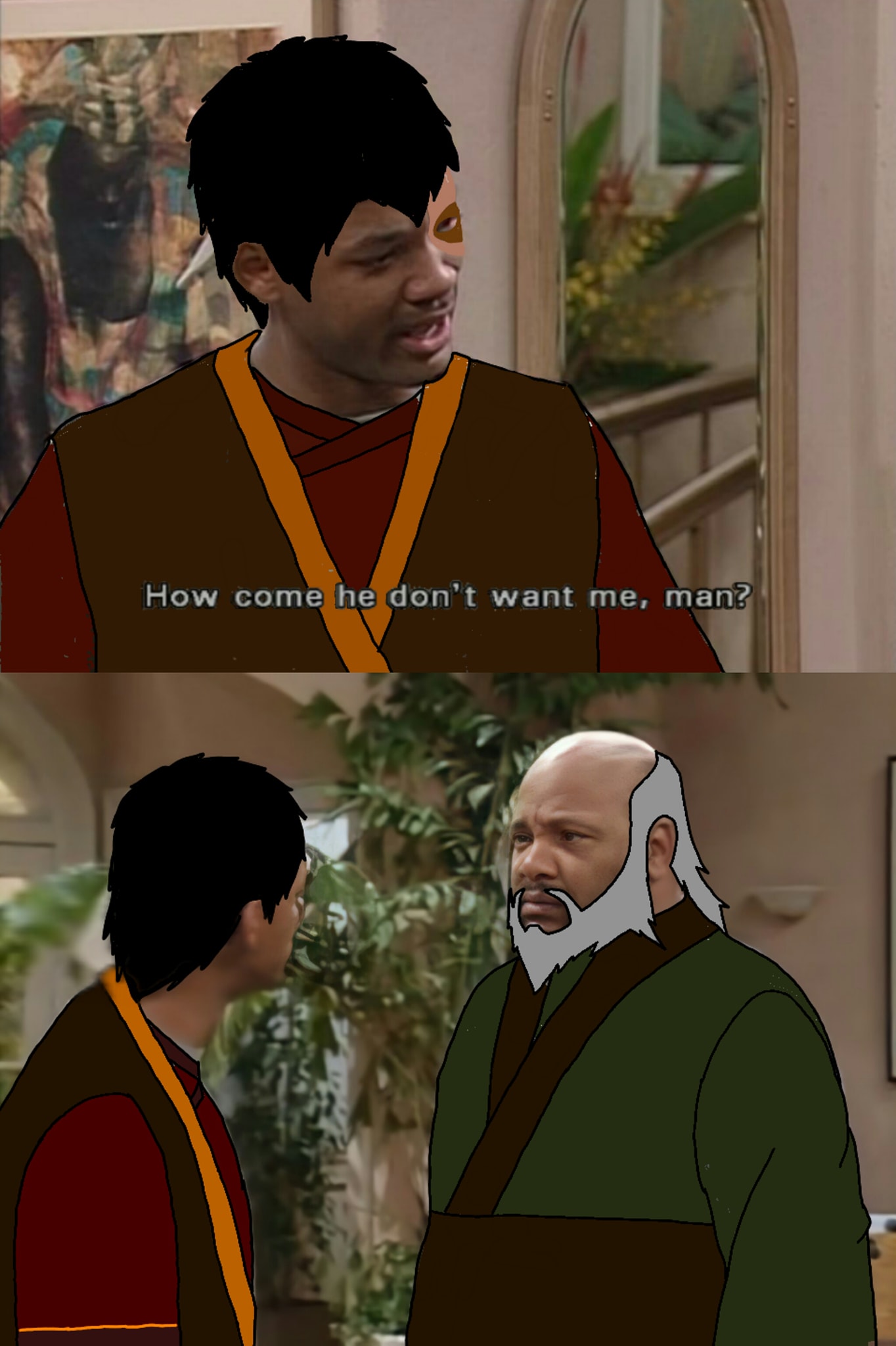
Okay, let's analyze this image using the frameworks you've requested. It's important to note that because this image appears to be a repurposed frame/meme (featuring characters from *Avatar: The Last Airbender* overlaid with text from a viral meme), the analysis is necessarily layered with intertextuality and relies on understanding the meme's origin as well. **1. Visual Description** The image depicts two male figures, seemingly derived from the animated series *Avatar: The Last Airbender*. The character facing forward and speaking (with a speech bubble) is younger, with dark hair, and wears a red-and-orange outfit. He is in an agitated or upset state, indicated by his facial expression and body language. His text bubble reads "How come he don't want me, man?" The other figure is an older man with long white hair and a beard, dressed in a green robe. He looks down at the younger man with what appears to be weariness or resignation. The background is an ornate interior, likely a palace or temple, with green plants and muted colors. The style is flat, indicative of the original animation but also enhanced by the digital editing. **2. Foucauldian Genealogical Discourse Analysis** This image, when considered with the origin of the meme (derived from a video of a man crying) allows for a fascinating Foucauldian reading. Michel Foucault’s genealogy examines how power operates through discourse and shapes our understanding of concepts. Here, the concept is *desire* and *rejection*. * **Power/Knowledge:** The younger man’s question is rooted in a desire for acceptance, for reciprocated affection. However, the very act of phrasing it as a question of "wanting" frames desire as a binary – either someone *wants* you, or they don’t. This binary is a construct of discourse, a way of organizing and understanding relationships. The older man's reaction suggests a more complex understanding. * **Discursive Formation:** The question itself is informed by a specific discursive formation: the discourse of romantic love, where "wanting" is often the primary marker of a successful relationship. But also the cultural discourse surrounding masculinity and emotional vulnerability. Why is the younger man feeling the need to *ask* why he isn’t “wanted”? What power dynamics are at play? * **Genealogy of Rejection:** A genealogical analysis could trace the historical evolution of how rejection has been understood—from a matter of survival to a psychological wound to a status symbol (think of "playing hard to get"). The image prompts us to question the historical roots of the pain expressed in the question. * **Normalization:** This image, as a meme, normalizes the experience of heartbreak and the raw expression of emotional pain. It’s a collective acknowledgement of a shared human experience. **3. Queer Feminist Intersectional Analysis** This analysis is particularly compelling because of the meme’s potential interpretations and the subtext it carries. It's essential to recognize that the meme’s power stems from the vulnerability expressed, and that vulnerability can be interpreted through a queer lens. * **Vulnerability and Masculinity:** The younger man's direct expression of emotional pain challenges traditional norms of masculinity that often discourage vulnerability. * **Desire and Power Dynamics:** The question "How come he don't want me?" speaks to a power imbalance. The younger man positions himself as the object of desire, and the other man as the agent holding the power to grant or deny that desire. * **Intersectionality:** While seemingly simple, the image invites consideration of how factors like race, class, and social status might influence how the young man experiences rejection. * **Queer Readings:** The image can also invite queer readings. The meme may resonate with those who have experienced rejection due to their sexual orientation or gender identity. The raw emotional vulnerability of the query may have strong connections to the pain of homophobia and the search for acceptance. **4. Postmodernism** The image fits neatly into postmodern aesthetics and concepts: * **Intertextuality:** The image is a prime example of intertextuality. It layers the characters and aesthetic of *Avatar: The Last Airbender* onto a completely unrelated internet meme. This blending of contexts creates new meaning. * **Pastiche:** The image can be seen as a pastiche, appropriating elements from different sources to create something new. * **Fragmentation and Loss of Meaning:** The image’s absurdity and lack of clear context can be seen as reflecting a postmodern sense of fragmentation and the loss of grand narratives. * **Deconstruction:** The image deconstructs the traditional relationship between image and text. The visual elements of *Avatar* clash with the raw emotionality of the meme, creating a sense of dissonance. Let me know if you’d like me to expand on any of these analyses or explore other theoretical frameworks!
tesseract-ocr
Wie See LT ) gag ! =| A ae R i. a ” . ny A J = o™ 4 ; > "| A Wee NON ke ae 7 ta 7 : | . . fy * | 7 \ J ; L- , | How Peetet (ite don’t want me, “a | . - “a i an” cs ; - . iis my fl . ae sl Tee f ee : tor : - A A ¢ » Hts a Way's A 7 / I . Ae . mn i , 7 y “ r} | i a / — Tt
llama3.2-vision
This meme is a screenshot from the TV show "The Office" with a character's face photoshopped to look like a character from the animated series "Avatar: The Last Airbender". The text "How come he don't want me?" is written over the character's face, referencing a famous line from the show. The meme is likely referencing a humorous situation where someone is trying to get something from someone who is not interested.