
First Seen
2023-05-10T21:03:34+00:00
gemma3-27b-vision
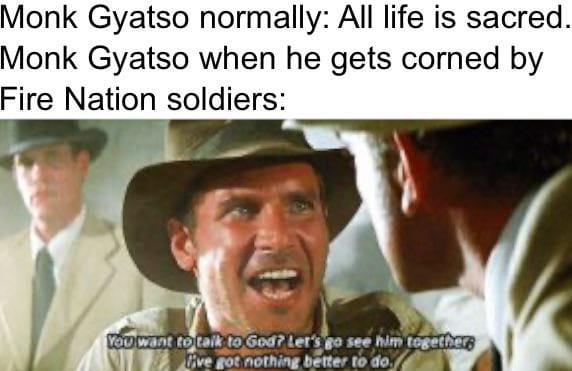
Okay, let's break down this meme using the frameworks you requested. It's important to note that memes are inherently multi-layered and often rely on shared cultural knowledge, so interpretations can be subjective. **Visual Description** The image depicts a screen capture from the movie *Indiana Jones and the Last Crusade*. Specifically, it's a close-up of Harrison Ford as Indiana Jones, looking panicked and somewhat desperate. He is wearing his iconic fedora and a tan jacket. The scene shows him surrounded by stern-faced, uniformed men, implying he’s cornered. Overlaid text reads: "Monk Gyatso normally: All life is sacred. Monk Gyatso when he gets cornered by Fire Nation soldiers: [Indiana Jones dialogue] 'You want to talk to God? Let's go see him together! I’ve got nothing better to do.'" The meme format relies on the contrast between a stated ideal ("all life is sacred," a tenet of the Avatar universe) and a moment of seeming hypocrisy or desperation (Indiana Jones' flippant dialogue). It's a setup-punchline structure playing with expectation and subversion. --- **Foucauldian Genealogical Discourse Analysis** This meme can be viewed through Foucault's lens by examining the *discourses* it draws upon and how these discourses shape our understanding of “sacredness”, “war”, and “self-preservation”. * **Discourse of Sacredness:** The statement "all life is sacred" is a key tenant of the *Avatar* universe and establishes a moral framework. However, the meme implies this framework is *performative*, not absolute. The meme problematizes this discourse. * **Discourse of War & Power:** The presence of the "Fire Nation soldiers" represents a discourse of power, dominance, and the justification of violence in pursuit of specific goals (imperialism in *Avatar*, a need to control/interrogate in the movie scene). It's a discourse where self-preservation is often prioritized over abstract ideals. * **Genealogy of "Facing Pressure"**: We can trace a genealogy of how the situation depicted (being cornered, forced to make a choice under duress) has been represented in various narratives. From religious martyrdom to survival stories, the narrative of being forced to compromise one's values is deeply embedded in our cultural understanding. The meme deconstructs this representation, framing it as a moment of ironic detachment. The meme’s power comes from disrupting the assumed coherence of these discourses. By juxtaposing the ideal with the seemingly cynical response, it reveals the *conditions* under which these discourses are maintained or broken down. It’s a demonstration of how power shapes the expression (or suppression) of values. --- **Critical Theory** Applying Critical Theory, this meme can be seen as a critique of ideology. The statement "all life is sacred" operates as an ideal, but the Indiana Jones clip suggests this ideal is not always applied in practice, especially in situations of power imbalance or personal threat. The meme implicitly questions *whose* life is considered sacred in different contexts. Is it universal, or is it selectively applied? The Fire Nation soldiers represent a system of power that disregards the sanctity of life in pursuit of its own goals. Indiana Jones' response could be interpreted as a surrender to the dominant power structure, a cynical acknowledgement that ideals are meaningless in the face of force. This highlights the inherent contradictions within systems of belief and the ways in which power structures influence individual behavior. The meme exposes the illusion of a unified moral code and suggests that individuals often act in ways that contradict their stated values when faced with difficult circumstances. --- **Postmodernism** This meme exemplifies many postmodern principles: * **Intertextuality:** It heavily relies on knowledge of both the *Avatar* series and the *Indiana Jones* movie. The meaning is generated through the combination of these pre-existing texts. * **Pastiche/Irony:** It combines elements from different sources in a playful, ironic way. The meme doesn’t take itself too seriously. The Indiana Jones quote is unexpected and humorous. * **Deconstruction of Grand Narratives:** It questions the “grand narrative” of universal sacredness, suggesting it’s not a fixed truth but a contingent construct. * **Loss of Authenticity:** The Indiana Jones response feels deliberately disingenuous, undermining the sincerity of the original statement. It hints at a world where meaning is fluid and truth is relative. The meme’s power lies in its self-aware referencing of other cultural texts. It doesn’t attempt to offer a definitive answer but instead encourages viewers to question the assumptions underlying both the *Avatar* universe and the broader cultural landscape. --- **Note:** It's important to recognize the limitations of applying these complex theoretical frameworks to a simple meme. The goal here is to demonstrate *how* these frameworks can be used to analyze even seemingly trivial cultural artifacts, revealing the deeper layers of meaning and ideology embedded within them. Also, some of these frameworks overlap significantly. Let me know if you'd like me to elaborate on any of these analyses or explore other frameworks!
tesseract-ocr
Monk Gyatso normally: All life is sacred. Monk Gyatso when he gets corned by Fire Nation soldiers: ao P aa . , a ae , ; whee = | \Za.. (CTD Oy eT ag mE temas |
llama3.2-vision
This meme is a humorous comparison between the ancient Indian spiritual leader, the Dalai Lama's, views on life and the modern-day, action-packed, Indiana Jones film character, Indiana Jones. The meme juxtaposes the Dalai Lama's quote "All life is sacred" with a scene from the Indiana Jones film where Indiana Jones, played by Harrison Ford, says "It's not the years, it's the mileage" (in a different context).