First Seen
2023-05-10T21:03:34+00:00
gemma3-27b-vision
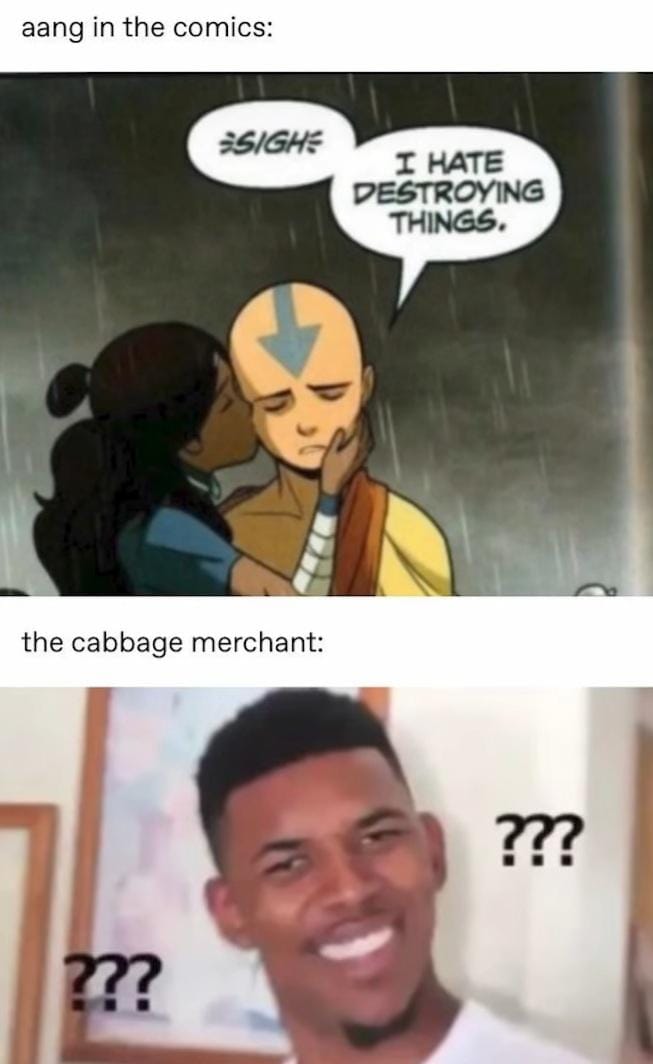
Okay, let's break down this meme through various theoretical lenses. It's a surprisingly rich image considering its simplicity. **Visual Description** The meme consists of two panels. The first panel is a still from the *Avatar: The Last Airbender* comics. It depicts Aang, the Avatar, being embraced by Katara. Aang is visibly distraught, and a speech bubble reads “Sigh... I hate destroying things.” The artistic style is typical of the cartoon/comic adaptation – clean lines, bold colors, and exaggerated expressions. The second panel features a stock photograph of a Black man with a confused/bewildered expression. Question marks are superimposed around his head, visually signifying his perplexity. The contrast between the artistic styles – a cartoon and a realistic photograph – is notable. **Foucauldian Genealogical Discourse Analysis** This meme highlights the *discourse* around "destruction" and "power". Foucault would be interested in how the very concept of "destroying things" is constructed through historical power dynamics. Aang's statement is not simply a personal preference; it’s a performance of the burden of being the Avatar, and a way he’s been *disciplined* to think. The Avatar is expected to use his power, but also to uphold balance, and Aang internalizes the pressure. The image of the cabbage merchant, bewildered, suggests an alternative, less grand narrative. He is not concerned with world-altering power or the morality of destruction. His existence is defined by the mundane – growing and selling cabbage. The question marks surrounding him ask, "Why are you (Aang) even concerned with such things?". This contrast can be read as a rejection of the grandiose, abstract systems of power the Avatar embodies, in favor of the grounded, everyday reality of the merchant. The merchant is a counter-discourse, resisting the pervasive narrative around power and destruction. **Critical Theory** From a Critical Theory perspective (drawing on thinkers like Adorno and Horkheimer), this meme can be seen as a subtle commentary on the *culture industry*. Aang's internal conflict, though presented as a personal struggle, is ultimately a symptom of a system that glorifies power and conflict. The idea that a powerful being is *burdened* by their power is a way of legitimizing that power. The cabbage merchant acts as a dissenting voice to this logic. He represents the unacknowledged labor and daily struggles that underpin the grand narratives of heroism and conflict. He embodies the "instrumental reason" that drives the cycle of destruction, asking a simple but radical question: What purpose does this destruction serve? **Marxist Conflict Theory** Applying a Marxist lens, we can see the core conflict as being between the Avatar (representing a ruling class with immense power) and the common people, represented by the cabbage merchant. Aang's angst represents the moral burden of wielding power within an unequal system. The merchant, constantly having his cabbage destroyed, symbolizes the proletariat—those whose livelihoods and property are constantly at risk due to the actions of the powerful. His bewildered expression is not just confusion; it's a silent protest against the systemic violence and disregard for the everyday lives of ordinary people. The question marks amplify his unspoken question: "Why is *my* cabbage always getting destroyed?". The meme subtly critiques the power dynamics that allow destruction to occur without accountability. **Postmodernism** A postmodern reading would focus on the meta-commentary inherent in the meme. By juxtaposing a scene from a fantasy world with a contemporary stock photograph, the meme disrupts the boundaries between reality and fiction. It highlights the constructed nature of both "heroism" and "villainy." The meme's humor derives from the absurdity of the comparison. It exposes the way we often treat fictional characters as if they have genuine moral dilemmas, while ignoring the very real injustices that exist in our own world. The question marks around the cabbage merchant are a symbol of the *deconstruction* of meaning. They suggest that there is no inherent truth or logic to the world, only a chaotic interplay of signs and symbols. **Queer Feminist Intersectional Analysis** This is a weaker application, but worth exploring. We can read the cabbage merchant’s bewilderment as a refusal to participate in a traditionally masculine narrative of power, conflict, and heroism. He is uninterested in these structures and simply wants to be left alone to sell his cabbage. This can be seen as a form of resistance to patriarchal norms that privilege violence and domination. Furthermore, given the merchant is Black, we can apply an intersectional lens, understanding his confusion as a response to a world that constantly imposes these grand, violent narratives on marginalized communities. His question marks represent a rejection of the expectation that he should be invested in these power struggles, and a prioritization of his own survival and well-being. The meme subtly subverts the traditional hero’s journey by centering the perspective of someone who is excluded from it. Let me know if you'd like me to elaborate on any of these analyses or apply other theoretical frameworks!
tesseract-ocr
3$/GH= I HATE DESTROYING THINGS. Al es, | % e aA \ NS ir « = the cabbage merchant: see er f .
llama3.2-vision
This meme is a humorous comparison between the popular TV show "Avatar: The Last Airbender" and the 2022 film "Everything Everywhere All at Once." The top image shows a scene from "Avatar" where the character Aang says "I hate destroying things" and the character Katara responds with "I hate destroying things too." The bottom image shows a person from the film "Everything Everywhere All at Once" with a confused expression, implying that they are also saying "I hate destroying things."