First Seen
2024-06-18T00:18:45.784473+00:00
gemma3-27b-vision
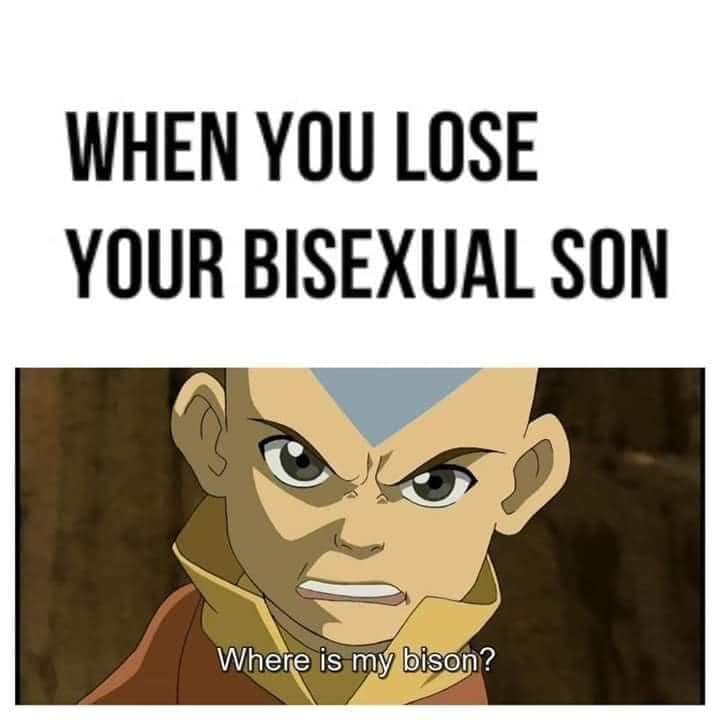
Okay, let's break down this meme through the lenses you've provided. It's a layered piece of internet humor, so we have some interesting options for analysis. **Visual Description** The image is a screen capture from the animated series *Avatar: The Last Airbender*. It features Sokka, a teenage character known for his comedic relief, frustration, and often nonsensical outbursts. He has a worried and intensely focused expression, his eyes narrowed. The text overlay reads "WHEN YOU LOSE YOUR BISEXUAL SON," and within the image itself, a speech bubble states "Where is my bison?" The contrast between the emotionally charged text and the seemingly unrelated question about a bison (Appa, his family's animal companion) is central to the humor. The color palette is typical of the animation style – muted earth tones with vibrant highlights in clothing and features. **Queer Feminist Intersectional Analysis** This meme is interesting as it uses humor to grapple with complex issues relating to queer identity, familial relationships, and societal expectations. Several layers can be untangled: * **The "Lost" Queer Son:** The phrase "lose your bisexual son" invokes a sense of loss, but not a literal one. It's coded language referencing anxieties parents might have about their children coming out, or about the social stigma surrounding queer identities. The loss here isn't about physical disappearance but about the potential perceived "loss" of a child fitting into heteronormative expectations. It also taps into fears of losing connection with a child due to difference. * **Humor as Coping:** The meme employs humor to address these anxieties. By presenting the situation as absurd, it allows for a (dark) engagement with potentially fraught emotions. This can be seen as a way to normalize conversation around queer issues and to create space for empathy and understanding. * **The "Bison" as Displacement:** The question "Where is my bison?" is a key element. It's a displacement of anxiety. The *real* concern (the bisexual son) is overlaid with a seemingly more trivial one (the missing bison). This could represent the ways parents sometimes focus on surface-level concerns rather than addressing deeper emotional issues. It might also speak to the ways parents might inadvertently "lose" their child by not being supportive or understanding, the bison representing the lost connection. * **Intersectional Complexity:** While the meme focuses on bisexuality, it's important to remember the intersectionality of identity. A queer son's experience will also be shaped by his race, class, cultural background, and other factors. **Foucauldian Genealogical Discourse Analysis** Applying Foucault, we can see this meme as revealing the *discursive* construction of both queerness and parenthood. * **Power/Knowledge:** The meme suggests that societal discourse constructs a specific expectation of "good" parenthood, often tied to conformity and the continuation of heteronormative family structures. A queer child challenges this, creating a perceived "loss" within that framework. * **Genealogy of "Loss":** We can trace the "loss" as a concept. It doesn't naturally exist in the context of a child’s identity. Rather, it emerges as a consequence of a power structure that prioritizes certain (heteronormative) configurations of family and identity. The “lost son” narrative is a product of historical and cultural forces. * **Disciplinary Power:** The societal anxieties around a child's queerness can be seen as a form of disciplinary power—a pressure to conform and maintain the “correct” familial order. The meme ironically highlights this through humor. * **The Absurdity:** Foucault would appreciate the meme’s embrace of absurdity. The non sequitur of the bison serves to expose the irrationality and arbitrariness of some social norms. **Postmodernism** Several postmodern characteristics are evident: * **Irony & Parody:** The meme relies heavily on irony and a subversion of expectations. It doesn’t present a straightforward emotional statement. The juxtaposition of the text and the image creates a playful, almost mocking effect. * **Deconstruction of Meaning:** The meme deconstructs the conventional meaning of “loss.” It’s not a literal loss but a symbolic one, tied to shifting societal norms and anxieties. * **Playfulness with Signs:** The meme is a self-referential play on internet culture, utilizing a recognizable image and format to convey a complex idea. The bison is a signifier that is used to deflect attention from the central issue. * **Rejection of Grand Narratives:** The meme doesn't offer a universal truth or a grand solution. It simply presents a specific, ironic situation, leaving interpretation open to the viewer. **Critical Theory** A critical theory lens can illuminate how this meme critiques power dynamics and societal norms. * **Critique of Heteronormativity:** The meme implicitly challenges the dominance of heteronormative assumptions. The anxiety surrounding the “lost bisexual son” stems from a system that privileges heterosexual relationships and family structures. * **Ideology & False Consciousness:** The parental concern in the meme can be seen as reflecting a societal ideology that reinforces normative expectations. The humor suggests a degree of "false consciousness" – an unawareness of how these norms shape perceptions and anxieties. * **Power Imbalance:** The meme subtly highlights the power imbalance between parents and children, particularly in relation to identity and self-expression. I hope this breakdown is helpful! Let me know if you’d like me to focus on any of these areas in more detail.
tesseract-ocr
WHEN YOU LOSE YOUR BISEXUAL SON A) < KN I
llama3.2-vision
This meme is a humorous reaction to a person's emotional distress after losing their child. The image is a screenshot from the animated TV series "Avatar: The Last Airbender," featuring a character named Aang, who is a young boy who is also the main protagonist. The text overlay on the image reads, "When you lose your child, but you still have your bison."