
First Seen
2023-05-10T21:03:34+00:00
gemma3-27b-vision
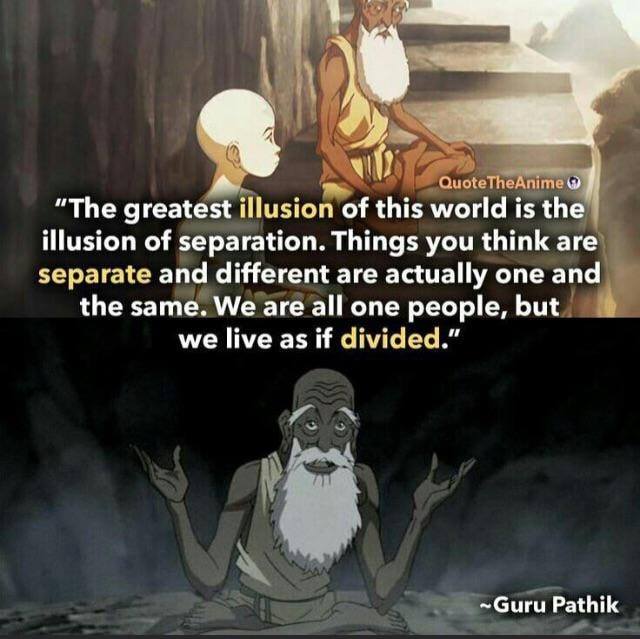
Here's an analysis of the image and quote, broken down into relevant theoretical frameworks. Note that some frameworks are more applicable than others, and I'll explain why. **Visual Description** The image is a still from the animated television series *Avatar: The Last Airbender*. It depicts a scene with two characters. One is a younger man, Aang, who is the Avatar, kneeling, appearing to be learning from an older, bearded, and robed man named Guru Pathik. The setting is a minimalist, somewhat monastic interior, appearing to be a retreat or training space. The color palette is muted earth tones. Overlaid on the image is a white text box containing a quote attributed to Guru Pathik. The quote emphasizes the illusory nature of separation and the underlying unity of all people. **Foucauldian Genealogical Discourse Analysis** This quote lends itself well to a Foucauldian analysis. Foucault examined how power operates through discourse – the ways in which we talk about and understand things. The quote directly challenges a dominant *discourse* of separation – the way society often categorizes and divides people based on perceived differences (nation, race, gender, etc.). A genealogical approach would ask *how* this discourse of separation came to be dominant. What historical processes and power relations have constructed the idea of inherent difference? It would examine how categorizations function to create and maintain power imbalances. Guru Pathik’s quote acts as a potential disruption to this discourse. By stating separation is an "illusion," it suggests that these categories are *constructed*, not natural or essential. It de-naturalizes the idea of 'otherness,' challenging the very foundation of systems built on division. Foucault's concept of "governmentality" is also relevant. The discourse of separation is a tool of governmentality—how states and other institutions seek to control populations by shaping their beliefs and behaviors. By claiming all are one, Guru Pathik challenges the basis of such control. **Critical Theory** The quote and the context of *Avatar: The Last Airbender* align strongly with critical theory, especially regarding the concept of ideology. Critical theory posits that dominant ideologies serve to obscure underlying power structures and perpetuate inequality. The "illusion of separation" functions as an ideological tool. The quote invites a questioning of dominant narratives. It suggests that the divisions we perceive are not inherent truths but social constructs designed to maintain existing power structures. The show *Avatar* is often about overcoming systems of oppression, with nations engaged in war because of misunderstandings and biases. This quote acts as a foundational concept for disrupting those systems. It’s a call to move beyond superficial differences to recognize a shared humanity. The show itself functions as a form of critical pedagogy, encouraging viewers to question the basis of conflict and division. **Marxist Conflict Theory** While the quote doesn't explicitly reference economic factors or class struggle, it *can* be interpreted through a Marxist lens. Marxist conflict theory posits that society is fundamentally divided by class conflict, and that this conflict is rooted in the control of resources. The "illusion of separation" can be seen as a tool used by the dominant class to maintain its power. By dividing the oppressed (based on race, nation, etc.), it prevents them from uniting and challenging the status quo. The quote suggests a path toward solidarity—recognizing shared interests beyond superficial differences. In the context of the show, different nations vie for control of limited resources. This quote offers a potential resolution: realizing their commonality as a people and transcending those conflicts. **Postmodernism** The quote's emphasis on the constructed nature of reality aligns with postmodern thought. Postmodernism rejects the idea of universal truths and emphasizes the subjective and relative nature of knowledge. The claim that separation is an "illusion" suggests that our perceptions of reality are not objective but shaped by social and cultural forces. Postmodernism would argue that there is no inherent "self" or "other" – these are categories we impose on the world. The quote implies a deconstruction of these categories, inviting a questioning of fixed identities and binaries. It challenges the notion of a stable, unified "self" and emphasizes the fluid and interconnected nature of existence. **Queer Feminist Intersectional Analysis** This framework is less directly applicable to the quote *in isolation*, but it can be layered onto the interpretation. The idea that separation is an illusion can be extended to challenge *all* forms of categorization and oppression. Queer theory challenges binary understandings of gender and sexuality. Feminist theory examines how gender is constructed and how it operates as a system of power. Intersectional analysis highlights how various forms of oppression (gender, race, class, etc.) intersect and compound each other. The quote can be interpreted as an invitation to dismantle *all* hierarchies and categories that create division and marginalization. Recognizing our shared humanity allows us to dismantle the systems that oppress those who are deemed "different." The show frequently tackles themes of prejudice and discrimination, making this an important lens to view the quote. Let me know if you'd like me to elaborate on any of these points!
tesseract-ocr
Am } | = | \)\ His aay ee _ Na l G Cire UE” Melero mem Clie R T=) | illusion of separation. Things you think are” yee Melia e Tae Nall) ar) Rue MAU Tel Ree St) ee we live as if divided.” ey So ect 4 th. On
llama3.2-vision
This meme is an image of a quote from the TV show "Avatar: The Last Airbender" with a character named Guru Pathik speaking about the interconnectedness of all things. The quote reads, "The greatest illusion of this world is the illusion of separation." The image is paired with a humorous, fictional quote from a character named Guru Pathik, saying, "The greatest illusion of this world is the illusion of separation. Things you think are separate and different are actually one and the same. We are all one and the same. We are all connected."