First Seen
2023-05-10T21:03:34+00:00
gemma3-27b-vision
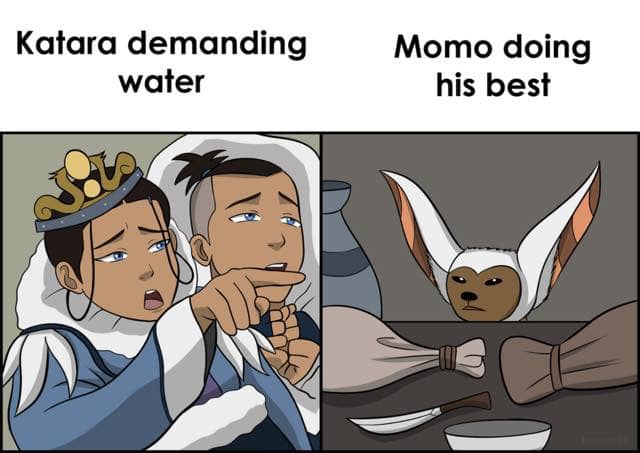
Okay, here’s an analysis of the image, broken down into the requested theoretical sections. It's important to note that applying these frameworks to a relatively simple image (a meme) requires some interpretation and can be a bit playful. **Visual Description** The image is a two-panel meme format. * **Left Panel:** Shows Katara, a character from *Avatar: The Last Airbender*, in a dramatic, distressed pose. She wears a regal gown and crown, and is gesturing aggressively (pointing) at someone off-screen, with a highly emotional expression. The lighting and coloring accentuate her intensity. * **Right Panel:** Shows Momo, a winged lemur character from the same series, appearing frustrated with a messy scene around him. There's a disassembled pot/utensil, scattered pieces, and Momo looking directly at the viewer with a weary expression. The meme format contrasts these two scenes, implying a relationship between Katara’s demanding nature and Momo’s effort to clean up the mess. --- **Foucauldian Genealogical Discourse Analysis** This image lends itself to a Foucauldian reading by demonstrating the power dynamics embedded within "caring" and "housework." * **Discourse of Care:** Katara’s demanding posture suggests a discourse of care that is performative, entitled, and possibly even disciplinary. The regal dress and crown amplify the power imbalance—she’s not just asking for water; she’s *demanding* it as a sovereign. This can be traced genealogically to historical discourses surrounding royalty, female authority, and expected subservience. * **Discipline & Normalization:** The implied “mess” that Momo is dealing with represents a deviation from an ideal, "normalized" order. Momo, as the one attempting to restore order, is enacting a disciplinary force - a cleaning up of the disruption. The expectation that someone (Momo) should fix the mess, rather than addressing the source of the demand, is part of this disciplinary system. * **Power/Knowledge:** Katara's authority is both claimed and acknowledged. She *knows* she deserves water and expects it. Momo's silent struggle, contrasted against her demand, reveals how power is deployed through seemingly harmless requests that rely on unacknowledged labor. --- **Critical Theory** Through a critical theory lens, this meme touches upon the theme of **unacknowledged emotional labor** and the burden of meeting others’ needs. * **Ideology:** The meme subtly exposes the ideology that certain characters (Katara) are entitled to care and support, while others (Momo) are relegated to fulfilling those needs without the same recognition or respect. * **Reproduction of Social Relations:** The meme gestures towards the way in which gendered and hierarchical social relations are reproduced within the *Avatar* universe (and reflected in our own). Katara, as a female character often positioned as the emotional center of the group, is frequently shown expressing needs and relying on others. Momo, while endearing, frequently ends up in a support role. * **Alienation:** Momo’s exhausted expression hints at a kind of alienation – a disconnection between his effort and any perceived appreciation. He's performing labor to maintain a certain order, but his internal state (the weary expression) suggests a lack of fulfillment. --- **Marxist Conflict Theory** From a Marxist perspective, the image represents a micro-level depiction of class and labor conflict. * **Exploitation of Labor:** Momo is the proletariat, performing the labor of cleaning up the “mess” while Katara, the perceived noble, demands a service. The image doesn’t highlight a conscious exploitation, but it subtly evokes the idea that labor is being performed to fulfill the needs of another without reciprocal benefit or appreciation. * **Power Dynamics & Class:** Katara's regal attire and commanding posture demonstrate power and privilege, while Momo's unassuming appearance and exhausted state suggests a lack of it. The scene presents a microcosm of a class-based social structure. * **False Consciousness:** It could be argued that the other characters in the series, and even Momo himself, have a “false consciousness” about this dynamic, accepting Katara’s demands as natural or inevitable without questioning the distribution of labor and responsibility. --- **Postmodernism** A postmodern reading focuses on the deconstruction of meaning and the questioning of grand narratives. * **Intertextuality:** The meme relies on intertextuality – the audience must be familiar with the characters and their roles in *Avatar: The Last Airbender* to understand the humor and commentary. * **Irony & Parody:** The meme is inherently ironic, taking a dramatic scene and juxtaposing it with a mundane one to create a humorous effect. It parodies the dynamic between characters. * **Deconstruction of Identity:** While subtle, the meme deconstructs the “ideal” identities of Katara (caring, powerful) and Momo (adorable, helpful) by showcasing a more complex and potentially unflattering side to their behaviors. The meme challenges the assumptions about their roles in the group. --- **Queer Feminist Intersectional Analysis** This is more of a stretch, but we can explore it. * **Subverted Gender Roles:** While Katara isn't necessarily displaying overtly negative "feminine" traits, her demanding demeanor can be read as a subversion of the "selfless caregiver" trope often assigned to female characters. * **Emotional Labor & Gender:** The image hints at the burden of emotional labor, often disproportionately placed on women. Katara’s demand for water can be seen as an expectation for emotional support or provision, which Momo is indirectly expected to facilitate. * **Intersectionality of Labor:** Momo's position as a non-human creature complicates the analysis. His “labor” is further marginalized because he isn't recognized as an equal social being. His exhaustion may represent a silencing of voices beyond the human sphere. **Disclaimer:** These analyses are interpretations, and the image is open to a range of readings. The purpose here is to demonstrate how different theoretical frameworks can be applied to even simple visual media to uncover deeper meanings and social commentary.
tesseract-ocr
water his best AN a AAs 2 wd AN : , uy
llama3.2-vision
The meme is a split-screen image comparing two characters' reactions to a situation. On the left, Katara from the animated series "Avatar: The Last Airbender" is shown looking concerned and telling her friend Sokka to "stop" as he's about to drink contaminated water. On the right, a character from the series "Avatar: The Last Airbender" named Momo is shown looking worried and telling his friend "stop" as he's about to drink contaminated water. The text "Katara: stop drinking that!" and "Momo: stop drinking that!" appears above and below the images, respectively.