First Seen
2023-05-10T21:03:35+00:00
simple-description (llama3.2-vision_11b)
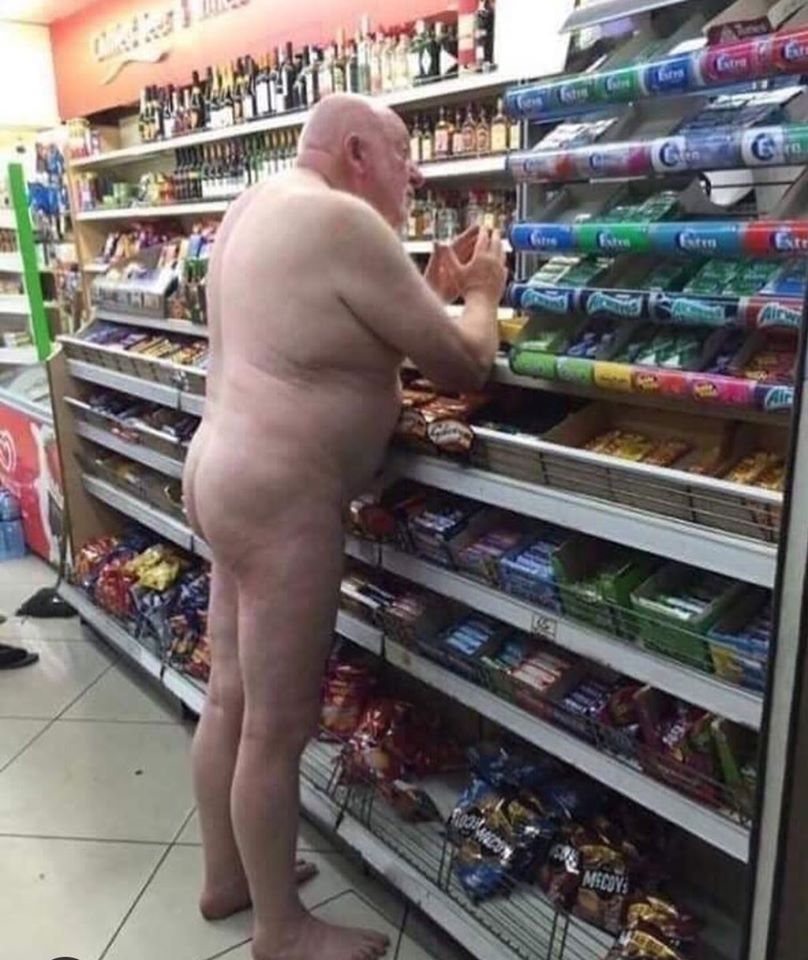
This meme features a man in a public place, likely a supermarket or store, wearing only his underwear. The image is captioned "I just wanted to see if the eggs were 3 for 5" and is meant to be humorous and absurd, poking fun at the idea of someone being so careless and inconsiderate in a public setting. The meme is a lighthearted way to poke fun at the idea of being a "naked shopper" and the absurdity of the situation.
detailed-analysis (gemma3-27b-vision)
Okay, here's a breakdown of the image, analyzed through the requested theoretical lenses. I'll only include sections where the theory is meaningfully applicable. Please be aware that applying these theories is inherently interpretative, and other readings are possible. I will include caveats and acknowledgement of limitations at the end.
Please note: This image is unusual and provocative. The analysis will necessarily touch upon themes of nudity and social norms, but I will aim for a theoretically informed, rather than sensational, approach.
Visual Description
The image depicts an older, nude man standing in front of a well-stocked snack and confectionery aisle in what appears to be a convenience store or small supermarket. He's gazing intently at the candy bars on display, holding his hands in front of him as if in contemplation or perhaps selecting a particular treat. The shelves are filled with a wide variety of brightly colored, packaged candies and chocolate bars. The lighting is fluorescent, common to retail environments. The background is out of focus, but appears to show other items on shelves and possibly a cash register area. The man's skin is pale, and he appears physically frail.
Foucauldian Genealogical Discourse Analysis
This image is ripe for a Foucauldian reading. Foucault’s work centers on how power operates through discourse and the construction of norms.
- Discourse & Norms of the Body: The most striking element is the man’s nudity. We immediately perceive this as abnormal because of the deeply ingrained discourse surrounding bodies, public space, and decency. This “abnormality” isn’t inherent in the state of being nude, but is produced by the historical and social construction of norms around visibility, modesty, and the regulation of the body. We've developed discourses that categorize nakedness as "private" and associate its public display with deviance, sexuality, or vulnerability.
- Panoptic Effect: The retail environment itself can be seen through a panoptic lens. The arrangement of shelves, the potential for surveillance (security cameras, employees), and the expectation of consumer behavior create a space of control and visibility. The man’s nudity disrupts this panoptic order, forcing a reassessment of the expected norms of the space.
- Genealogy of Decency: Examining the historical evolution of ideas about the body, decency, and public display would reveal that these concepts are not fixed, but have been negotiated and changed over time. What was considered acceptable nudity in one historical period is taboo in another.
- Power/Knowledge: The act of observing and categorizing the man’s nudity as ‘abnormal’ or ‘transgressive’ is an exercise of power. This power is connected to knowledge—our understanding of social norms and the rules governing public behavior. The image challenges us to examine the origins and implications of this knowledge.
Critical Theory (specifically, Adorno & Horkheimer's Culture Industry)
The image can also be analyzed through the lens of the Frankfurt School's critique of the culture industry.
- Commodification of Desire: The candy aisle itself represents a curated and standardized form of desire. The culture industry doesn’t simply fulfill needs, it creates them. The brightly colored packaging and tempting displays are designed to stimulate impulsive buying and perpetuate consumerism.
- Fragmentation & Spectacle: The man's nudity disrupts the smooth flow of consumer spectacle. He introduces an element of the 'real,' the unmediated, into the carefully constructed world of consumer desire. This disruption momentarily forces us to confront the artificiality of the consumer environment.
- Loss of Individuality: The mass-produced, identical candies on the shelves symbolize the homogenization of culture and the suppression of individual expression. The man’s nakedness could be read as a desperate attempt to assert individuality in a world that increasingly demands conformity.
- The Unexpected as Critique: The image itself, being so jarring and unexpected, can be viewed as a form of critique of the culture industry. It forces a pause in the usual consumption patterns and prompts viewers to consider the spectacle they are normally immersed in.
Marxist Conflict Theory
While not the most prominent lens, Marxist theory can offer some insight.
- Alienation: The man’s nudity could be interpreted as a manifestation of alienation from the capitalist system. Stripped of the clothes that signify his social status and participation in the consumer economy, he appears as a ‘raw’ individual, disconnected from the structures of production and consumption.
- Commodity Fetishism: The focus on the packaged candy obscures the labor and resources that went into producing it. The man's nudity, in contrast, is a display of the body as a ‘natural’ object, a stark contrast to the processed and commodified objects on the shelves.
- Social Disruption: The man's behavior disrupts the expected order of the retail space and challenges the norms of capitalist exchange. This disruption, while seemingly insignificant, can be seen as a micro-level expression of social conflict.
Limitations and Caveats
- Context is Crucial: Without knowing the context surrounding this image (is it performance art, a protest, a mental health crisis, or something else?), any analysis is speculative.
- The Gaze: The interpretation of the image is inevitably shaped by the viewer’s own social, cultural, and historical background. Different viewers may have vastly different reactions and interpretations.
- Potential Harm: It's important to recognize that the depiction of nudity can be exploitative or harmful, depending on the intent and context. Analysis should be done with sensitivity and awareness of potential power dynamics.
I hope this provides a comprehensive and nuanced analysis of the image through the requested theoretical frameworks. Let me know if you’d like me to elaborate on any particular point or explore other theoretical perspectives.
simple-description (llama3.2-vision)
The meme features a photo of a man who is naked in a public place, specifically in a grocery store. The image is captioned "Just me at the supermarket" and is often used to express a sense of awkwardness or embarrassment. The meme is humorous because it's relatable to anyone who's ever felt like they're not quite dressed for a situation, but taken to an absurd extreme.
tesseract-ocr
- 1 e yn ae tare agi th ere aie wy ghee ty Ga : Sheer wes, Pe a |g aS x Ryall Me es | " \ = : Sw ' ee Se ae . = i eee! , - SY} = kj at 4 Sa SS ry re ot NSE