First Seen
2023-05-10T21:03:35+00:00
simple-description (llama3.2-vision_11b)
The meme features a photo of a tiny, luxurious RV (recreational vehicle) that has been transformed into a full-fledged, high-end home, complete with a spacious living room, a kitchen, and a bedroom. The caption reads "Burner" which is a reference to the annual Burning Man festival, where people build elaborate and often absurdly large structures, called "burner" homes, as a form of art.
detailed-analysis (gemma3-27b-vision)
Okay, let's break down this image through the lenses you've requested. It’s a fascinating and layered visual, opening up several avenues for analysis.
Visual Description
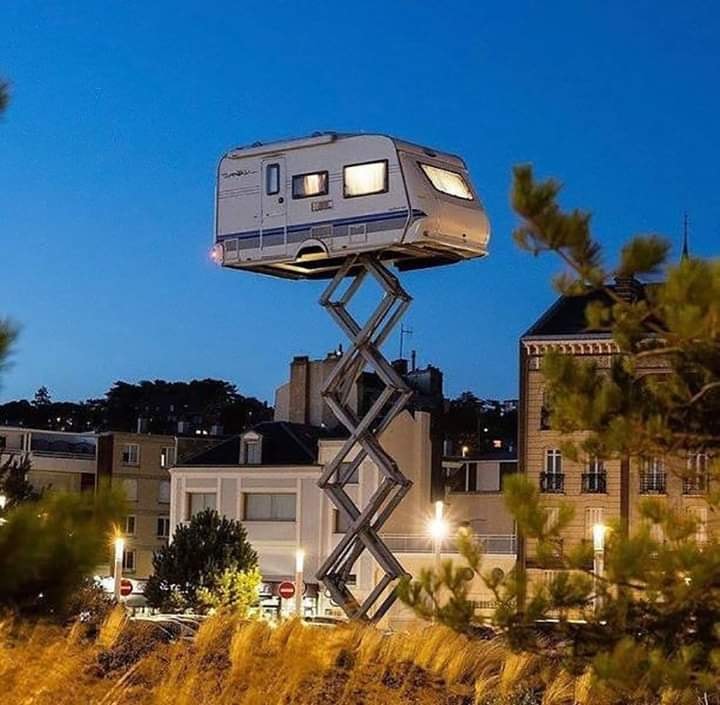
The image depicts a white caravan (or camper trailer) precariously balanced atop a large, industrial-looking scissor lift. This lift is set within an urban landscape, appearing to be a park or overgrown lot bordering residential buildings. The scene is captured during twilight, with a deep blue sky contrasting with the warm artificial lights of the caravan and some streetlights. The foreground features tall, dry grasses and foliage. The overall effect is surreal and striking, creating a sense of imbalance and temporary suspension. The buildings in the background appear to be of European architectural style, adding a contextual element.
Foucauldian Genealogical Discourse Analysis
This image is ripe for Foucault. The scissor lift is a powerful symbol of power/knowledge. Think about what scissor lifts do. They raise things, provide access to otherwise unreachable spaces, and are typically instruments of work, construction, or maintenance. But it's not just about the physical function. It's a mechanism of control. The lift dictates where and how the caravan is positioned, demonstrating an underlying structure of power.
The caravan itself, traditionally a symbol of freedom, mobility, and escaping societal norms, is now dependent on this mechanism of control. Its freedom is conditional, literally and figuratively suspended.
A genealogical approach would investigate how this arrangement came to be. What discourses (ways of thinking and talking) have led to a situation where even symbols of autonomy are subject to such control? Is this a commentary on the increasing surveillance and regulation of all aspects of life? Is it suggesting that even "escaping" requires participation in a system of power? The image doesn’t tell us the answers; it reveals the historical construction of power relations manifesting in a symbolic way.
Critical Theory
From a Critical Theory perspective (drawing on the Frankfurt School and thinkers like Adorno and Horkheimer), the image can be seen as a manifestation of the dialectic of enlightenment. The scissor lift, a product of technological progress and rationalization, has become an instrument of control, seemingly subsuming the very idea of freedom represented by the caravan.
The image is unsettling because it disrupts our expectations. The caravan, traditionally linked to leisure and escape, is rendered immobile and precarious. This disruption forces us to question the promises of progress and the supposed emancipation offered by technology.
We could see it as commenting on the culture industry and the way it manufactures desires and then controls their fulfillment. The desire for freedom and mobility is acknowledged, but then is contained within the framework of a controlled, regulated environment. The “promise” of escape is an illusion, reinforcing the existing social order.
Marxist Conflict Theory
From a Marxist lens, the image presents a stark visual metaphor for class struggle and the control of resources. The caravan, representing a mobile home or a symbol of potential self-sufficiency, is raised – literally elevated above the ground – by a mechanism controlled by an unseen power.
This can be interpreted as a commentary on the socio-economic forces that limit access to housing, mobility, and autonomy. The lift represents the capitalist system that controls the means of production (in this case, the technology allowing for elevated access) and dictates who has access to resources and opportunities.
The precariousness of the caravan’s position can be read as reflecting the vulnerability of the working class or marginalized communities, who are constantly subject to the whims of economic forces and power structures.
Postmodernism
This image embodies many core tenets of Postmodernism. It is fundamentally deconstructive. It takes familiar symbols – the caravan as freedom, technology as progress – and disrupts their conventional meanings. The combination of elements is bizarre and unsettling – a deliberate rejection of grand narratives and simplistic explanations.
The image plays with simulation and hyperreality. The caravan isn’t truly “escaping”; it is suspended in a state of artificiality, its potential for movement rendered meaningless. It’s a spectacle, divorced from any grounding in “real” experience.
The image rejects any singular interpretation. It's open to multiple readings, emphasizing the subjective nature of meaning and the rejection of any overarching, unifying truth. The ambiguity invites us to question the nature of reality and the constructedness of our perceptions.
Queer Feminist Intersectional Analysis
This is where things get really interesting. Consider the caravan as a traditionally mobile space, historically utilized by marginalized groups (travellers, Romani communities, alternative lifestyles). Elevating it on this machine can be seen as an act of containment and control, stripping away agency and limiting movement. This resonates with historical and ongoing attempts to control and marginalize mobile communities.
Intersectional analysis brings in the layers of how this control intersects with other power dynamics. The mechanical lift, typically associated with male-dominated construction fields, visually represents patriarchal control over spaces and movement. The very act of raising something up can be interpreted as a visual manifestation of power dynamics, historically used to signify dominance.
Furthermore, the image can be read as a critique of heteronormative assumptions around domesticity. The caravan, traditionally associated with a mobile “home,” represents a challenge to the conventional, fixed structures of family and belonging. Elevating it on this machine can be seen as an attempt to “contain” and regulate alternative forms of kinship and community.
In all, it’s a complex and evocative image that opens up a lot of interesting possibilities. Does that breakdown cover what you were looking for? Let me know if you’d like me to elaborate on any of these points!
simple-description (llama3.2-vision)
This meme features an image of a tiny house, known as a "treehouse," but it's actually a car with a house on top of it, perched on a giant metal pole, stuck in a tree. The text that appears in the image reads, "I've been trying to get out of a relationship, but I'm stuck in the tree with my ex."
tesseract-ocr
oo oS | a= “Se VV MBS , wha fod eee )/ aay ee =| a. Leth i fe Fl ie Sai Y fia ale Ps Pe 2S .ic ponte ei ee a ee oe eas LT © ses ‘ bhi ene a ce ae BA Se Ms Gt a