First Seen
2023-05-10T21:03:35+00:00
simple-description (llama3.2-vision_11b)
This meme is a photograph of a bathroom wall with a piece of graffiti that reads "Burning Man is cancelled. We are not doing this." The text is written in a messy, handwritten style, and the word "Burning Man" is crossed out with a red pen. The text is likely a response to the cancellation of the Burning Man festival, which was originally scheduled to take place in 2020.
detailed-analysis (gemma3-27b-vision)
Okay, here's an analysis of the image, broken down into the requested theoretical frameworks. Not every framework will be a strong fit (that's intentional, it reflects real analytical practice), and I'll indicate where that's the case.
Visual Description
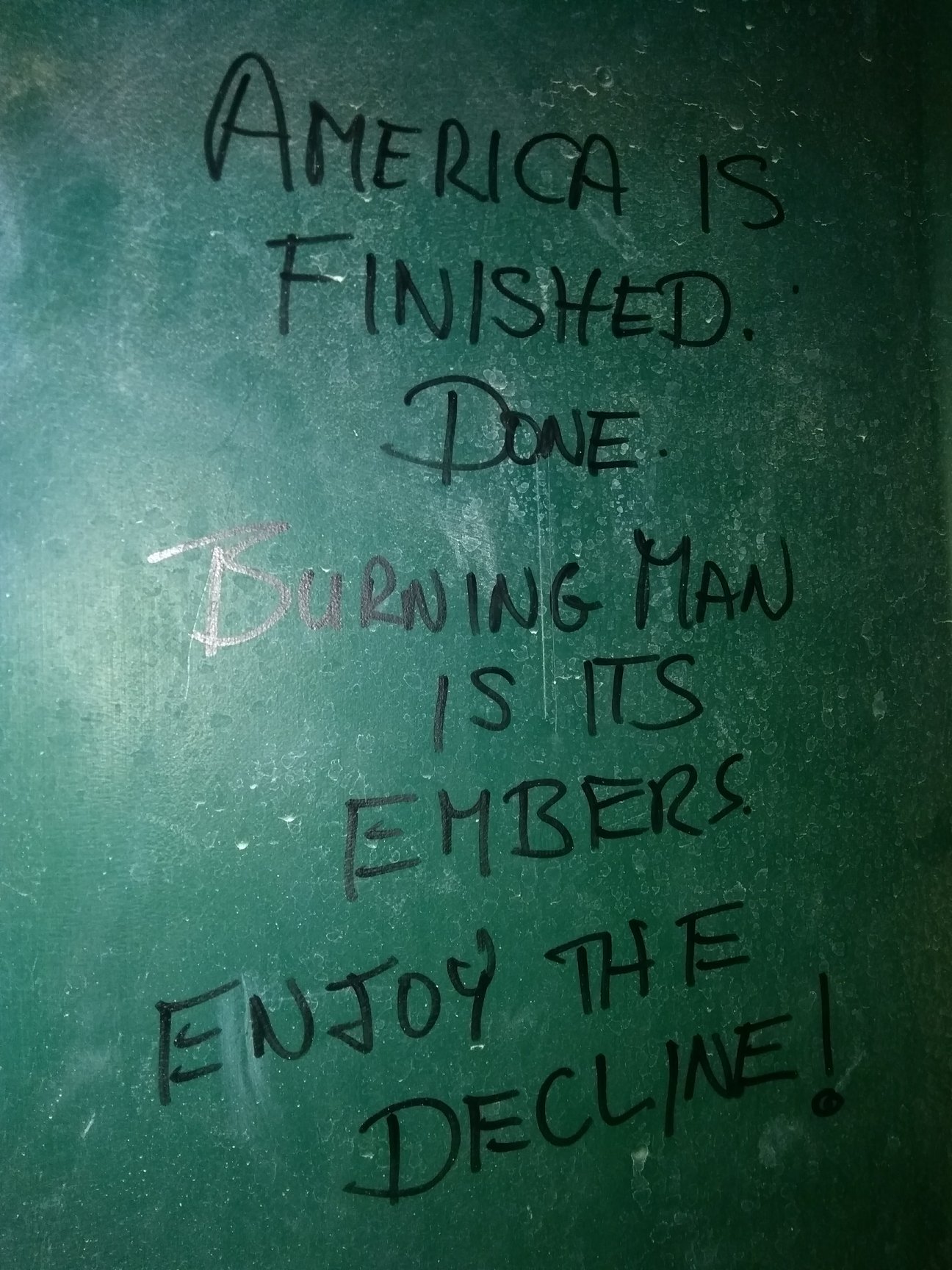
The image is a photograph of what appears to be a dark green, textured wall, likely painted. Scrawled across the wall in bright red lettering is the text:
“AMERICA IS FINISHED.
DONE.
BURNING MAN IS ITS EMBERS
ENJOY THE DECLINE!”
The lettering is hand-written, with a somewhat rough or urgent style. The overall impression is one of graffiti, or a deliberately provocative statement. The texture of the wall is noticeable, suggesting it's not a pristine surface, adding to the sense of decay or immediacy. There are slight imperfections on the surface of the wall.
Foucauldian Genealogical Discourse Analysis
This text is ripe for a Foucauldian analysis. The statement isn’t about an objective “truth” of America’s state, but a discourse that is constructing a narrative of decline.
- Power/Knowledge: The statement isn’t simply expressing a feeling; it performs an act of power by asserting a specific judgment. By declaring America “finished,” it participates in a broader discourse of national self-critique or disillusionment. The act of writing this publicly also contributes to a power dynamic – the author exerts a claim over the interpretation of America's present and future.
- Genealogy: A genealogical approach would investigate the historical conditions that gave rise to this statement. What discourses about America are preceding this one? What anxieties, social movements, and historical events are converging to make this statement resonate? The reference to “Burning Man” suggests an interest in counter-cultural movements and alternative ways of life, a genealogy that traces a break with traditional American values.
- Discursive Formation: The very way the statement is phrased ("America is finished. Done.") is interesting. The repetition emphasizes the finality of the judgment. The phrasing is stark and declarative, bypassing nuanced argument. This is a specific tactic within the discourse of decline.
Critical Theory
The text speaks to several key themes in critical theory, particularly regarding societal critique and the concept of "endings."
- Social Critique: The statement is, fundamentally, a critique of the current state of American society. It suggests a deep dissatisfaction and a sense of systemic failure. The message challenges the dominant narratives of progress and exceptionalism often associated with American identity.
- Negative Dialectic: The idea of "America being finished" can be read as a form of negative dialectic. It’s not offering a positive vision of the future but identifying what isn't working and what must be abandoned.
- The Culture Industry: While the image is not a mass-produced cultural artifact, the rhetoric of decline is often exploited by the culture industry (media, entertainment, etc.). This message, if disseminated widely, could become commodified and lose its critical edge.
Marxist Conflict Theory
This image can be analyzed through the lens of class conflict and the inherent contradictions of capitalism.
- Internal Contradictions: The declaration that America is “finished” can be interpreted as a response to the increasing social and economic inequalities in the United States. The reference to "embers" and the implied destruction of America may represent the potential for systemic upheaval and revolution.
- The Base and Superstructure: The statement could be viewed as a reflection of a shift in the "base" (the economic and material conditions of society). A perceived crisis in capitalism, or a sense of growing class antagonism, could be manifesting in the "superstructure" – the cultural and ideological expressions like this graffiti.
- Alienation: The message could also be viewed through the lens of alienation, indicating a sense of disconnect and estrangement from American society and its values.
Postmodernism
This message aligns strongly with certain aspects of postmodern thought.
- The Death of Metanarratives: Postmodernism is characterized by a rejection of grand, overarching narratives (metanarratives) that attempt to explain the world. The declaration that “America is finished” can be seen as a rejection of the American Dream, the narrative of American exceptionalism, and other dominant narratives.
- Deconstruction: The statement challenges the very notion of a fixed, stable "America". It suggests that American identity is fluid, contested, and potentially unraveling.
- Fragmentation & Disillusionment: Postmodernism often reflects a sense of fragmentation and disillusionment with modern institutions and values. The message clearly expresses a strong sense of dissatisfaction and despair.
Queer Feminist Intersectional Analysis
This is the framework that is the least directly applicable from the text itself, but a thoughtful reading can still yield some insights.
- Critique of Power Structures: Queer and feminist theories are concerned with challenging systems of power and oppression. While the message doesn't explicitly mention gender or sexuality, the broader critique of America can be seen as a rejection of patriarchal, capitalist, and colonial power structures that contribute to marginalization.
- Intersectionality & Erasure: The statement, in its broadness, potentially erases the experiences of marginalized groups within America. While it critiques the nation as a whole, it doesn't specify which groups have been most harmed by its failings. A more nuanced critique would acknowledge the intersectional nature of oppression.
- The “Burning” as Transformation: The metaphor of "embers" could be interpreted as a call for radical transformation and rebuilding, a sentiment that resonates with queer and feminist movements that seek to dismantle existing power structures and create a more just and equitable society. However, the lack of a specific focus on gender and sexuality means this interpretation remains somewhat speculative.
Let me know if you'd like me to elaborate on any of these analyses or explore another theoretical framework.
simple-description (llama3.2-vision)
This meme is a humorous image of a blank wall with a single phrase written in marker: "I can explain why the wall is blank. Because I've been explaining it for 40 years."
tesseract-ocr
mI he mere poe ‘ ee rival A za e f q i. € jy agen ea se ve aS ; — Alisa wi! pense Ss i Se at ote i ote. ff tae ee, ; Bes oy oe f \ hos i SUE 5 Oe eater = Peri a a i ha > 4 ere a a dt Se i way “ Se <i We th oa By | nm 2 oN ae : <> ERPS: “We ae {- oie i “p42 <a eT JE a & a iK : ‘ : rs aa ee ee ys = ie BY Nn aera eee a x ae ‘ Se ine OR pier eee eee J ihe Pe eee Ga cod ad. MeN SS a Sh ORR ee iy. RAG tints oe 7 ee ees RES. ONS aa Se eee eS Sip oe ee a GR ry Sri cee = oe + Bal ico: XS : ¥ tea rope fe, ee NS Ds ~ ‘ Cee. Sia wee NWO NS RE : ied acts. PND SS ee oS ae 2S ee ee L : : * } RE Gee eae 10 gaat eo age : 0 AEROS RE i ge Pea , iF ees rere ee : > RS en ee Le ' "7 ee ca a Sa See eters ~8t ES Se wep ee Rees ac 4 game r Sn ie ee NM I ee ees a Bn ee 1 ee as a zB s I ANE au res i (PE Aa Sc eee ee er ae i NE TE Rd * ee ee a 0 OL EAE ao RCN Pi NB ROE Po aca A ap PPR Ewe’ GS eeiwsa sty tg} ‘i conan TEC a ENN Pore f mo ee aes Ie oe A ME ee re oe \- 17 Oe BAe BFE Y oe OA AER i oi eve ern Sido A Ae et ke oie 4 ST A ee Naas VA fae a) AIST SG Ga a eh ea 4 tear On a) ME Peer tee 9 : EN ae Ir neat y ie Uae PINE ON SCACRD aee Oe & & Gt asl ee 0 eae we pros je) ¥ t es pS re oe eed AE SES St 2 rary ene eee Me eS : 4 GE Sey sme Y BOA DP Ve ee i {i Gole im To s : z COS aa Nee ee ae ee peer) ae i gia: i ei eee al A y 2 ge Is 6 ae ae ei ea eR va ORL i hy aaa ee ok ce aaa ae 5 aN aa Y eee 7 u tee Pee et ee fs ° 7 NS ee DEL, CS Aa ee ee a Oe a ce Ee aaa Nel ogi Un heagmie ee eee eres ff p ; c Blt Ee gaan 7 mia eat, ee ; ae ‘ " ee My wee oe . Dae WA § ec ok A. }, iia di fd eg he Fe Bol a EG) ee oat f ie ee Coos a amegen q ratte = if a Sa ee p ‘ aa ee i a C4 P as - ore ie. aa ive mate ;A r UR, IOS esi as iar Sam aa cg : eae OEE A aaeret ak. bic ¢ i