First Seen
2023-05-10T21:03:35+00:00
simple-description (llama3.2-vision_11b)
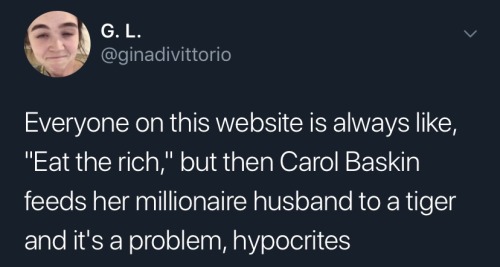
The meme is a humorous take on the popular phrase "Eat the rich" and is now being used to mock Carole Baskin, a former big cat owner and reality TV star. The image shows a screenshot of a tweet that reads: "Everyone on this website is always like, 'Eat the rich,' but then Carole Baskin feeds her millionaire husband to a tiger and it's a problem, hypocrites." The meme is poking fun at the irony of Carole Baskin's actions, as she was known for owning a big cat sanctuary and was accused of feeding her husband to a tiger, which is a major contradiction to her "Eat the Rich" mantra.
detailed-analysis (gemma3-27b-vision)
Okay, here's an analysis of the tweet, broken down into relevant theoretical sections, with headings as requested. Note that not every theory fully applies; some will be more tangential.
Visual Description
The image is a screenshot of a tweet from user @ginadivittorio. The tweet features a small circular profile picture of a person with curly brown hair. The text of the tweet is on a dark background, a standard for Twitter/X. The tone of the text is sarcastic and accusatory. It references the slogan "Eat the Rich" and juxtaposes it with the controversial story of Carole Baskin (of Tiger King fame) and the disappearance of her then-husband. The phrasing implies a double standard.
Critical Theory
The tweet fundamentally critiques the performative nature of online political discourse. Critical Theory, broadly, examines power structures and their impact on society. The user is pointing out a hypocrisy within the context of a popular slogan. The phrase "Eat the Rich" is used often online, and the user suggests people struggle to fully embrace the idea when confronted with a real-world example – in this case, the very dubious circumstances surrounding the disappearance of Carole Baskin’s husband, Don Lewis, and the implication that she may have played a role.
The user is questioning the genuineness of the anger directed at the wealthy. Is it a genuine desire for systemic change, or just a fashionable online expression of frustration? The tweet invites reflection on whether the “Eat the Rich” slogan is a truly radical call to action or just a safe, symbolic gesture that people feel comfortable expressing without actual consequences. The act of being a hypocrite is itself a way of reinforcing power dynamics.
Marxist Conflict Theory
This tweet is inherently linked to Marxist ideas, although subtly. “Eat the Rich” is a direct expression of class resentment—a core tenet of Marxist thought. Marxist Conflict Theory sees society as inherently divided by class struggle. The slogan is a symbolic call for the redistribution of wealth and the dismantling of capitalist structures.
The user’s observation speaks to the difficulty of enacting this change. Even those who express support for “eating the rich” seem to struggle with the practical implications, particularly when it involves someone who, in a somewhat extreme way, actually lost their wealth (and life). The tweet suggests a disconnect between the ideology and the willingness to truly confront and dismantle the power of the wealthy. It can be read as a commentary on how deeply ingrained capitalist structures are, even within supposedly radical online communities.
Postmodernism
The tweet aligns with certain aspects of Postmodern thought, particularly the deconstruction of grand narratives. "Eat the Rich" is a simplified slogan that seeks to represent a complex issue. The user is essentially questioning the validity of this simplified narrative by highlighting the messy, ambiguous reality of the situation.
Postmodernism challenges the idea of absolute truth and instead emphasizes the role of context and interpretation. The tweet suggests that the meaning of “Eat the Rich” is not fixed, but rather, is shaped by our biases and hypocrisies. There is also a play on the idea of simulation, where the symbolic act ("Eat the Rich" online) is contrasted with the real-world, potentially violent, act (the disappearance of a man who had wealth). The tweet highlights the gap between the signifier (the slogan) and the signified (actual wealth redistribution).
Foucauldian Genealogical Discourse Analysis
A Foucauldian approach would examine the discourse surrounding wealth, power, and justice. The tweet implicitly critiques the way we talk about these concepts online. The “Eat the Rich” slogan, as a form of discourse, establishes certain power dynamics and norms. It’s a way of framing the conversation about wealth inequality.
A genealogical analysis, following Foucault, would trace the historical development of this discourse. The idea of targeting the wealthy is not new; it has roots in historical uprisings and revolutions. The tweet reveals how this historical sentiment has been reappropriated and transformed within the context of online culture. It also highlights the ways in which power operates through language and the creation of categories (e.g., "the rich," "hypocrites"). The fact that a woman is implicated in the story introduces the role of gender and how that shapes the discourse.
Queer Feminist Intersectional Analysis
While not central to the tweet, there’s a potential for an intersectional reading. Carole Baskin, as a public figure, has faced a significant amount of scrutiny and often gendered attacks. The narrative surrounding Tiger King involved a lot of speculation about her sexuality and relationships.
An intersectional approach would consider how gender, class, and power intersect in this situation. The fact that the victim was a man, and the alleged perpetrator a woman, adds another layer of complexity. A feminist lens might examine the ways in which gender stereotypes and biases shape the narrative and the reception of the story. It is worth noting that in addition to being a woman, Carole Baskin has also been the subject of queer coding and speculation, and that may play into the interpretations of the situation.
I hope this provides a thorough analysis of the tweet through various theoretical lenses! Let me know if you'd like me to elaborate on any specific point.
simple-description (llama3.2-vision)
The meme is a humorous take on a common phrase, "Eat the rich," but with a twist. The text "Everyone on this website is always like, 'Eat the rich,' but then Carol Baskin feeds her millionaire husband to a tiger and it's a problem, hypocrites" is a sarcastic commentary on the irony of the phrase's original meaning.
tesseract-ocr
@ uly . @ginadivittorio Everyone on this website is always like, "Eat the rich," but then Carol Baskin feeds her millionaire husband to a tiger and it's a problem, hypocrites