First Seen
2023-05-10T21:03:35+00:00
simple-description (llama3.2-vision_11b)
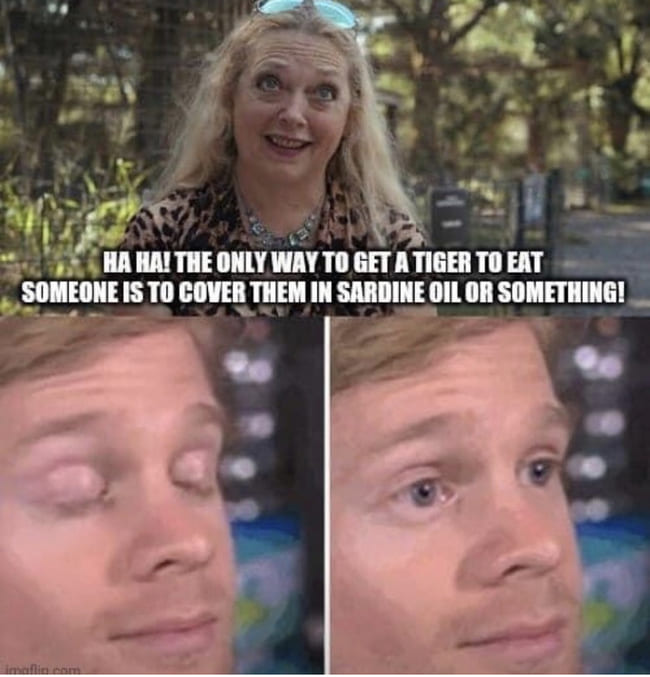
This meme is a play on the infamous "Tiger King" documentary series, which featured Carole Baskin, a big cat owner and former zoo owner. The meme is a joke about her infamous claim that she doesn't eat her tigers, but rather feeds them fish. The text reads: "HA HA HA! THE ONLY WAY TO GET A TIGER TO EAT SOMETHING IS TO COVER THEM IN SARDINE OIL OR SOMETHING!"
detailed-analysis (gemma3-27b-vision)
Okay, let's break down this meme through a few of the requested theoretical lenses. It's important to note that applying all of these to one meme can be a bit of an academic exercise, but we'll try to be insightful.
Visual Description
The meme is a two-panel format. The top panel features a still from the show Tiger King, specifically of Carole Baskin. She is smiling somewhat strangely, her eyes wide and a slightly unsettling gaze. A text overlay reads "HA HA! THE ONLY WAY TO GET A TIGER TO EAT SOMEONE IS TO COVER THEM IN SARDINE OIL OR SOMETHING!" The bottom two panels feature a close-up of a man, presumably reacting to what Carole Baskin said, and displaying varying degrees of distress or disbelief. The left panel shows him with slightly furrowed brows, appearing perplexed. The right panel displays a more exaggerated expression of horror, with eyes wide open and a tense facial expression. The background of the bottom panel is an abstract, blurred purple. The bottom of the image has the Imgflip.com watermark.
Foucauldian Genealogical Discourse Analysis
This meme allows for a compelling Foucauldian reading centered on the discourse of "animal expertise" and the construction of power/knowledge within the context of Tiger King. Carole Baskin, as presented in the documentary, attempts to establish herself as the primary authority on tiger behavior and the dangers involved with big cat ownership. Her statement, while seemingly absurd about sardine oil, is framed as "knowledge" about how tigers operate.
- Genealogy: We can trace the history of how “animal expertise” became tied to authority. Previously, expertise might have rested with indigenous populations or experienced animal handlers. Tiger King and its surrounding cultural phenomena re-defined who is considered an expert (Baskin, in this case).
- Power/Knowledge: Baskin’s “expertise” grants her power within the narrative. It allows her to position herself as a rational actor, while others (particularly Joe Exotic) are framed as irrational or dangerous. The meme highlights the absurdity of the "expertise" – the sardine oil statement is so ridiculous it undercuts the claim to authority.
- Discursive Formation: The statement isn't about the truth of tiger behavior; it's about constructing a discourse where Baskin appears knowledgeable and therefore holds authority. The meme points to the performative nature of this authority – it sounds like expertise, but doesn’t hold up under scrutiny.
- Normalization: The meme, by highlighting the absurdity, also implies that what she says could be normalized as knowledge in a specific context. The meme subtly suggests how absurd it is to try to rationalize everything using "expert" knowledge.
Critical Theory
Applying a critical theory lens, this meme reveals a critique of the spectacle of celebrity and the media’s role in constructing narratives around controversial figures.
- The Culture Industry: Tiger King is a product of the "culture industry" (Adorno and Horkheimer). The documentary presented a sensationalized, fragmented reality for entertainment. The meme points to the absurdity that became spectacle.
- Commodification of the Exotic: The documentary itself commodified the "exotic" – both the animals and the personalities. The meme underscores the strange fascination with and exploitation of this world.
- Alienation: The man’s horrified expression represents a sense of alienation from the bizarre reality presented in the documentary. It is a reaction to the loss of authenticity and the manufactured drama of the spectacle.
- Ideology: The meme also deconstructs the ideology of ‘animal experts’ and challenges the notion that such expertise leads to knowledge.
Postmodernism
The meme embodies several key tenets of postmodernism:
- Pastiche/Hyperreality: Tiger King as a whole is a pastiche of bizarre subcultures and exaggerated personalities. The meme represents a distillation of that hyperreality. It’s not a realistic portrayal of tiger behavior, it's a constructed, exaggerated reality.
- Irony and Parody: The meme relies on irony. It presents a statement that is absurd and then juxtaposes it with a reaction of disbelief. This is a form of parody, mocking the absurdity of the situation.
- Deconstruction of Grand Narratives: The documentary and the meme both challenge any "grand narratives" about animal conservation or ethical animal ownership. It shows how these concepts are manipulated and distorted.
- Simulacra and Simulation: Baskin's claims, and the entire documentary, can be seen as a “simulacrum” – a copy without an original. It's a constructed reality that has become detached from any actual truth.
Note: The other requested lenses (Marxist Conflict Theory and Queer Feminist Intersectional Analysis) are harder to firmly apply to this meme without further stretching the interpretations. While we could attempt to link it to power dynamics within the animal ownership context or explore the performative gender aspects of the show's personalities, these connections feel less direct and robust than the analyses presented above.
I hope this detailed breakdown is helpful! Let me know if you'd like me to delve deeper into any of these theoretical lenses or explore other potential interpretations.
simple-description (llama3.2-vision)
This meme features a photo of a woman, likely a celebrity or public figure, with a shocked or surprised expression. The text overlay reads "HA HA HA! THE ONLY WAY TO GET A TIGER TO EAT SOMEONE IS TO COVER THEM IN SARDINE OIL OR SOMETHING!" The meme is likely a humorous take on a popular TV show or movie, using the character's reaction to a ridiculous or absurd situation.
tesseract-ocr
J a at ~~ J 7 ~*~ Pd M 7 r i 5 ty em -9 ms) 8 3°, Toy f ie 7. he eRe a (<9 Mi “11 re ier int) o> ie - Se a ae eG Isto COVER THEM ORS TR a a @e 4 ee 2 ® « = 7 7 > . —- ‘GS ne ~ “e —_— a —