First Seen
2023-05-10T21:03:35+00:00
simple-description (llama3.2-vision_11b)
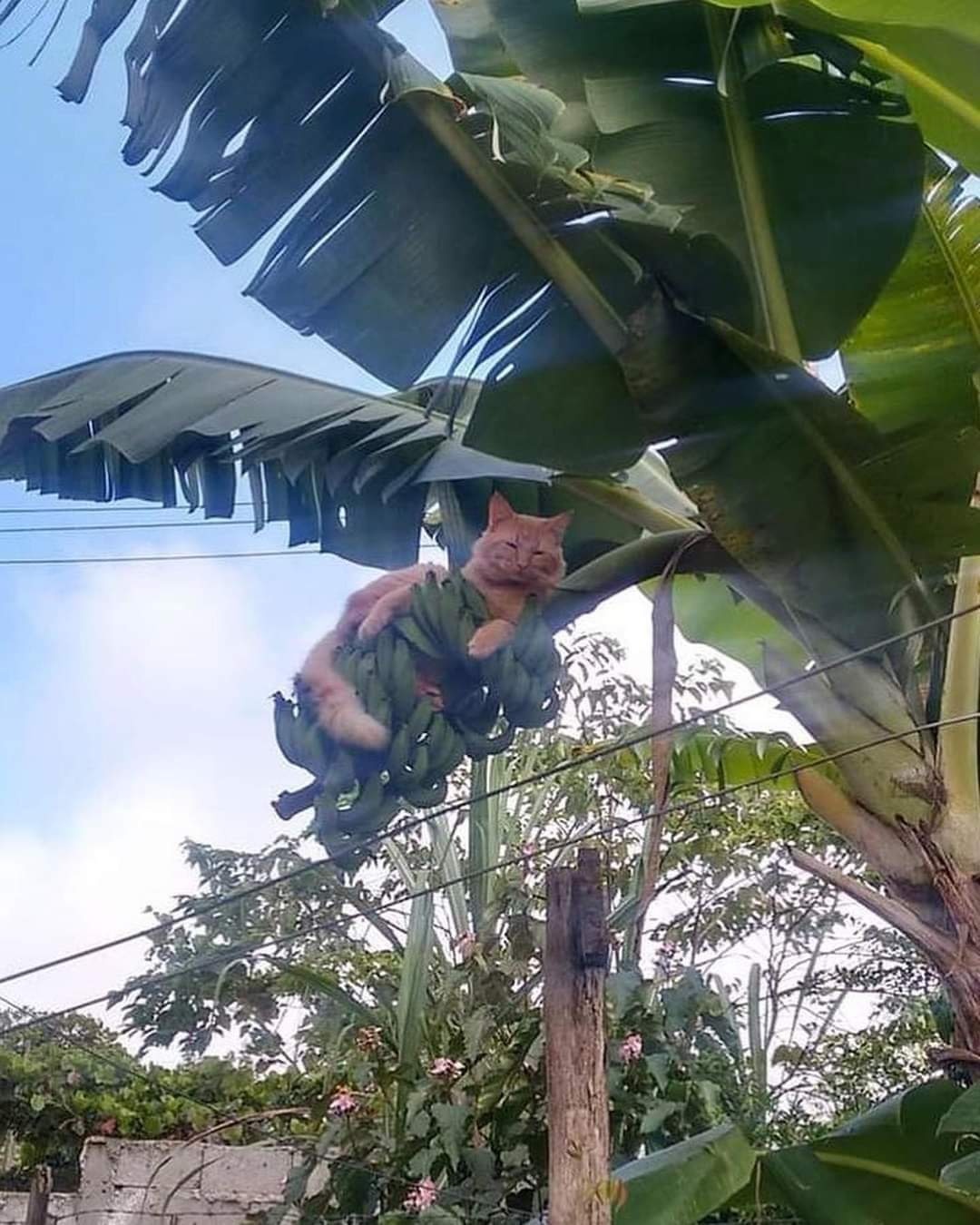
The meme features a photo of a cat stuck in a banana tree, with the cat's paws and tail entangled in the fruit. The image is captioned "When you're trying to eat a snack, but your snack is eating you."
detailed-analysis (gemma3-27b-vision)
Okay, here's an analysis of the image broken down into sections as requested. I'll note when a section doesn't apply strongly. Note that applying these theories to a simple image like this will inevitably be a bit 'reaching' at times, but it’s a good exercise in applying theoretical frameworks.
Visual Description
The image depicts a ginger cat suspended precariously between large banana leaves and some electrical wires. The cat appears relaxed, if somewhat awkwardly positioned, and is seemingly “hammocked” by the leaves and wires. The leaves are lush and vibrant green, dominating the frame. The background shows foliage (bushes, trees, and some distant, indistinct buildings) under a muted blue sky. The overall impression is of a tropical or subtropical environment. The lighting seems to be slightly overcast, resulting in soft shadows. The image is taken from a low angle, looking upwards, which emphasizes the height and the cat's unusual position. The image is somewhat grainy, giving it an informal or candid quality.
Foucauldian Genealogical Discourse Analysis
The image can be examined through the lens of power/knowledge relationships, central to Foucault. The cat’s position is a disruption of expected spaces. Cats are typically associated with domesticity, the interior, and the ground. Here, it occupies a liminal space – suspended between nature (banana trees) and technology (power lines). This could be seen as a subversion of the expected order.
Further, the power lines themselves represent a modern form of control and discipline. They structure the landscape, channeling energy and enforcing a certain order. The cat, in its seemingly innocent positioning, momentarily disrupts that order. It’s not resisting power, but its very presence questions the neat categorization of space and function.
A genealogical approach would examine how this space (between tree and wires) has come to be understood as not a place for cats. It would ask, what discourses (ways of speaking and thinking) have shaped our expectations regarding where cats should be? The image thus invites a deconstruction of these normalized understandings.
Marxist Conflict Theory
The image itself doesn't directly demonstrate class conflict, but one could interpret it metaphorically. The banana trees, common in tropical regions, are often associated with agricultural labor and potentially exploitative economic systems (banana republics, etc.). The cat, in its position of relative comfort and leisure, could be seen as embodying a privileged position within that landscape, oblivious to or benefitting from the underlying inequalities.
However, this is a significant stretch. A stronger application might consider the image as a representation of the commodification of nature. The banana trees are cultivated for economic gain, and the cat’s presence subtly suggests the intrusion of domesticity into that system.
Postmodernism
The image embodies several postmodern characteristics. The juxtaposition of the natural (banana leaves) and the artificial (power lines) is a key feature, blurring the boundaries between nature and culture. The cat’s unexpected placement challenges notions of order and stability. The lack of a clear narrative or ‘meaning’ is also characteristic. We are left to interpret the scene ourselves, and multiple readings are possible.
The image embraces pastiche – a playful combination of elements. It’s not making a grand statement, but it’s offering a fragmented, ambiguous, and ultimately ironic view of the world. There's a self-referential quality to the image – it draws attention to its own constructedness. The grainy quality also contributes to the postmodern aesthetic, rejecting the smooth, polished surfaces of high modernism.
Queer Feminist Intersectional Analysis
This is where applying the theory gets trickiest. One could argue (and it would be somewhat speculative) that the cat's defiance of gravity and its unconventional positioning can be read as a metaphor for challenging societal norms and expectations. Cats, historically, have sometimes been associated with femininity and independence, and the cat's agency in finding a comfortable (albeit precarious) position could be seen as a form of feminist resistance.
The intersectionality aspect comes into play by considering the context of the image. If taken in a region with specific gender roles or power dynamics, the cat’s actions might be interpreted as a disruption of those norms. However, this requires a deeper understanding of the local context. The intersectional reading also has to acknowledge the limits of anthropomorphism; projecting complex social meaning onto an animal can be problematic.
I hope this analysis provides a thoughtful response to your request, even if some sections stretch the application of these complex theories to a relatively simple image! Let me know if you'd like me to elaborate on any specific point.
simple-description (llama3.2-vision)
The meme is a picture of a cat sitting on top of a banana plant, with the cat's paws and tail wrapped around the plant's stem. The cat is looking directly at the camera with a smug expression, as if it's proud of its precarious perch. The text overlayed on the image reads "I can feel your eyes on me".
tesseract-ocr
J Lis i J Y De = = a ~ yy ] Vi vi Va 2 { ; _ fs EB E > La ” A a as : t wh dhe es J lf | \ on | ee 4. = | ~ ‘ . . Lis L = ZY ¢ 5 |) Sat oes is < g hae? (WEES ile: eee os Vena mo | Noe aon Te a yee |) wo OY dee < TS a as 8 [es Tf g 4 By mre