First Seen
2024-04-09T18:31:29.730901+00:00
simple-description (qwen3.5_2b-q8_0)
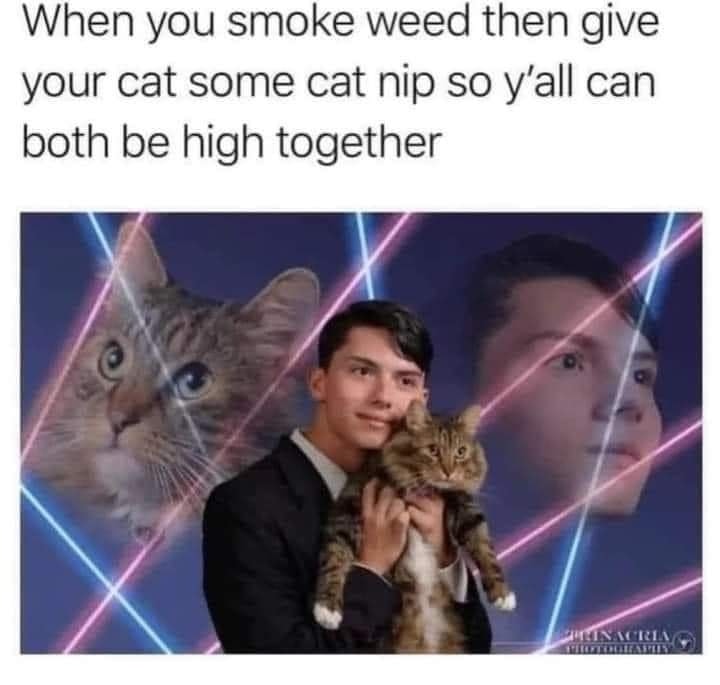
The meme uses a humorous take on feline comfort foods. It suggests that if you smoke cannabis (weed) and sprinkle catnip on your pet, you can both feel the effects of a high together. The background of the photo features an intense, glowing image of a cat and a boy's face, emphasizing the psychedelic and energetic vibe associated with smoking.
simple-description (llama3.2-vision_11b)
The meme is a humorous image of a cat wearing a pair of sunglasses and a hat, with the caption "When you smoke weed and your cat is also high". The image is meant to be a playful and relatable take on the common experience of getting high with your pet, and the caption is a lighthearted way to poke fun at the idea that cats can also get stoned.
detailed-analysis (gemma3-27b-vision)
Okay, let's break down this meme using the requested theoretical lenses. It’s a lot to apply to a meme, so I’ll focus on the most relevant points, and indicate when a theory doesn’t quite land.
Visual Description
The image is a manipulated digital photo, resembling a poorly made yearbook-style portrait. It features a man in a dark suit with a kitten on his shoulders. Two slightly translucent, oversized cat heads are superimposed in the background, one on either side. The background is a wash of purple and accented with bright neon lines. The man appears to be smiling slightly with closed eyes. The kitten looks slightly disoriented, with its eyes wide open. The overall aesthetic is intentionally campy and psychedelic. The watermark is "Prinacria Photography."
Foucauldian Genealogical Discourse Analysis
This meme offers a fascinating point for applying a Foucauldian lens. The “discourse” at play revolves around “getting high.” Examining the genealogy of this discourse reveals how the practices around altering states of consciousness (through substances like cannabis and catnip) have been historically constructed, regulated, and imbued with meaning.
- Power/Knowledge: Historically, societies have constructed "normal" and "deviant" behaviors around substance use. Cannabis, for instance, has been alternately demonized and medicalized. The meme subverts this binary by equating the human experience of “getting high” with the feline experience via catnip. It proposes a parallel, suggesting that both are natural, pleasurable states.
- Disciplinary Power: Disciplinary power, as Foucault describes, isn't about overt oppression but about normalizing behaviors. The meme could be seen as a micro-resistance to the normalization of substance abstinence, instead suggesting a playful acceptance of altered states.
- Genealogy of “Play”: The meme relies on the concept of "play" as a sanctioned form of deviance. Giving catnip to a cat is typically a harmless, accepted behavior, while human substance use is often criminalized or stigmatized. The meme juxtaposes these, exposing the arbitrariness of the boundaries.
Critical Theory
Critical Theory, especially as developed by the Frankfurt School, focuses on how culture reinforces systems of domination. This meme can be examined through the lens of ideology and consumerism.
- Commodification of Experience: The meme subtly implicates the commodification of altered states of consciousness. Both cannabis and catnip are products sold for a specific effect. The meme doesn’t explicitly critique this, but it highlights how experiences (pleasure, relaxation) are increasingly packaged and sold.
- False Consciousness: It could be argued (though weakly) that the meme promotes a "false consciousness" by encouraging escapism through substance use. However, the playful, lighthearted tone undermines this interpretation. The meme is more about shared experience than about masking underlying social problems.
Marxist Conflict Theory
Applying pure Marxist Conflict Theory to this meme is difficult. There isn't an obvious class struggle being represented. However, we can stretch the interpretation:
- Alienation and Leisure: In a capitalist system, leisure time is often commodified. “Getting high” could be seen as a form of escape from the alienation of labor. The meme suggests a shared experience of leisure (for both human and cat) that briefly transcends capitalist relations. But this is a very generous reading.
- Pet Ownership as Capital: One could argue (again stretching) that the meme highlights the commodification of companionship. Pets are often purchased, and their care requires financial resources. The shared "high" is a moment of bonding within this capitalist framework.
Postmodernism
This meme strongly resonates with postmodern sensibilities:
- Pastiche and Intertextuality: The meme’s aesthetic – the dated yearbook photo style, the neon effects, the juxtaposition of human and animal – is inherently pastiche. It borrows from multiple sources and recombines them in a playful, self-aware manner.
- Irony and Playfulness: The meme is intentionally absurd. It doesn't offer a serious message but rather a playful disruption of expectations. This is characteristic of postmodern art and culture.
- Deconstruction of Boundaries: The meme blurs the boundaries between human and animal, rational and irrational, serious and frivolous. It challenges the idea of fixed meanings and categories.
- Simulacra: The image itself is a simulation of a yearbook photo—not authentic but a copy of a copy. The "high" state is also arguably a simulation of a different state of consciousness.
Queer Feminist Intersectional Analysis
This lens doesn't immediately lend itself to the meme, but we can make some connections, though they are more nuanced.
- Subversion of Normative Animal/Human Hierarchies: The meme, by aligning human and animal pleasure (through altered states), subtly challenges the hierarchical view of humans as superior to animals. This can be seen as a small act of resisting anthropocentric thinking.
- Playfulness as Resistance: Queer theory often embraces playfulness and subversion of norms. The meme’s absurdity could be interpreted as a form of playful resistance against rigid social expectations.
- Intersectional Potential: One could stretch this to argue that the meme challenges the expectation that “adult” leisure activities should be serious and productive, which is a norm often imposed on marginalized groups who are expected to constantly prove their worth.
Overall:
The meme is most powerfully analyzed through a Postmodern lens. Its playfulness, irony, and blurring of boundaries are key characteristics of postmodern culture. Foucauldian analysis also provides some interesting insights into the construction of discourses around substance use and pleasure. The other theoretical lenses are less directly applicable, but we can still find some connections with careful interpretation.
tesseract-ocr
When you smoke weed then give your cat some cat nip so y’all can both be high together ; \/ | : s : 4 ] ‘ dae / > ie
simple-description (llama3.2-vision)
This meme is a humorous image featuring a photo of a person holding a cat, with a caption that reads: "When you smoke weed and your cat gets high too." The image is likely to be a playful and relatable depiction of a common experience, with the caption implying that the person and their cat are both enjoying the effects of marijuana.