First Seen
2023-05-10T21:03:35+00:00
simple-description (llama3.2-vision_11b)
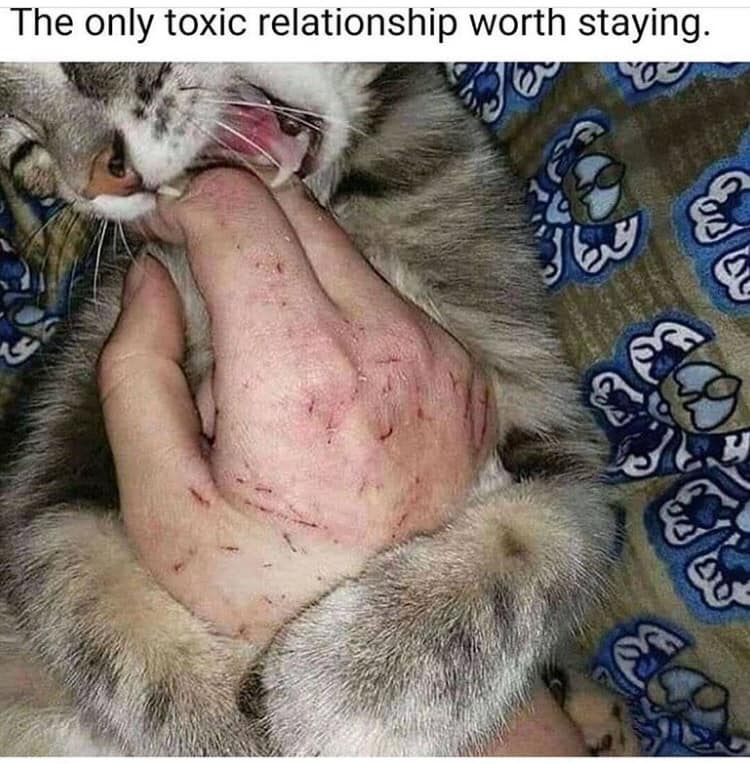
This meme features a picture of a cat with its mouth clamped around a human hand, with scratches and claw marks visible on the hand. The text above the image reads, "The only toxic relationship worth staying in." The meme is a humorous commentary on the idea that some relationships, like those with cats, can be toxic but still worth maintaining.
detailed-analysis (gemma3-27b-vision)
Okay, let's break down this image and the attached text ("The only toxic relationship worth staying in") through several theoretical lenses. This is going to be a bit complex, as the meme itself is ironic and layered.
Important Disclaimer: The analysis below explores theoretical frameworks applied to a representation (a meme) of a potentially harmful situation. It does not endorse or minimize the harm of abusive relationships. It aims to demonstrate how these theories can be applied to understand cultural representations.
Visual Description
The image shows a close-up view of a human hand being actively bitten by a cat. The cat's teeth are clearly visible in the flesh of the hand, which is visibly scratched and appears to be bleeding in several places. The cat has a determined and focused expression, with its ears slightly back. The background shows a patterned fabric, possibly a blanket or bedding. The lighting is flat, suggesting an indoor setting. The overall composition emphasizes the act of biting and the resulting injury. It is likely a candid shot, given the raw, unpolished quality of the image.
Foucauldian Genealogical Discourse Analysis
Applying Foucault’s approach, we can examine how the idea of “toxic relationships” and enduring harm has been historically constructed through discourse.
- Power/Knowledge: The meme’s humor relies on a power imbalance – the cat's active aggression and the human’s passive acceptance. This reflects a cultural fascination with "damage" and an almost romanticization of suffering. The discourse around relationships often frames enduring hardship as a sign of “true love” or strength. This meme plays with that discourse, flipping it to an extreme – accepting even physical harm as worthwhile.
- Genealogy: Looking historically, the discourse around animal-human relationships has shifted. From utilitarian views of pets to their increasing classification as "family members," the meaning of harm inflicted by a pet has also evolved. Historically, certain forms of dominance and subjugation have been normalized. The image's ironic acceptance of harm can be seen as a continuation of this normalization, albeit presented through a humorous and self-deprecating lens.
- Disciplinary Power: The meme, in a small way, participates in a discourse that subtly normalizes accepting a level of pain or injury within relationships. This isn't a powerful form of discipline, but it contributes to a broader cultural understanding of relationships where boundaries can be blurred.
Critical Theory
From a Critical Theory perspective, this meme is a manifestation of a deeper societal critique.
- Ideology: The meme subverts the dominant ideology that healthy relationships should be equitable and safe. It presents a counter-narrative where enduring harm is not only accepted but embraced, albeit ironically. This can be seen as a commentary on the disillusionment with conventional relationship expectations.
- Domination & Resistance: The cat, in this context, can be interpreted as a symbol of an oppressive force—a source of harm that is nonetheless endured. The human hand’s acceptance of the bite can be seen as a form of passive resistance—a defiant embrace of suffering rather than a conventional attempt to escape it.
- Commodification of Suffering: While ironic, the meme potentially participates in a wider trend of commodifying suffering – turning trauma into relatable content for likes and shares. It leverages a painful image for entertainment.
Marxist Conflict Theory
Applying a Marxist lens, we can analyze the inherent power dynamic and the expression of conflict.
- Power Imbalance: The cat and the human represent asymmetrical power dynamics. The cat is enacting physical dominance, and the human is accepting it. This mirrors broader societal power structures where certain groups or forces exert control over others.
- Exploitation: While not literal exploitation in a capitalist sense, the cat's “taking” of flesh can be seen as a symbolic representation of the exploitative relationships that exist within society. The human's willingness to endure the bite can be interpreted as a form of self-exploitation—accepting harm as a consequence of a desired connection.
- Class Struggle: The conflict between the cat and the human can be read as a micro-level representation of broader social conflicts. It illustrates the constant tension between opposing forces and the acceptance of pain as a condition of maintaining a relationship.
Postmodernism
From a Postmodern perspective, the meme embraces irony, fragmentation, and the deconstruction of meaning.
- Hyperreality: The meme is a representation of a representation—a photograph of a painful experience used to create a humorous and ironic statement. This contributes to a blurring of the line between reality and simulation.
- Deconstruction of Romance: The meme subverts traditional notions of romantic relationships by presenting a “toxic” dynamic as something “worth staying in.” This deconstructs the idealized image of romance and challenges conventional expectations.
- Irony and Parody: The meme relies heavily on irony and parody. It mocks the trope of enduring suffering in relationships by exaggerating it to an extreme and presenting it as something desirable.
Queer Feminist Intersectional Analysis
This lens is particularly powerful in examining the meme, given its potential to speak to experiences of enduring harm in relationships.
- Toxic Relationships & Gender: Often, discussions of toxic relationships disproportionately focus on heterosexual dynamics, and women are often framed as the primary victims. This meme could be read as a sardonic commentary on those dynamics or a broader acknowledgement that harm can be part of any relationship.
- Intersectionality & Harm: Intersectional feminism emphasizes that experiences of harm are shaped by multiple identities (gender, race, class, sexuality, etc.). This meme, while visually simple, highlights a universal experience of being harmed by someone we are close to.
- Disrupting Normative Relationship Models: The meme challenges the idea of a “perfect” or “healthy” relationship by suggesting that some degree of harm is acceptable. This can be seen as a rejection of normative expectations and a celebration of unconventional connections, even if those connections are painful.
In conclusion, this meme, while seemingly lighthearted, is a rich text for analysis through various theoretical frameworks. It reflects broader cultural trends, power dynamics, and the ways in which we understand relationships and harm. It's important to remember that while these analyses provide insights, they don't negate the seriousness of abusive relationships.
Please let me know if you'd like any of these sections expanded or explored further!
simple-description (llama3.2-vision)
The meme features a photo of a cat with its paws wrapped around a human hand, with the cat's claws out and visible. The image is captioned "The only toxic relationship worth staying in." The joke is that the cat is holding onto the hand so tightly that it's essentially "staying" in the relationship, implying that the cat is more committed to the relationship than a person would be in a toxic partnership.
tesseract-ocr
The only toxic relationship worth staying. ss A E FE 7) Ais Oe i a a ‘ ge a Po) > mn "> Lee i , a ; ro C#. oe A oe co 5 4 P lk EE Hae | Ne SAG i. a F . ys a NS = s : ly VINSON > « ») iis Ar 5 EX a a pe Fan 2 a ome ee a, & a ek, ~~ ae ed Bc ee 2 yy fk UN a Ni. ae. 5a! ANN NY ay I = ee Ge" apy) SS NS ae & UAE a ns Ci VS RNRNRGE Nw C