First Seen
2023-08-14T01:42:16+00:00
simple-description (qwen3.5_2b-q8_0)
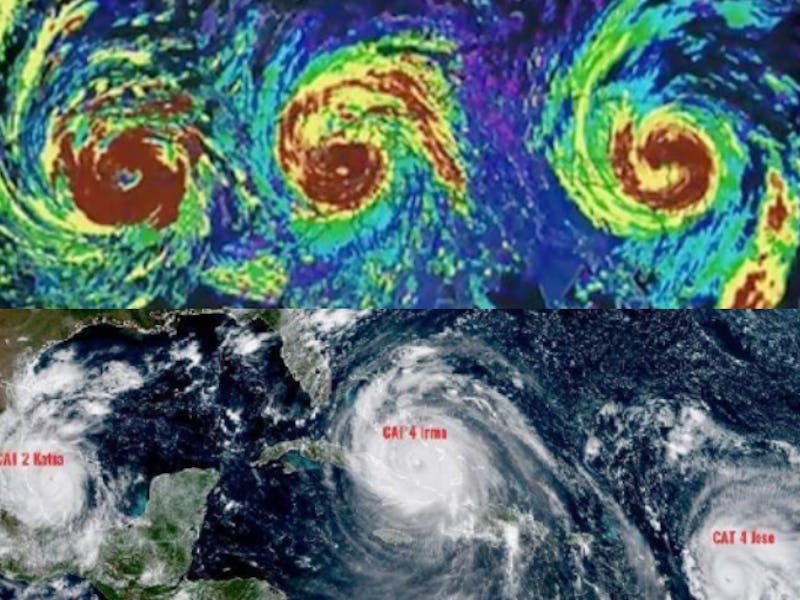
The image presents a striking contrast between a top layer of digital, colorful swirls (resembling tornadoes or supercells) and a bottom layer of real satellite photos of tropical cyclones. The storms are labeled with the category text "CAT," specifically listing severe events such as "CAT 2 Katrina," "CAT 4 Irma," and "CAT 4 Jose." Within the context of the "Climate Change - Thermohaline Collapse" category, this visual represents the escalating severity of tropical storms caused by the warming of the ocean and the destabilization of global currents.
simple-description (llama3.2-vision_11b)
The meme depicts a humorous take on the 2023 Atlantic hurricane season, which was one of the most active on record. The image shows a cartoonish, exaggerated storm cloud with a cartoonish, cartoon-like face, captioned "2023 Atlantic Hurricane Season: 'We're not even mad. We're just happy to see you!'"
detailed-analysis (gemma3-27b-vision)
Okay, here's an analysis of the image, divided into the sections you requested, addressing only those sections that apply. It's a complex task, so I’ll try to provide thoughtful interpretations within the specified frameworks.
Image Description
The image is a composite displaying two sets of hurricane imagery.
-
Top Section: Shows three brightly colored, visually striking, infrared satellite images of hurricanes. The color scheme emphasizes heat signatures, rendering the storm centers in intense reds and oranges, surrounded by yellows and greens. The storms are depicted in the form of spiraling vortexes, and the background is a swirling mix of dark blues and purples, indicative of cloud cover and atmospheric conditions.
-
Bottom Section: Displays a grayscale satellite view of the Atlantic Ocean and surrounding landmasses. Three hurricanes are visible: Hurricane Harvey (labeled "CAT 4 Harvey"), Hurricane Irma (labeled "CAT 4 Irma"), and Hurricane Jose (labeled "CAT 4 Jose"). These storms are visualized in shades of white and gray, showing the swirling clouds and large scale structure. It is positioned in a way that shows the proximity of each storm to land.
Foucauldian Genealogical Discourse Analysis
The image, specifically the labeling with "CAT 4" (Category 4) for each hurricane, is a powerful illustration of the creation of discourses around natural disasters. Michel Foucault’s genealogical approach would examine how these categories emerged as a form of knowledge/power.
-
The Category as a Construct: The “Category” system (1-5) isn’t a natural phenomenon. It's a human construction created by meteorologists and the National Hurricane Center. It’s a way to classify and manage risk. This classification system allows for a certain type of ‘knowing’ about hurricanes – a knowing that prioritizes measurable damage potential.
-
Power/Knowledge: The classification system isn’t neutral. It’s linked to power. The ability to categorize, predict (to a degree), and label a hurricane allows institutions to exert control – issuing evacuation orders, allocating resources, and framing the narrative of disaster. The "CAT 4" label signifies a level of danger that demands specific actions.
-
Historical Contingency: A genealogical analysis would ask how this specific classification system emerged. What historical events, scientific developments, and societal concerns led to its creation? Was there a prior system? How did this system replace it?
-
Disciplinary Power: The labeling of these storms as Category 4 creates a disciplinary effect. It normalizes a certain level of fear and response, shaping public perception and behavior.
Critical Theory
From a Critical Theory perspective, particularly influenced by the Frankfurt School, this image can be seen as illustrative of the tension between nature and modernity and the alienation of humans from natural systems.
-
Instrumental Reason: The image represents a reduction of complex natural phenomena (hurricanes) into quantifiable data ("CAT 4"). This is an example of “instrumental reason” – the application of rationality and calculation to achieve specific goals (predicting, controlling, minimizing damage). While seemingly pragmatic, this approach can obscure the deeper ecological and social forces at play.
-
Domination of Nature: The effort to categorize, predict, and mitigate hurricanes reflects a broader cultural impulse to dominate and control nature. This control, though intended to be beneficial, can have unintended consequences and reinforces a hierarchical relationship between humans and the environment.
-
Commodification of Risk: The labeling and categorization can also be linked to the commodification of risk. Insurance companies, disaster preparedness agencies, and other institutions benefit from the ability to assess and manage risk.
-
Alienation: Modernity, characterized by rationality and control, alienates humans from natural systems. We view these storms not as integral parts of a complex ecosystem, but as threats to be managed and neutralized.
Marxist Conflict Theory
This image, viewed through a Marxist lens, highlights the disproportionate impact of natural disasters on marginalized communities and the role of socio-economic factors in vulnerability.
-
Unequal Vulnerability: While hurricanes affect everyone, the damage they inflict isn't distributed equally. Poor communities, communities of color, and those lacking access to resources are far more vulnerable to the impacts of these storms. The image, by showing these storms bearing down on populated regions, implicitly suggests these disparities.
-
Capitalism and Disaster: Capitalism, with its focus on profit and accumulation, can exacerbate disaster vulnerability. Development patterns that prioritize short-term economic gain over environmental sustainability (e.g., building in flood-prone areas) increase risk.
-
Class Struggle: Disaster response can be viewed as a microcosm of class struggle. Those with wealth and privilege have the means to protect themselves (evacuate, rebuild), while those without are left to bear the brunt of the damage.
-
Resource Allocation: The image implicitly raises questions about how resources are allocated in the wake of disaster. Who benefits from disaster relief? Who is left behind?
Postmodernism
From a Postmodern perspective, the image challenges the notion of objective truth and highlights the constructed nature of our understanding of natural disasters.
-
Deconstruction of Categories: Postmodernism would question the validity of the "Category 4" label. Is it a meaningful and accurate representation of the storm's destructive power? Or is it a subjective construct that serves specific ideological purposes?
-
The Simulacrum: The image itself, as a digital representation of a natural event, can be seen as a simulacrum – a copy of a copy that has lost its connection to the “real.” It’s a mediated experience of disaster, shaped by technology and representation.
-
Fragmentation and Uncertainty: Postmodernism embraces fragmentation and uncertainty. The image, by showing multiple storms simultaneously, highlights the chaotic and unpredictable nature of weather events.
-
Narrative Construction: The way we tell stories about natural disasters shapes our understanding of them. The image, by providing a visual narrative, contributes to this process.
I hope this comprehensive breakdown provides a solid analysis of the image across multiple theoretical frameworks. Let me know if you’d like me to elaborate on any specific aspect.
tesseract-ocr
y me ee nm, ff 7s 2) J Oe ee | ee | ee . d , ; pt ne, rd / ae i Ti . 4 oe. a ¥ SS : mt . Se $ LOS Sy eee h SS ee dg ta D 2 ney. ‘Sheena 7) MP ia & phi is Co RO a Dicgtia P ih ae BLES a pe PFE Rie _* A aa} ie i ty 5 oe ed wt Sin ethee Fi ie : So ee SN ie, 4 paper he a ; = “7 “ORR ia a ‘ ser ae a he ge a Qe tl ae me a ee TE SR.
simple-description (llama3.2-vision)
This meme is an image of a satellite image of Hurricane Irma's storm system, with a red circle highlighting the storm's center. The image is captioned "The calm before the storm".