First Seen
2023-05-10T21:03:35+00:00
simple-description (llama3.2-vision_11b)
The meme depicts a series of car windshields with increasing amounts of debris, symbolizing the growing impact of climate change on the environment. The text "1990, 2020, 2050" appears in the top-left corner of each panel, indicating the year each scenario takes place. The final panel is blank, implying a future where the environment is so degraded that it's impossible to drive safely, making the joke that in 2050, you'll be lucky if you can see through the windshield.
detailed-analysis (gemma3-27b-vision)
Okay, let's break down this cartoon in several sections addressing the requested theoretical frameworks. It's important to note that applying these frameworks can be interpretive and open to discussion, and not all will necessarily apply equally.
Visual Description
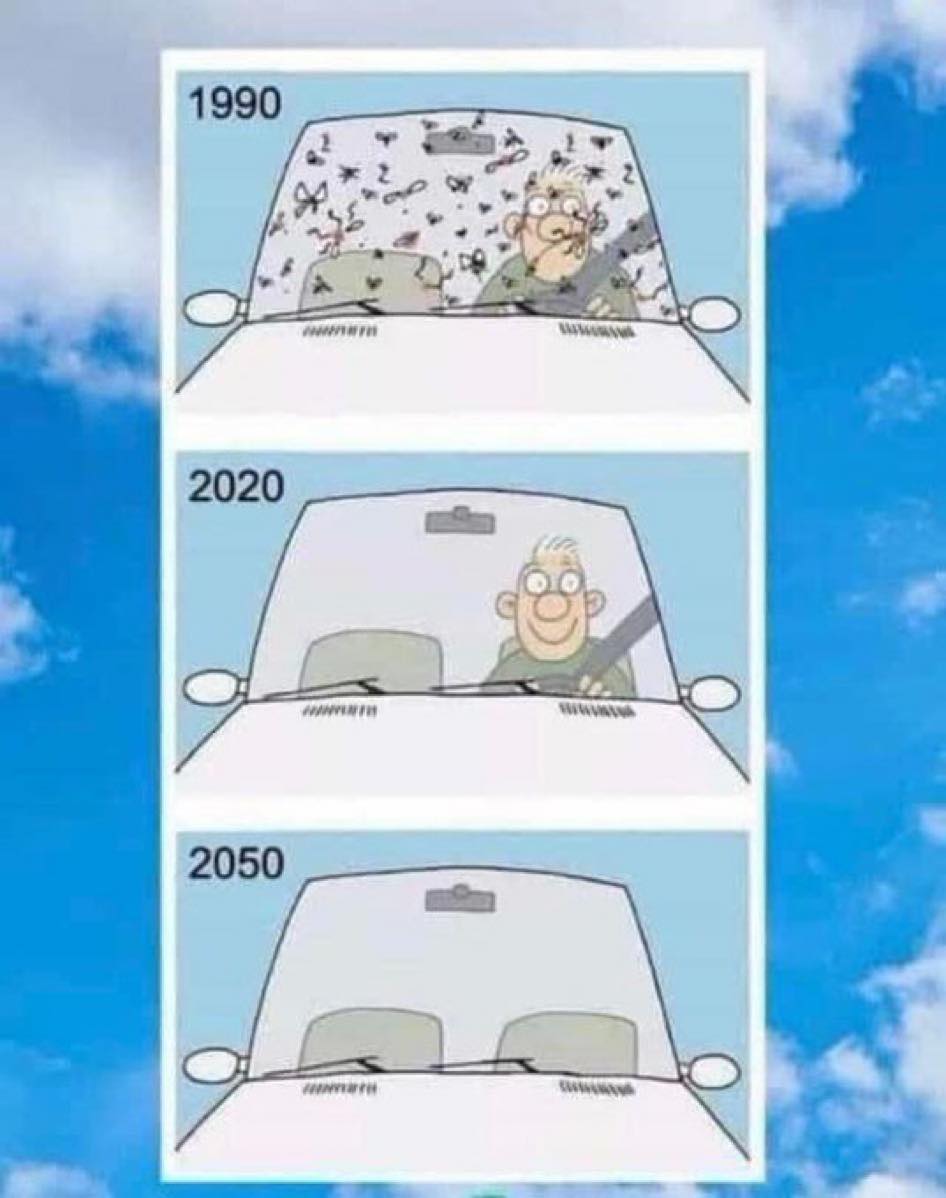
The image is a three-panel cartoon depicting a car's windshield view at different time periods: 1990, 2020, and 2050.
- 1990: The windshield is covered with insects—butterflies, bees, moths—suggesting a thriving insect population. A man (depicted stereotypically with exaggerated features) is driving, seemingly unaffected by the insects.
- 2020: The windshield is much clearer, with only a few insects visible. The man is still driving, smiling broadly, and appears to be happily engaged with the act of driving.
- 2050: The windshield is completely clear of insects. Two seats are visible, and an androgynous figure(s) are sitting in the driver and passenger seat. They do not engage with each other.
The cartoon uses a simple, cartoonish style, relying on visual contrast to convey its message.
Foucauldian Genealogical Discourse Analysis
This cartoon lends itself well to a Foucauldian analysis. The image traces a discourse surrounding nature, technology, and human control over the environment.
- The Power/Knowledge Nexus: The shift in the windshield view represents a shift in power dynamics. In 1990, nature (in the form of insects) appears to hold a certain power—they are numerous and visibly present, occupying the "space" of vision. Over time, this power is subdued through technological advances (pesticides, agricultural intensification, habitat loss) and accepted societal norms (e.g., prioritizing clean windshields over biodiversity). This isn’t simply about killing insects; it’s about constructing a reality where their absence is normalized and even desired.
- Genealogy: Tracing the "genealogy" of the clean windshield reveals a history of agricultural practices, chemical engineering, and consumer preferences. The cartoon implicates us in the production of this reality—our desire for convenience and a "clean" environment has contributed to the decline of insect populations.
- Disciplinary Power: The focus on a pristine windshield functions as a disciplinary mechanism. It normalizes the idea that nature must be controlled and that any intrusion of the "natural world" into our immediate experience is undesirable.
Critical Theory
From a Critical Theory perspective (drawing on thinkers like Adorno and Horkheimer), the cartoon can be read as an illustration of the domination of nature. The cartoon shows the increasing subjugation of the natural world for the sake of human convenience and control.
- Instrumental Reason: The cartoon highlights the application of instrumental reason, where nature is viewed solely as a resource to be exploited and manipulated for human ends. The absence of insects isn't lamented as an ecological loss; it’s presented as a “positive” outcome, a clean windshield.
- The Culture Industry: The cartoon implicitly critiques the "culture industry" by suggesting that our perceptions of nature are shaped by advertising, media, and consumer culture. We are conditioned to value cleanliness and convenience above biodiversity.
- Loss of the Non-Identical: The decline of insects represents a loss of the “non-identical,” a concept central to Critical Theory. The unique and irreplaceable aspects of the natural world are being erased in the pursuit of sameness and control.
Marxist Conflict Theory
A Marxist reading focuses on the power relations and the exploitation of nature as a form of class conflict.
- Capitalism and Environmental Degradation: The decline of insect populations can be linked to the logic of capitalism, which prioritizes profit over environmental sustainability. Intensive agriculture, pesticide use, and habitat destruction are driven by the need to maximize yields and profits, regardless of the ecological consequences.
- Nature as a Means of Production: Nature is treated as a “means of production,” a resource to be exploited for economic gain. Insects are not seen as valuable in their own right but as obstacles to production (e.g., pests that damage crops).
- Alienation: The cartoon can be interpreted as a reflection of alienation – both from nature and from the consequences of our actions. We have become so detached from the natural world that we no longer recognize the ecological costs of our choices.
Postmodernism
A postmodern interpretation would focus on the shifting representations of nature and the deconstruction of grand narratives.
- The End of Nature: The cartoon implicitly suggests the “end of nature” as described by Bill McKibben – the idea that nature is no longer a separate, independent realm but is increasingly constructed and mediated by human technology and culture.
- Simulacra and Simulation: The image of the clean windshield can be seen as a simulacrum – a copy without an original. It represents a desire for a pristine, idealized environment that has no basis in reality.
- Deconstruction of the Human/Nature Dichotomy: The cartoon challenges the traditional dichotomy between humans and nature. The windshield, as a mediating device, blurs the boundaries between the two, suggesting that our experience of nature is always constructed and filtered.
Queer Feminist Intersectional Analysis
This framework, while perhaps less immediately obvious, can also be applied.
- Ecofeminism: Drawing on ecofeminist thought, the cartoon can be seen as reflecting a patriarchal system that values control and domination over both women and nature. The act of "clearing" the windshield can be interpreted as a metaphor for the suppression of wildness and the imposition of control.
- Intersectionality: The impact of environmental degradation is not felt equally by all. Marginalized communities—particularly women of color—are often disproportionately affected by pollution, climate change, and loss of biodiversity. The cartoon can be read as a critique of a system that prioritizes the needs and desires of dominant groups at the expense of others.
- Challenging Binary Oppositions: The clean windshield represents a desire for order and control. This is in line with patriarchal norms that privilege rationality and logic over emotion and intuition. A queer feminist reading would challenge these binary oppositions and celebrate the beauty and complexity of the natural world.
I hope this detailed breakdown is helpful! Let me know if you’d like me to elaborate on any of these points.
simple-description (llama3.2-vision)
This meme is a humorous illustration of the changing times. The image depicts a driver's view through the windshield, with a humorous comparison of the driving experience in 1990, 2020, and 2050. The text "1990", "2020", and "2050" are written above each panel, indicating the time period each image represents.
tesseract-ocr
1990 2 1 * Wea > a ¥ 2, nem ' ’ |, # ee ot oh 7 _ BRL “I a . a Ee o ee % A ——— ah . ‘ ae \ ye — pamarenar ret ma) 2020 OO. . |. &) — / Lie | 2a C3 en) RK 2050 Rn SN ‘ a